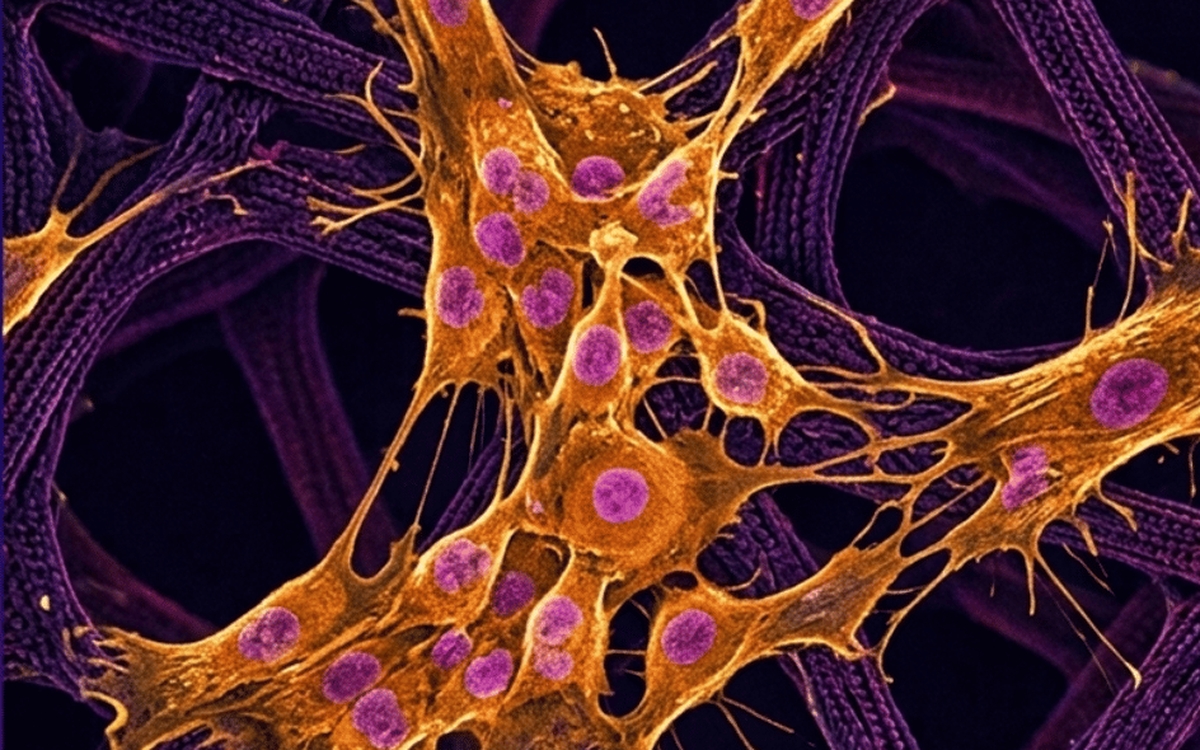
Collagen hydrogels are still the benchmark for regenerative medicine because they provide cells with an environment that feels biologically familiar. However, the next challenge within this field is no longer proving whether or not collagen works, but in capably engineering it with enough precision to recreate the genuine complexity of living tissue.
Collagen is not the strongest hydrogel, and neither is it the easiest to manufacture or print. Yet researchers continue to return to it because no synthetic alternative captures the biomimetic characteristics of the extracellular matrix.[1] That biological advantage has shaped regenerative medicine for decades, and is still continuing to change what researchers expect from collagen hydrogels today.
Collagen Hydrogels Are Becoming More Biomimetic
Early collagen hydrogels were valued most significantly for their biocompatibility and their ability to support cell growth. However, today’s research has become far more centred on creating hydrogels that closely replicate the physical and biochemical properties of native tissue. Mechanical stiffness, fibril organisation, matrix architecture, and other factors all influence how cells behave. And by controlling these characteristics, researchers can create environments as seen in vivo.
This shift has been closely linked to newer, more contemporary advances in mechanobiology: cells do not respond only to biochemical signals, and can sense the mechanical properties of their surroundings, which means that those cues can influence everything from gene expression to tissue development. That means that modern collagen hydrogels are increasingly designed with this interaction in mind.
3D Bioprinting is Raising Expectations
The rapid growth of 3D bioprinting has accelerated innovation in collagen-based biomaterials. Researchers are now looking for bioinks that are still biologically relevant while also remaining reliable during printing.
That balance isn’t necessarily straightforward. Collagen provides an excellent environment for cells, but traditionally has presented challenges in printability and structural stability. Improving those characteristics without compromising biological function has become a major area of research, because as printing technologies continue to evolve, collagen hydrogels are expected to underpin increasingly sophisticated tissue models. These include organoids, disease models and engineered tissues that more accurately reproduce human physiology.
The Path Towards Clinical Translation
The future of collagen hydrogels won’t be defined by biological performance alone. Clinical translation also demands the standard markers: consistency, scalability, reproducibility.
At the same time, factors like batch variability, mechanical durability, and manufacturing standards also remain significant challenges across the field. Addressing these issues is essential if collagen hydrogels are to move beyond research laboratories and into routine therapeutic applications, and researchers are responding by developing more consistent collagen sources, refining hydrogel formulations and combining collagen with complementary biomaterials to improve performance.[2] These advances are helping to steadily narrow the gap between experimental models and more clinically relevant therapies.
What Will Regenerative Medicine Look Like Moving Ahead?
Collagen has remained central to regenerative medicine because it provides something synthetic materials still struggle to replicate: a biologically familiar environment that cells naturally recognise and thrive in. That fundamental advantage is unlikely to change.
In all, the future of collagen hydrogels is unlikely to be defined by a single breakthrough. More likely, it’ll emerge through a series of incremental advances that make these materials more reproducible, as well as more representative of the tissues they are designed to model. And that matters because researchers are developing more complex disease models, engineering larger tissue constructs and moving closer to clinically relevant applications. Each step places greater demands on the materials that support those systems.
The challenge now is to shape a biologically recognisable environment with greater precision. If the next generation of collagen hydrogels succeeds, they will not simply support tissue regeneration, but will help direct it.
Author Bio