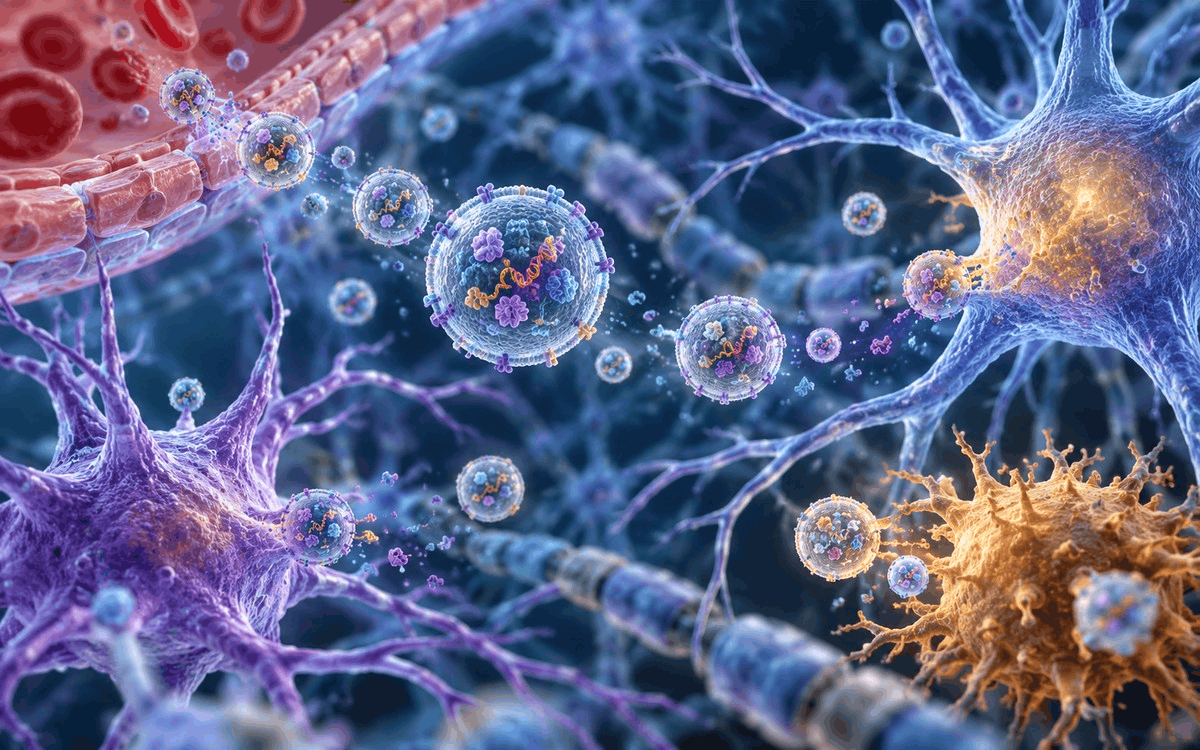
Extracellular vesicles are attracting growing attention in neurology because they can carry proteins, lipids and nucleic acids between cells and may reflect aspects of the biological state of their cells of origin. Their potential applications include liquid-biopsy research, disease-mechanism studies, regenerative approaches and investigation of engineered delivery systems. Translation remains constrained by vesicle heterogeneity, source-dependent biology, isolation methods and inconsistent characterization. Against this backdrop, Creative Biolabs provides research resources spanning extracellular vesicle profiling, umbilical cord mesenchymal stem cell-derived vesicles and microorganism-derived vesicles for investigators exploring neurological questions.
Are Extracellular Vesicles Being Asked to Do Too Much, Too Soon?
Extracellular vesicles, or EVs, are increasingly described as one of the most promising platforms in neurological research. They may provide access to molecular signals originating from the central nervous system, participate in cell-to-cell communication and potentially serve as naturally derived delivery vehicles.
But enthusiasm creates its own scientific problem.
Before EVs can become reliable neurological biomarkers or experimental therapeutics, researchers must determine exactly what has been isolated, where it came from, what cargo it carries and whether the observed biological effect is genuinely attributable to the vesicle population under study.
That distinction matters particularly in neurology, where biological material from the brain is difficult to obtain and where the blood-brain barrier complicates both biomarker discovery and drug delivery.
Current research therefore places EVs at an unusual intersection: they are simultaneously being investigated as indicators of neurological disease, mechanistic participants in disease progression and possible vehicles for intervention.
Neurological Biomarkers Begin With Better Profiling
One of the strongest translational arguments for EV research is that vesicles carry molecular cargo reflective of their source cells.
Proteins, RNA species, lipids and other molecules associated with EVs may provide information about cellular stress, inflammation and disease-related pathways. Recent research has explored blood-derived EV proteomic profiles as potential biomarkers in ischemic and hemorrhagic stroke, while other work has investigated brain- or neuron-enriched EVs across neurological and neurodegenerative conditions [1].
The opportunity, however, depends heavily on analytical resolution.
A heterogeneous EV preparation may contain vesicles originating from multiple cell types as well as non-vesicular material. Consequently, detecting a molecule in an EV-enriched sample does not necessarily establish its cellular origin or biological significance. In blood-based neurological biomarker studies, assigning an EV population to a specific neural cell type requires particular caution because enrichment markers and isolation procedures may not establish an unambiguous cellular origin.
Creative Biolabs’ extracellular vesicle profiling services support research into vesicle composition and molecular cargo. Comprehensive profiling can help investigators move beyond particle counts to ask which EV populations carry reproducible, disease-associated molecular information and how molecular signatures differ among disease states.
Standardization May Be the Real Translational Bottleneck
The International Society for Extracellular Vesicles’ MISEV2023 recommendations reflect a broader concern across the field: EV research requires transparent nomenclature, appropriate separation methods and multiple complementary approaches to characterization [2].
For translational neuroscience, this is more than a methodological detail.
Differences in isolation, storage, sample handling and analytical platforms can alter observed particle concentration and cargo composition. Without standardized workflows, biomarker signatures discovered in one laboratory may be difficult to reproduce elsewhere.
The same issue becomes even more consequential when EVs are investigated as therapeutic materials.
Source cells, culture conditions, purification strategy, dose definition and batch-to-batch consistency can all influence biological activity. Translation therefore depends not only on demonstrating an effect, but also on establishing a sufficiently defined and reproducible preparation for meaningful comparison.
Why Umbilical Cord MSC-Derived Vesicles Are Drawing Attention
Mesenchymal stromal or stem cell-derived EVs have become an important branch of neurological EV research because of their association with intercellular signaling, tissue repair and immune modulation.
Among these sources, umbilical cord mesenchymal stem cell-derived EVs are being investigated in preclinical models involving neurological injury and neurodegenerative disease.
A 2025 review in Frontiers in Cell and Developmental Biology summarized research into MSC-derived EV preparation, characterization, pharmacokinetics and potential applications across neurological disorders, including Alzheimer’s disease, Parkinson’s disease, amyotrophic lateral sclerosis, spinal cord injury and peripheral nerve injury [3]. These are research areas under investigation; findings from individual preclinical models should not be interpreted as evidence of established clinical benefit.
Creative Biolabs supports research involving the umbilical cord mesenchymal source, including EV isolation, characterization and analysis.
An important next step is to determine which EV-associated components, source conditions and administration strategies contribute to neuroprotective effects reported in specific preclinical models.
A Less Conventional Frontier: Microbial Extracellular Vesicles
EV research in neurology is also expanding beyond mammalian cells.
Bacterial and other microorganism-derived extracellular vesicles are gaining interest because microorganisms can package proteins, metabolites, nucleic acids and signaling molecules into membrane-bound particles that may interact with host systems.
This has become particularly relevant to studies of the microbiota-gut-brain axis.
Research has proposed microbial EVs as potential mediators of communication between the gut microbiome and the central nervous system. More recent work has examined relationships among gut microbiome-derived EVs, neuroactive metabolites and host signaling pathways [4]. The extent and mechanisms of any direct effects on the central nervous system remain active research questions; these findings should not be taken to establish that microbial EVs generally cross the blood-brain barrier.
The same biology may have different effects depending on context. Vesicles from pathogenic organisms may promote inflammation or alter barrier function, while engineered or commensal-derived vesicles are being studied as potential delivery or immunomodulatory platforms.
Creative Biolabs’ research resources on microorganism-derived extracellular vesicles cover isolation, characterization and application-oriented research.
For neurology, microbial EVs remain an emerging rather than established translational platform, but their possible role in host-microbe communication makes them a relevant research target.
From Interesting Particles to Translational Platforms
The future of extracellular vesicles in neurology will likely depend less on a single breakthrough than on improved experimental definition.
Researchers must distinguish among EV subpopulations, connect molecular cargo with cellular origin, validate disease-associated signatures and establish reproducible workflows before laboratory findings can be interpreted confidently.
Although these EV sources serve different research objectives, they share a common analytical requirement: investigators must establish vesicle identity, sample purity, cargo characteristics and assay-specific functional relevance before drawing biological conclusions. Brain- and blood-derived vesicles may be investigated for biomarker discovery, MSC-derived EVs for regenerative and neuroprotective research, and microbial EVs as a way to study the gut-brain axis.
Creative Biolabs supports this research landscape through EV profiling, source-specific vesicle research and characterization resources for basic and translational studies.
The larger lesson for the field is clear: extracellular vesicles may provide a new window into neurological disease, but their value will depend on how rigorously researchers define what that window is actually showing.
Author Bio
Dr. Emily R. Coleman is a senior scientist at Creative Biolabs with a background in immunology, oncology research, and translational biotherapeutic development. Her work focuses on translating complex biological mechanisms into practical experimental strategies for next-generation therapeutic discovery, spanning both immune system biology and disease modeling platforms.
In addition to her core expertise in tumor immunology and antibody engineering, Dr. Coleman has contributed to cross-disciplinary research initiatives involving neurodegenerative disease modeling and human cell-based assay development. Her recent work includes supporting integrated preclinical research strategies that leverage advanced in vitro systems, including human-derived cellular platforms relevant to neurodegeneration research.
At Creative Biolabs, she provides scientific insight across multiple R&D domains, including antibody discovery and development, gene and cell therapy research, and translational assay design. She is particularly focused on improving the connection between mechanistic biology and predictive preclinical models to support more effective therapeutic development across complex disease areas, including neurodegenerative disorders and immune-related diseases.
About Creative Biolabs
Creative Biolabs is a biotechnology research service provider supporting extracellular vesicle and exosome studies across isolation, purification, characterization, profiling, engineering and functional research. Its EV-related platforms support academic, biotechnology and pharmaceutical researchers investigating vesicle biology, disease mechanisms, biomarker discovery and emerging translational applications.
Creative Biolabs’ products and services are intended for research use only and are not for diagnostic or therapeutic use.