Not all honey is created equal. That statement, once dismissed as marketing language, is now well-supported by peer-reviewed chemistry. Manuka honey is produced by bees foraging on Leptospermum scoparium, a flowering shrub native to New Zealand and south-eastern Australia. It has attracted sustained scientific attention over the past two decades for a single reason: a chemically unusual and stable organic compound called methylglyoxal (MGO). Understanding its origin, measurement, and biological activity is now essential for anyone working at the intersection of natural products and clinical science.
The Chemistry: From Nectar to MGO
The story begins in the flower. Leptospermum scoparium nectar contains unusually high concentrations of dihydroxyacetone (DHA), a simple three-carbon sugar. During ripening inside the hive, DHA undergoes a spontaneous, non-enzymatic conversion to methylglyoxal, a reaction that accelerates with time and temperature. This explains why MGO concentrations continue to rise during post-harvest storage.
For years, Manuka honey was known empirically to possess what researchers called “non-peroxide activity” (NPA): an antimicrobial effect that persisted even when hydrogen peroxide was neutralised. The identity of the responsible compound remained elusive until 2008, when Professor Thomas Henle and colleagues at the University of Dresden identified MGO as the principal driver of NPA (Henle et al., 2008, Molecular Nutrition and Food Research). This gave the science a measurable, stable biomarker and opened the door to standardised grading.
The stability of MGO is clinically significant. Hydrogen peroxide, the antimicrobial agent in most floral honeys, degrades rapidly on exposure to light, heat, and the enzyme catalase present in wound tissue. MGO, by contrast, is chemically stable under physiological conditions, making it far more relevant for clinical and pharmaceutical applications.
Measurement, Authentication, and Grading
New Zealand’s Ministry for Primary Industries (MPI) introduced a science-based authentication framework requiring Manuka honey destined for export to satisfy five attributes: four chemical markers (MGO, DHA, leptosperin, and hydroxymethylfurfural) and one DNA marker confirming L. scoparium pollen. Testing must be conducted by an IANZ-accredited laboratory. This multi-attribute approach reduces adulteration risk and provides a consistent evidentiary baseline for research.
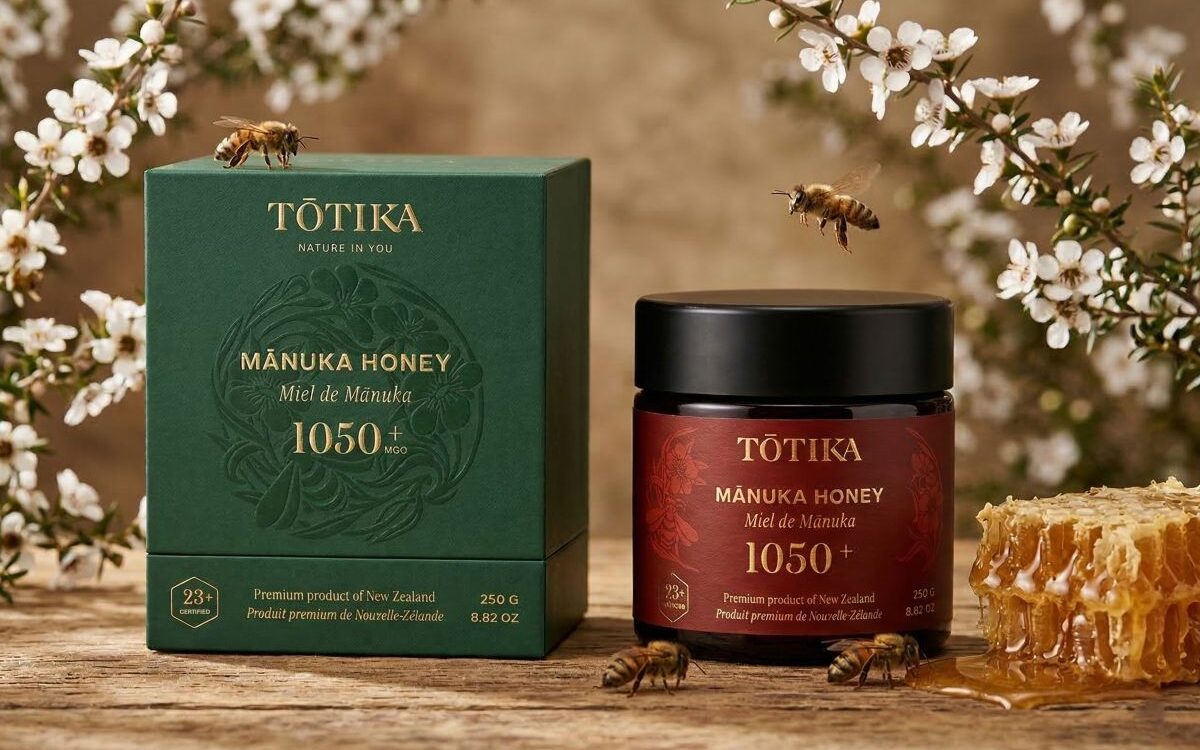
The Unique Manuka Factor (UMF) grading system translates MGO concentration into a practical scale. MGO 250+ (UMF 10+) is the entry point for therapeutic consideration, while MGO 1050+ (UMF 24+) represents the ultra-high-grade end of the commercial spectrum, where bioactive properties are at their most concentrated.
Wound Care: The Strongest Evidence Base
Wound care represents the most mature area of Manuka honey research. Three mechanisms underpin its bioactivity. First, its low pH (3.2 to 4.5) creates an acidic wound environment that inhibits bacterial growth and supports tissue repair. Second, its high osmolarity draws fluid from wound tissue, generating an autolytic debridement effect. Third, MGO at therapeutic concentrations has demonstrated activity against antibiotic-resistant organisms, including methicillin-resistant Staphylococcus aureus (MRSA) and vancomycin-resistant enterococci (VRE).
A Cochrane systematic review examining honey as a wound dressing drew on 26 randomised controlled trials involving 3,011 participants, supporting its use in burns, surgical wounds, and chronic wounds (Jull et al., Cochrane Database of Systematic Reviews). The foundational work of Professor Peter Molan at the University of Waikato remains a cornerstone reference in this field.
Critically, bacteria have not demonstrated the capacity to develop resistance to MGO via the same mechanisms as conventional antibiotics. MGO’s broad, multi-target mode of action disrupts bacterial metabolism rather than targeting a single receptor pathway, which is a property of considerable relevance given the global antimicrobial resistance crisis.
Emerging Therapeutic Areas
Gastric health. Studies have examined Manuka honey’s activity against Helicobacter pylori, implicated in gastric ulcers and gastric cancer. Research in Oxidative Medicine and Cellular Longevity has explored both antimicrobial and anti-inflammatory properties of Manuka honey polyphenols in gastric mucosal contexts. Clinical translation remains active.
Oral health. Research from the University of Otago has investigated high-MGO Manuka honey (MGO 1050+) in reducing dental plaque and gingivitis. Regular consumption as part of an oral hygiene protocol showed measurable benefit, consistent with established antibiofilm properties of MGO against oral pathogens including Streptococcus mutans.
Oncology support. Early research has examined Manuka honey and bee propolis in supportive oncology, specifically the potential of MGO and propolis-derived caffeic acid phenethyl ester (CAPE) in mitigating chemotherapy-associated mucositis (Shen et al., 2019; Al-Omairi et al., 2020). This field is still developing and clinical recommendations await larger controlled trials.
Conclusion: Science Is Catching Up
Manuka honey occupies an unusual position in the life sciences: a traditional remedy whose principal bioactive compound is now well enough understood to support standardised grading, clinical investigation, and early-stage pharmaceutical development.
The DHA-to-MGO conversion mechanism is documented. The MPI authentication framework is enforced. The wound care evidence base, while heterogeneous, is substantial. What is now needed is more standardisation in trial design: consistent honey grades, clearer MGO dosing protocols, and better separation of honey types in systematic reviews. The science is there. The infrastructure is in place. The next step is using both rigorously.
About the Author

Dr Isaac Flitta, Founder and CEO of Totika Health Limited
Isaac Flitta holds a PhD in materials science (aluminium extrusion, Airbus A380 application) and an MPhil in Bio-Engineering, Carbon Fibre Fracture Plates (Bone Fracture). He is the Founder and CEO of Totika Health Limited, in NZ and Totika Nature in both CA and CH, a vertically integrated Manuka honey and bioactive skincare company based in Kerikeri, Bay of Islands, New Zealand. He is a founding member of the New Zealand Apiculture Body and created the beekeeping curriculum at NorthTec. He has been keeping bees and working at the intersection of materials science and honey bioactives for over a decade.
Disclaimer – The author is Founder and CEO of Totika Health Limited, a vertically integrated Manuka honey and bioactive skincare company. This article reflects his independent scientific analysis.