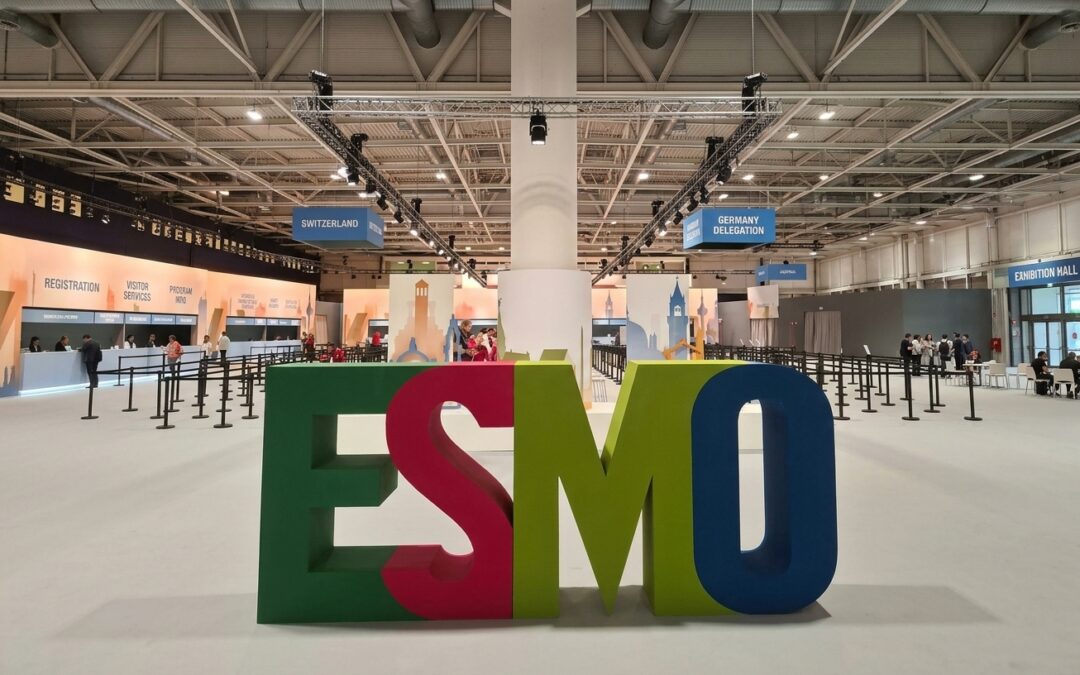
Amgen and AstraZeneca presented full DeLLphi-305 results at the ESMO Congress in Madrid. The phase 3 trial added Amgen’s Imdelltra (tarlatamab-dlle) to AstraZeneca’s Imfinzi (durvalumab). It cut the risk of death by 58 per cent in extensive-stage small cell lung cancer (ES-SCLC). AstraZeneca’s release is dated 24 October 2026. No filing for Imdelltra Imfinzi approval in first-line maintenance had been announced when this article was written. A search on 26 October 2026 found none, so no US or UK decision date exists yet.
When might the combination reach patients? Imdelltra Imfinzi approval depends on a regulatory filing, and the sponsors have not set one out. The sections below cover the data, the safety profile, the limits of the evidence and the UK position.
What did the DeLLphi-305 trial show?
DeLLphi-305 (NCT06211036) was a global, randomised, open-label phase 3 trial. It enrolled 563 patients with ES-SCLC whose disease had not progressed after induction. Induction was durvalumab, platinum-based chemotherapy and etoposide. Patients then received maintenance with Imdelltra plus Imfinzi, or Imfinzi alone, until progression or unacceptable toxicity. Overall survival (OS) was the primary endpoint. Amgen announced on 8 September 2026 that the trial met it at a pre-specified interim analysis. That announcement gave no figures.
The figures arrived with the ESMO presentation. According to AstraZeneca’s release, the hazard ratio for death was 0.42 (95 per cent confidence interval 0.32 to 0.54; p<0.001). Median OS was 21.1 months with the combination and 12.7 months with Imfinzi alone. The 12-month OS rate was 79 per cent versus 53 per cent. Median follow-up was about 16 months in each arm.
Progression-free survival (PFS) also favoured the combination. The hazard ratio was 0.34 (95 per cent confidence interval 0.28 to 0.42). Median PFS was 7.4 months versus 1.9 months. The confirmed objective response rate was 26.4 per cent versus 4.1 per cent. The New England Journal of Medicine published the paper. Maurice Pérol is first author and Jacob Sands is final author.
Sands is associate chief of the Lowe Center for Thoracic Oncology at Dana-Farber Cancer Institute. He was the international coordinating investigator. In AstraZeneca’s release he said the “magnitude and consistency of benefit in DeLLphi-305 are striking.” That is an investigator’s statement. It appears in a sponsor release.
When could Imdelltra Imfinzi approval happen?
The answer is not yet known. Any Imdelltra Imfinzi approval requires a regulatory submission, and none has been announced. In its 8 September 2026 release, Amgen said it would share the data with regulators. Jay Bradner is Amgen’s executive vice president of research and development. In Amgen’s 24 October release, he said the company was “moving with urgency” to share the results with regulators worldwide. Neither statement gives a date.
A filing announcement from Amgen would be the first signal. Acceptance by the US Food and Drug Administration (FDA) would normally set a review goal date. Until then, any forecast of an Imdelltra Imfinzi approval date is speculation. Amgen’s September release describes first-line maintenance use as investigational.
The current US label is narrower. Amgen’s release of 14 September 2026 describes the indication as adults with ES-SCLC. Their disease must have progressed on or after platinum-based chemotherapy. That wording predates the DeLLphi-305 data.
According to BioSpace, Truist Securities estimated that approval could lift the US addressable population. It put the figure at about 21,600 patients, up from about 12,900. That is one broker’s estimate, not company guidance. The report did not name the individual analyst.
How safe is the Imdelltra and Imfinzi combination?
Safety needs to be read in both directions. Grade 3 to 4 treatment-related adverse events occurred in 20.9 per cent of patients on the combination. The rate was 10.8 per cent on Imfinzi alone. AstraZeneca’s release reported no treatment-related deaths with the combination.
Amgen’s 24 October release and OncLive gave more detail. Cytokine release syndrome (CRS) affected 49.6 per cent of combination patients versus 1.4 per cent with Imfinzi alone. One patient (0.4 per cent) had grade 3 CRS, with no grade 4 or fatal cases reported. Immune effector cell-associated neurotoxicity syndrome (ICANS) affected 1.1 per cent, none at grade 3 or higher. Tarlatamab was stopped for treatment-related events in 3.2 per cent, per OncLive. OncLive also reported fatal treatment-related events in 0.7 per cent of patients on Imfinzi alone.
Imdelltra carries a boxed warning for CRS and neurologic toxicity, including ICANS. These reactions can be life-threatening or fatal. They explain the monitoring rules around the early doses.
Monitoring rules for the first doses
DeLLphi-305 used 1 to 2 hours of monitoring after the first two doses. Some regions, including Europe, used 6 to 8 hours. Separately, Amgen announced on 14 September 2026 that the FDA had cut monitoring for the first two infusions. The label period fell from 22 to 24 hours to 6 to 8 hours. GlobalData, writing in Clinical Trials Arena, suggested further label changes would be needed for community practice.
What are the limits of the evidence?
The OS result came from a planned interim analysis. OncLive reported it was conducted at 61 per cent of the target information, and OS follow-up continues. The trial was open-label, so investigators and patients knew the treatment. Median follow-up of about 16 months means long-term survival is not yet defined.
Subgroups need care. OncLive reported a hazard ratio of 0.82 in the Americas subgroup of 75 patients. The confidence interval was 0.39 to 1.71. That interval crosses 1, so the subgroup alone does not show a clear benefit. The report noted that some subgroups were small. The overall hazard ratio remains 0.42.
Treatment exposure also differed. Median exposure was 46.9 weeks with the combination and 8.1 weeks with Imfinzi alone, per OncLive. Per OncLive, Sands said the results support the combination as “a new standard of care first-line maintenance therapy”. That is an investigator’s view, not a regulatory position. A search on 26 October 2026 found no regulator decision on the combination.
Amgen’s 24 October release lists ongoing phase 3 trials including DeLLphi-312, a first-line induction and maintenance study with chemotherapy. It also lists DeLLphi-306 in limited-stage disease. Those readouts could widen or refine the evidence base.
What would Imdelltra Imfinzi approval mean for UK patients?
The UK route is separate. The Medicines and Healthcare products Regulatory Agency (MHRA) first authorised tarlatamab on 31 December 2024. It used a national procedure under Project Orbis. The UK brand name is Imdylltra. The electronic medicines compendium summary of product characteristics was revised on 14 October 2026. It lists adults with small cell lung cancer whose disease progressed after platinum-based chemotherapy.
A search on 26 October 2026 found no first-line maintenance indication in that text. The National Institute for Health and Care Excellence (NICE) is appraising tarlatamab for use after platinum chemotherapy. Its project page shows the appraisal (ID6617) as in progress, with no publication date stated. Background on the British position is in an earlier report on small cell lung cancer treatment access in the UK.
What to watch next
Three events would settle most of the open questions. The first is a filing announcement and any FDA acceptance. The second is mature OS data from DeLLphi-305. The third is any MHRA or NICE step that extends beyond the post-platinum setting.
Readers tracking regulatory dates can follow the wider list in the FDA drug approval decisions tracker. Any filing announcement will change the answer on Imdelltra Imfinzi approval timing.