
The human brain presents an intricate evolutionary paradox. While its sophisticated neural networks govern complex cognition, its architecture is uniquely susceptible to progressive degradation. For decades, the biomedical community has grappled with an uncomfortable truth: traditional pre-clinical models frequently fail to mirror the nuances of human neurodegenerative diseases. From high clinical trial attrition rates to poorly translated therapeutic targets, the gap between animal physiology and human pathology has stalled progress in managing conditions like Alzheimer’s disease (AD) and Parkinson’s disease (PD).
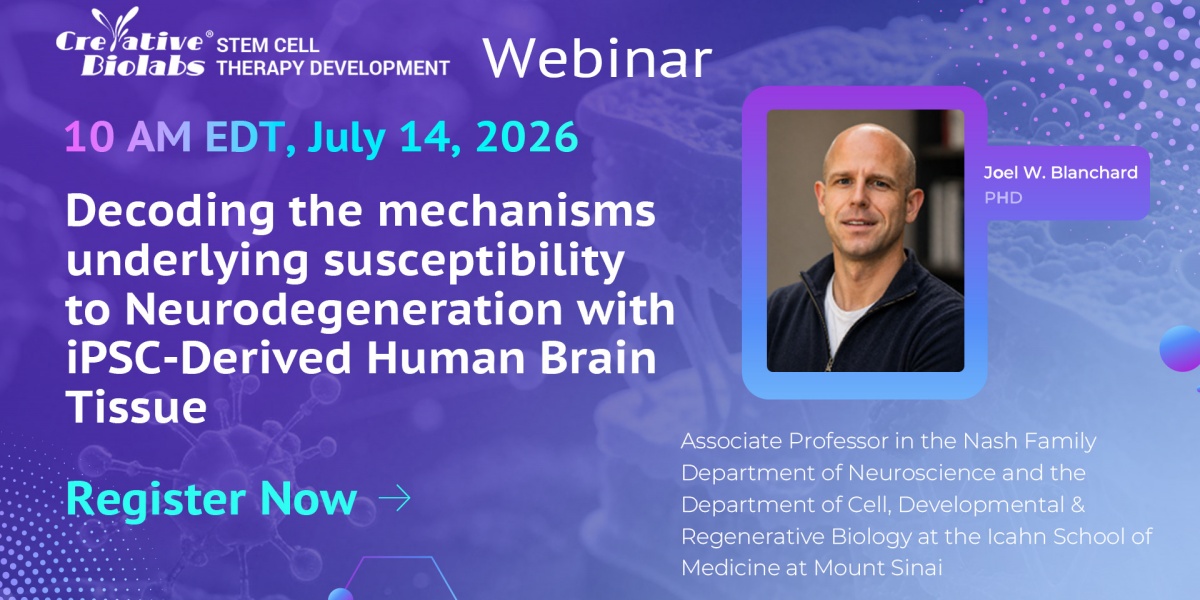
However, a fundamental shift is underway. To explore the frontier of this methodology, Creative Biolabs is hosting an upcoming scientific webinar titled “Decoding the Mechanisms Underlying Susceptibility to Neurodegeneration with iPSC-Derived Human Brain Tissue“. Scheduled for July 14, 2026, at 10:00 AM EDT, the session features Dr. Joel W. Blanchard, Associate Professor at the Icahn School of Medicine at Mount Sinai, who will share insights into how engineered human brain models unravel mechanisms that have long eluded traditional systems. The integration of human induced pluripotent stem cell (iPSC) technology with advanced 3D tissue engineering has enabled researchers to construct multicellular human brain tissues in vitro, serving as high-fidelity proxies for the living human brain.
Overcoming the Limitations of Traditional Disease Modeling
Historically, neurodegeneration research relied heavily on transgenic rodent models. While these models helped identify gross pathological hallmarks—such as amyloid-beta plaques or alpha-synuclein aggregates—they consistently struggle to replicate the precise spatial, temporal, and cellular interactions observed in human patients. A primary limitation is interspecies genetic divergence. Human brains exhibit unique cellular proportions, specialized glial functions, and distinct gene expression profiles that cannot be fully recapitulated in non-human subjects.
This systemic gap explains why therapeutics showing stellar efficacy in animal studies frequently fail when transitioned to human clinical trials. Human neurodegeneration is rarely caused by a single isolated factor; it is a multicellular cascade involving complex interactions between neurons, astrocytes, microglia, and the surrounding vasculature.
By leveraging patient-derived iPSCs, scientists can generate personalized, functional human brain cells that retain the exact genetic background of the donor. When cultured within 3D biomimetic frameworks or organoid systems, these cells assemble into complex, multi-lineage tissues. This approach allows researchers to study early-stage disease development, identify cellular vulnerabilities, and evaluate therapeutic compounds within a physiologically relevant human microenvironment.
Key Breakthroughs to Be Featured in the Webinar
The upcoming webinar will highlight how advanced stem cell engineering translates into concrete mechanistic discoveries. Dr. Blanchard’s presentation will focus on three distinct case studies that exemplify the analytical power of 3D human brain models:
- Unveiling the Lysosome–Polyamine–Epigenetic Axis in Juvenile Parkinson’s Disease
While Parkinson’s disease is traditionally viewed as a condition affecting older adults, rare genetic mutations can precipitate severe, early-onset juvenile forms. Investigating these early-onset cases provides a clear look at direct genetic drivers without the confounding variables of natural aging. Using engineered multicellular iPSC-derived brain tissues, researchers have mapped an intricate pathway connecting lysosomal dysfunction to polyamine metabolic imbalances, which ultimately alter chromatin structures and drive epigenetic neurodegeneration. This discovery reveals a therapeutic vulnerability that traditional models could not expose. - Dissecting Glial Dysfunction and Alpha-Synuclein Co-Pathology via APOE4
The APOE4 allele stands as the strongest genetic risk factor for late-onset Alzheimer’s disease, yet its influence extends across multiple neurodegenerative landscapes. The webinar will dive into how APOE4 actively promotes alpha-synuclein co-pathology—a hallmark shared between Parkinson’s and Lewy body dementias. By isolating human cell types within an iPSC-derived tissue matrix, researchers demonstrated that APOE4 triggers profound glial dysfunction, impairing the capacity of astrocytes and microglia to clear aberrant protein aggregates and accelerating synaptic degradation. - Mapping Cerebrovascular and Blood-Brain Barrier (BBB) Breakdown
A healthy brain relies heavily on its vascular network, but in Alzheimer’s disease, the blood-brain barrier often degrades long before clinical cognitive deficits manifest. Traditional cell cultures fail to capture the mechanical and structural relationships between endothelial cells, pericytes, and astrocytes. Dr. Blanchard will present data showing how APOE4 alters human cerebrovascular remodeling. These 3D human tissue platforms demonstrate exactly how vascular dysfunction contributes to the broader neurodegenerative cascade, highlighting the BBB as a viable target for early intervention.
Translating Tissue Engineering into Scalable Drug Discovery
Moving from structural characterization to scalable drug screening requires highly standardized cell source material and precise maturation strategies. While 3D brain organoids offer exceptional biological complexity, their utility in high-throughput screening depends entirely on the consistency of the initial cellular inputs.
To support researchers working across these workflows, specialized biotechnology organizations provide tailored solutions to de-risk the process. For instance, companies like Creative Biolabs offer comprehensive iPSC differentiation services, converting high-quality pluripotent lines into specialized neural lineages, including functional cortical neurons, dopaminergic neurons, microglia, and astrocytes.
In addition to cellular production, accessing ready-to-use nervous system and brain organoid model products allows laboratories to bypass the lengthy, variable protocols associated with self-assembly. These validated models ensure that parameters like cell ratio, vascularization potential, and extracellular matrix composition remain uniform across batches. By utilizing uniform human cell sources and pre-formed brain tissues, translational research teams can confidently scale up phenotypic screening and evaluate compound safety without losing physiological relevance.
Join the Discussion
The evolution of iPSC technology from basic monolayer cultures into complex, multicellular 3D human brain models represents a major leap forward for translational neuroscience. By bridging the gap between human genetics and functional tissue pathology, these platforms are systematically dismantling the barriers that have historically stalled neurodegenerative drug discovery.
Whether you are an academic investigator dissecting basic disease pathways, a stem cell engineer optimizing organoid architecture, or a pharmaceutical scientist looking to reduce clinical trial attrition, understanding these advanced human-derived models is essential.
Register for the upcoming session to see how these engineered tissues can advance your research and expand our collective understanding of human neurodegeneration.
Webinar Overview
Title: Decoding the Mechanisms Underlying Susceptibility to Neurodegeneration with iPSC-Derived Human Brain Tissue
Date: July 14, 2026
Time: 10:00 AM EDT
Speaker: Joel W. Blanchard, PhD (Associate Professor, Icahn School of Medicine at Mount Sinai)
Registration Link:
https://neuros.creative-biolabs.com/decoding-the-mechanisms-underlying-susceptibility.htm
Author Bio
Dr. Emily R. Coleman is a senior scientist at Creative Biolabs with a background in immunology, oncology research, and translational biotherapeutic development. Her work focuses on translating complex biological mechanisms into practical experimental strategies for next-generation therapeutic discovery, spanning both immune system biology and disease modeling platforms. In addition to her core expertise in tumor immunology and antibody engineering, Dr. Coleman has contributed to cross-disciplinary research initiatives involving neurodegenerative disease modeling and human cell-based assay development. Her recent work includes supporting integrated preclinical research strategies that leverage advanced in vitro systems, including human-derived cellular platforms relevant to neurodegeneration research.
At Creative Biolabs, she provides scientific insight across multiple R&D domains, including antibody discovery and development, gene and cell therapy research, and translational assay design. She is particularly focused on improving the connection between mechanistic biology and predictive preclinical models to support more effective therapeutic development across complex disease areas, including neurodegenerative disorders and immune-related diseases.