

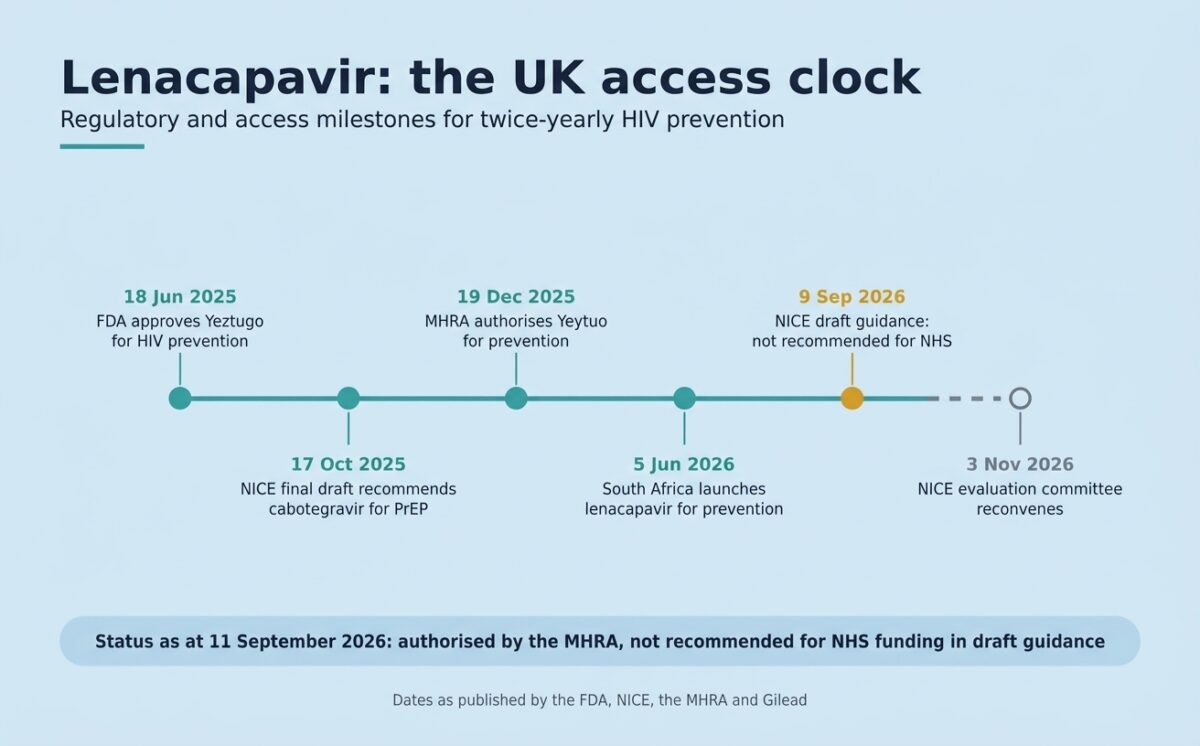
Lenacapavir NHS access for HIV prevention has stalled at the first hurdle. NICE published draft guidance on 9 September 2026. It does not recommend the twice-yearly injection as pre-exposure prophylaxis in England. The draft does not question whether the medicine works. It questions the price, and where this injection sits beside one the NHS already funds.
What the NICE draft guidance actually says
The recommendation is preliminary, not final. The NICE appraisal of lenacapavir for preventing HIV-1 remains in progress. HIV i-Base reports that the consultation closes on 30 September 2026. The evaluation committee is due to meet again on 3 November 2026.
The committee did not dispute the clinical case. Reporting by Pharmaceutical Technology says NICE accepted that lenacapavir reduces HIV risk more than oral options. The objections were economic and methodological.
NICE cited cost-effectiveness estimates above the range it treats as an acceptable use of NHS resources. It flagged uncertainty about how far the trial populations reflect people at risk in the UK. Further uncertainty sat in modelled HIV incidence among high-risk groups without PrEP. The committee also questioned assumptions about people switching between injectable and oral options. It found gaps in how the model captured quality of life.
The comparator question
NICE already recommends one long-acting injection for prevention. It recommended cabotegravir in final draft guidance on 17 October 2025. Technology appraisal TA1106 followed on 5 November 2025. That recommendation is narrow. It covers adults and young people at high risk who cannot have oral PrEP.
NHS England said on 17 October 2025 that around 1,000 people each year were expected to be eligible. Cabotegravir is given six times a year after two loading doses.
That creates an awkward benchmark. The appraisal covers the full licensed prevention population. That is broader than the comparator’s funded niche. LSDN’s observation is that this appraisal turns on positioning as much as on price. A product judged against a restricted comparator can inherit the restriction.
Fierce Pharma reports that NICE also noted the absence of a direct clinical comparison between the two injections. The difference between them is not only clinical. Cabotegravir is dosed every two months. Lenacapavir is dosed every six. Fewer visits could ease adherence and reduce clinic time. The draft nonetheless placed the cost-effectiveness estimates above the acceptable range.
Lenacapavir NHS access has stalled once before
This is the second UK access impasse for the same molecule.
The MHRA authorised lenacapavir for multidrug-resistant HIV-1 treatment in 2022. HIV i-Base reports that NICE referred that decision to NHS England in May 2023. Gilead then closed its UK early access programme to new referrals in April 2025. About 30 people were enrolled at the time. More than two years had passed without an agreed price.
NHS England published a clinical commissioning policy for the treatment indication on 16 July 2026, according to i-Base. The policy reference is 2344. It covers adults with limited or no remaining options, added to an optimised background regimen. NHS England announced the rollout on 18 August 2026. It said around 92 people would be contacted first. It expects nearly 300 to be eligible over three years. NHS Scotland had accepted the treatment use in April 2025.
Lenacapavir NHS access for prevention therefore lands on a molecule with a long UK pricing history. Our reporting on UK access routes after a new approval sets out how recognition and appraisal stages interact.
What the prevention evidence shows
The MHRA approved lenacapavir for prevention on 19 December 2025, under the brand name Yeytuo. The authorised indication is prevention of sexually transmitted HIV-1 infection in adults and adolescents. Dosing is six-monthly, with an oral lead-in. The product is subject to additional monitoring.
Julian Beach, Interim Executive Director of Healthcare Quality and Access at the MHRA, commented in the agency’s announcement. He said the approval “marks the introduction of a 6-monthly long-acting preventative option”. He described it as an option for sexually transmitted HIV-1 infection.
The FDA approved the same molecule as Yeztugo on 18 June 2025. Gilead’s announcement reported two Phase 3 studies. PURPOSE-1 enrolled 2,134 participants in the lenacapavir group and recorded zero HIV infections. PURPOSE-2 enrolled 2,179 in that group and recorded two infections.
The safety picture is not uniformly favourable. The US label carries a boxed warning on drug resistance in undiagnosed HIV-1 infection. Testing is required before initiation and with each injection. Adverse reactions reported at 5 per cent or above were injection site reactions, headache and nausea. Gilead also warns that intradermal rather than subcutaneous administration risks serious injection site reactions.
LSDN found no Yeytuo summary of product characteristics on the electronic medicines compendium as at 11 September 2026. The UK warning wording therefore could not be compared with the US label.
The service burden behind the cost-effectiveness estimate
Six-monthly dosing sounds simpler than a daily tablet. In practice it moves work into clinics. Each injection needs an HIV test, an appointment and a trained administrator.
England delivers PrEP mainly through sexual health services. ViiV Healthcare’s implementation guide for cabotegravir tells providers to secure Blueteq access for reimbursement in England. Commissioners therefore face a service redesign, not a simple product switch. That cost sits behind any incremental cost-effectiveness ratio.
A two-tier access picture
Lenacapavir’s global access architecture is already built. Gilead signed non-exclusive, royalty-free voluntary licences with six generic manufacturers in October 2024. The partners are Dr. Reddy’s Laboratories, Emcure, Eva Pharma, Ferozsons Laboratories, Hetero and Viatris’ Mylan. The licences cover 120 low-income and lower-middle-income countries. They span both prevention and treatment of multidrug-resistant HIV. Gilead has said it expects large-scale generic rollout to start in 2027.
Delivery has begun. Gilead said on 5 June 2026 that South Africa had launched lenacapavir for prevention. The government of South Africa and the Global Fund led that launch. Gilead is supplying initially at no profit, through Global Fund and PEPFAR partnerships.
The programme has critics. Médecins Sans Frontières said on 4 August 2026 that four countries sit outside the licences. Brazil, Peru, Mexico and Argentina are excluded, despite having hosted clinical trials. MSF asked Gilead to supply at no more than 40 dollars per person per year. It wants that price across all low-income and middle-income countries.
Lenacapavir NHS access sits outside both routes. The UK is not a licence territory, and it has no agreed price. That is an LSDN observation about market structure, not a criticism of the licensing programme. It does help explain an awkward result. A high-income health service can reach a medicine later than a middle-income one.
A falling epidemic changes the arithmetic
Prevention economics depend on how much HIV there is to prevent.
UKHSA provisional data published on 21 May 2026 show a clear fall. New HIV diagnoses in England dropped from 2,922 in 2024 to 2,542 in 2025. That is a decline of 13 per cent. Diagnoses fell 7 per cent among gay and bisexual men. They fell 22 per cent among heterosexual women.
Not every trend moved the same way. Diagnoses among ethnic minority gay and bisexual men rose 2 per cent, from 305 to 312. Among white gay and bisexual men they fell 14 per cent.
Falling incidence lowers the modelled benefit per person treated. It also concentrates remaining risk in groups that oral PrEP has reached least well. That tension is an LSDN observation, not a NICE position.
Price is the variable nobody outside the room can see
A NICE spokesperson told The Pharmaceutical Journal that the current price is too high. The evaluation had been paused for commercial access discussions. Those discussions did not produce an agreement.
The only published list price is American. HIV i-Base reported the US figure as 14,109 dollars per injection. That works out at 28,218 dollars a year.
LSDN found no published UK list or net price for the prevention indication as at 11 September 2026. NICE appraisals routinely run on confidential commercial arrangements. External parties cannot therefore test the committee’s cost-effectiveness estimate.
For market access teams, lenacapavir NHS access is now a pricing question rather than an evidence question. The November meeting looks like a pricing round rather than an evidence round.
What happens next for lenacapavir NHS access in England
Gilead has kept its language procedural. The company told Fierce Pharma that the appraisal process remains ongoing. It said it continues to work with NHS England, DHSC and other stakeholders. The stated aim is to support potential future access to lenacapavir for HIV prevention.
Advocacy groups were blunter. Richard Angell OBE is Chief Executive of the Terrence Higgins Trust. He called twice-a-year injectable PrEP the most exciting innovation in HIV prevention for years. Daniel Fluskey is Director of Policy at the National AIDS Trust. He said his organisation believes the injection would save lives and reduce health inequalities.
One structural point matters for commissioners. NICE recommends medicines within their marketing authorisation. A final negative determination would leave no routine national commissioning route in England. The MHRA authorisation itself would still stand.
The draft is a consultation document, not a final determination. Consultees can submit comments, further analyses and revised commercial terms before the deadline. Patient access schemes are the usual mechanism for closing a cost-effectiveness gap in England.
The committee reconvenes on 3 November 2026. Lenacapavir NHS access now depends on what Gilead puts on the table before then.