
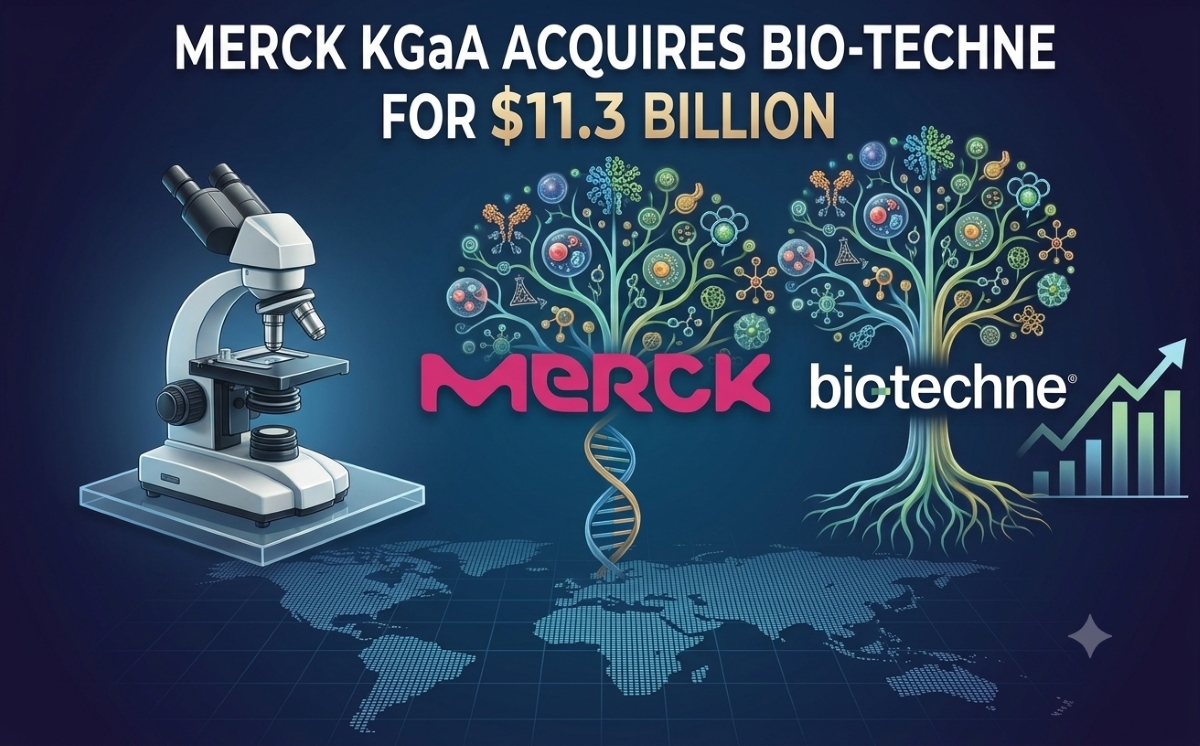
The Merck KGaA Bio-Techne acquisition values the Minneapolis-based life science tools company at approximately $11.3 billion. Merck KGaA, the German science and technology group, announced on 25 June 2026 that it will acquire Minneapolis-based Bio-Techne Corporation in an all-cash transaction valued at approximately $11.3 billion (EUR 9.9 billion), or $73 per share. The deal reshapes the life science tools market in a single stroke, bringing together Merck’s global manufacturing and distribution infrastructure with Bio-Techne’s half-century of expertise in proteins, antibodies, spatial biology and cell therapy supply. It is Merck’s largest acquisition since it agreed to buy Sigma-Aldrich in 2014, and one of three transactions each exceeding $10 billion announced in a single week across the life science sector.
The acquisition arrived in the same week that AbbVie confirmed a $10.9 billion deal for Apogee Therapeutics (announced 22 June), and less than three weeks after GSK announced it would pay $10.6 billion for Nuvalent. That concentration of capital deployment in a single week is unusual even by the elevated standards of 2026, which is already shaping up to be one of the strongest years for biopharma and life science mergers and acquisitions in over a decade.
Merck KGaA Bio-Techne: What the Deal Adds
Bio-Techne is a company with 50 years of heritage and more than 500,000 products in its catalogue, serving academic researchers, biopharmaceutical developers and clinical diagnostic laboratories from 34 locations worldwide. In fiscal year 2025, it generated net sales of more than $1.2 billion, supported by a workforce of over 3,000 people across 15 manufacturing facilities in the United States, Canada, the United Kingdom, Switzerland and China.
Its portfolio is organised into three customer-facing brands. The R&D Systems brand covers recombinant proteins including cytokines and growth factors, together with more than 425,000 antibodies and a broad range of immunoassay kits. These are foundational reagents for drug discovery, and Bio-Techne’s protein manufacturing capability gives Merck immediate depth in a product category central to next-generation biologics development.
The Bio-Techne Spatial brand is built around RNAscope, an in situ hybridisation technology that enables researchers to detect and localise individual RNA molecules within intact tissue at single-cell resolution. Paired with the Lunaphore COMET platform, an automated spatial hyperplex instrument capable of simultaneous proteomic and transcriptomic profiling, Bio-Techne occupies a strong position in spatial biology, one of the fastest-growing areas of translational research and precision diagnostics. The Bio-Techne Diagnostics brand completes the picture with in-vitro diagnostic grade reagents, assay kits and precision controls for clinical laboratory use.
Merck will also absorb Bio-Techne’s 19.9 per cent stake in Wilson Wolf Corporation, manufacturer of the G-Rex cell culture device widely used in cell therapy production workflows, with an option to acquire the remaining ownership immediately following the end of calendar year 2027.
Jean-Charles Wirth, Merck’s Life Science Chief Executive, said the acquisition adds capabilities across multi-omics, spatial biology, precision diagnostics and cell and gene therapy, reinforcing all three of the company’s business lines: Discovery Solutions, Advanced Solutions and Process Solutions. He described Bio-Techne’s catalogue of 6,000 proteins and 425,000 antibodies as a significant advantage for customers navigating increasingly complex research and manufacturing workflows.
Kai Beckmann, Merck KGaA’s Group Chief Executive, said Bio-Techne is
“an outstanding fit that directly supports our strategic direction focused on delivering cutting-edge products and solutions across the entire industry value chain – from lab customers to those manufacturing in the biotech and pharmaceutical industries.”
Kim Kelderman, President and Chief Executive of Bio-Techne, said the company’s 50-year history of enabling breakthroughs across proteomics, spatial biology and novel therapeutics had positioned it well for the combined organisation, and that joining Merck’s global infrastructure would give Bio-Techne access to new customer channels and manufacturing scale that it could not readily build as a standalone company.
Deal Structure and Financial Terms
The $73 per share offer represents a 36 per cent premium to Bio-Techne’s one-month volume-weighted average trading price, and a 24 per cent premium to the company’s closing price on 24 June 2026. Bio-Techne’s shares rose approximately 20 per cent in premarket trading on the day of announcement. Merck KGaA shares gained around 3 per cent.
Merck will fund the transaction through a combination of existing cash and new debt, while preserving its investment-grade credit rating. The company held approximately EUR 2.74 billion in cash and cash equivalents at the time of announcement. The deal is expected to be immediately accretive to Merck’s sales growth and EBITDA pre margin on closing, with earnings per share accretion anticipated by year three. Cost synergies of approximately EUR 140 million are expected to be fully realised by the third year following completion.
Bio-Techne’s board of directors unanimously approved the transaction. Completion is expected in late 2026 or early 2027, subject to Bio-Techne shareholder approval, regulatory clearances and customary closing conditions.
Strategic Logic: Filling Gaps in the Life Science Tools Market
The acquisition continues a deliberate programme of portfolio expansion that Merck KGaA has pursued consistently for more than two decades. Since 2000, the company has deployed more than $35 billion through acquisitions, including Millipore in 2010, Sigma-Aldrich (completed 2015), Versum Materials in 2019 and SpringWorks Therapeutics in 2025. Each deal has extended the company’s reach along the research and manufacturing value chain, and Bio-Techne follows the same logic.
The protein and antibody catalogue deepens Merck’s reagent offering in areas critical to next-generation drug development. The RNAscope and COMET platforms establish Merck in spatial biology at a point when demand for high-resolution tissue analysis is accelerating rapidly across oncology, neuroscience and immunology research. The ProteinSimple automated protein detection instruments add analytical depth to Merck’s bioprocessing solutions. And Bio-Techne’s GMP-grade cytokines and proteins, already widely used by cell therapy manufacturers, slot directly into Merck’s Process Solutions business unit.
In the life science tools market more broadly, these dynamics have been driving consolidation for several years. Thermo Fisher Scientific and Danaher have each built integrated platforms by steadily absorbing mid-sized reagent and instrument businesses, creating end-to-end offerings that are difficult for smaller competitors to match on price, breadth or service quality. Merck’s acquisition of Bio-Techne is a direct and significant response to that competitive pressure.
Bio-Techne Deal in Context: The Scale of the Moment
The Bio-Techne deal sits among the five largest life science transactions announced so far in 2026, alongside the €10.7 billion take-private offer for Recordati, Sun Pharma’s $11.75 billion acquisition of Organon, the AbbVie and Apogee deal and the GSK and Nuvalent transaction. The broader biopharma M&A market entered 2026 with strong momentum driven by the patent cliff, recovering biotech valuations and substantial undeployed capital on large pharma balance sheets. Those forces have produced a dealmaking environment that observers across the sector have consistently described as a supercycle, and the final week of June provided a vivid illustration of what that looks like in practice.
Life Science Daily News has been tracking every major deal of the year in its biopharma M&A 2026 tracker, which sets out the drivers behind this sustained wave of consolidation activity.
What Happens Next for Merck and Bio-Techne
For the life science tools market, the Merck KGaA and Bio-Techne combination continues a consolidation dynamic that shows no immediate sign of slowing. Scale is becoming a structural prerequisite across reagents, instruments and bioprocessing, and businesses that remain sub-scale across multiple product categories will face growing pressure to seek partners or buyers. Whether the resulting concentration ultimately benefits customers through broader access, greater investment and integrated workflows, or narrows their commercial options, will take years to assess with confidence.
What is already clear is that Merck KGaA has made one of the most consequential single moves in the life science tools market in over a decade, and that the combined business, drawing on Bio-Techne’s scientific depth and Merck’s global reach, will be a significantly more formidable competitor when the transaction closes.