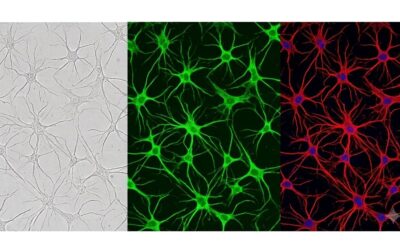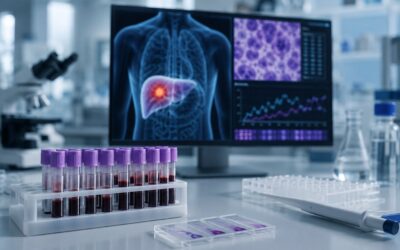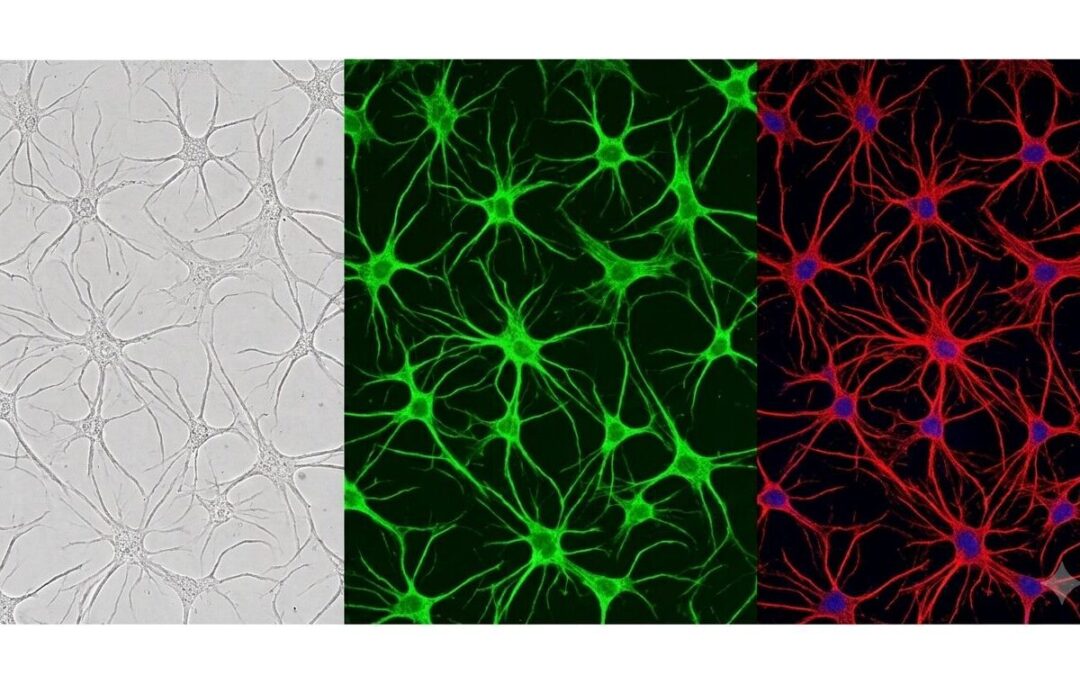

A research team at the University of Colorado Boulder took a marine dinoflagellate called Pyrocystis lunula, mixed it into 4 wt% sodium alginate, crosslinked the gel ionically in calcium chloride, and extruded it through a Cellink BIO X bioprinter into printed grids and logos (Brachi et al., Science Advances, 2026). The encapsulation chemistry will be familiar to anyone who has worked with alginate microcapsules for cell transplantation or 3D in vitro culture. The organism inside does two jobs. It fixes carbon dioxide by photosynthesis during its light phase, and it emits blue light when the chemistry of the surrounding medium changes.
The carbon arithmetic
Microalgal biomass is approximately 50% carbon by dry weight, which sets the arithmetic for everything that follows. Yusuf Chisti’s 2007 review in Biotechnology Advances states that producing 100 tonnes of algal biomass fixes roughly 183 tonnes of carbon dioxide (Chisti, 2007). In turn, what this means is that one kilogram of dry biomass corresponds to about 1.83 kg of CO2 taken up. A 2026 review by Leonel Pereira in the Journal of Marine Science and Engineering reports approximately 1.8 kg of CO2 per kg of dry algal biomass from a separate line of sources (Pereira, 2026). Unicellular organisms take up dissolved inorganic carbon across the whole cell surface and build no roots, stems or vascular tissue, which is why microalgae grow roughly ten times faster than larger plants (Ingenia, 2015).
Pereira’s comparative figures put microalgal areal productivity at 10 to 50 times that of temperate forests, and I would be rather careful with the upper end of that range outside a controlled reactor. The same paper describes its values as upper-bound estimates under optimized or experimental conditions, normalized for cross-system comparison, with site-specific field performance left open. Pilot data support the caution. A 2024 meta-analysis in Environmental Science and Pollution Research, covering 69 cultivation conditions drawn from 23 studies, calculated an average specific growth rate of about 0.54 per day in outdoor pilot systems against roughly 1 per day reported in laboratory work (Velásquez-Orta et al., 2024). So, 50x… at optimized cultivation conditions, with a documented halving of growth rate on the way outdoors.
Fixation is not sequestration
The 2026 Chemical Reviews assessment of biomass carbon removal by Crotty and colleagues separates two things:
- Fixation, the biological conversion of atmospheric CO2 into biomass carbon
- Durable sequestration, holding that carbon out of the atmosphere for a defined period
Contractual durability standards in that review run from 10 to more than 100 years, while project developers claim anywhere from 1 year to 10 million years (Crotty et al., 2026). The same review gives carbon-to-nitrogen ratios below 15 for microalgae against 100 to 500 or higher for woody biomass. Low C:N material decomposes quickly, because nitrogen-rich substrates are more accessible to microbial decay. As a result of this, raw algal biomass is among the poorer feedstocks for long-duration storage, and its climate value has to come from displacing an emitting product or process.
I would say each of the applications below stands or falls on whether the algae displace something that emits, because the biomass itself holds its carbon for a short time once it leaves the reactor.
Light on demand
The CU Boulder constructs emit light on chemical stimulation, and the two stimuli tested gave different results. Exposure to a pH 4 buffer (roughly the acidity of tomato juice) produced localized emission sustained for up to 25 minutes. Exposure to pH 10 produced a diffuse, short-lived signal that the authors attribute to ionic imbalance, loss of membrane integrity and cell death. Printed constructs under acid stimulation reached 2.4-fold higher luminescence than base-treated ones (P < 0.05), and in free suspension peak photon counts were 112,000 ± 14,315 for acid against 43,000 ± 4,729 for base.
The four-week cyclic stimulation experiment is the result I find most interesting for device work. Acid-treated constructs kept responding through all four weekly cycles, with 75% still luminescent at week 4, while base-treated constructs reached zero reactivity by week 3. Peak flux in the acid group moved from 256,000 ± 43,770 arbitrary units at cycle 2 to 205,000 ± 33,803 at cycle 4. Mechanical compression applied after chemical priming raised total output to 661.3 ± 118.4 arbitrary units against 304.6 ± 31.6 in unprimed controls. Conventional mechanical activation of dinoflagellates is largely single-use, because the stimulation degrades the material.
Algae in buildings
Pyrocystis lunula photosynthesizes during the day and emits light at night, which is the basis for calling a bioluminescent installation carbon-removing and electricity-replacing at the same time. An LED fixture consumes electricity and returns light. A bioluminescent panel consumes buffer solution and returns light plus a quantity of fixed carbon. The hydrogels, chemical stimulants, printing equipment and maintenance infrastructure carry embodied carbon of their own, and 25 minutes of emission per stimulation sits against commercial LEDs rated for tens of thousands of hours. In turn, what this means is that the near-term path into buildings looks like hybrid installations, with bioluminescent accent and wayfinding elements supplementing conventional fixtures. If LEED or WELL begin crediting carbon-negative biomaterials the way they credit green roofs and living walls, adoption would move faster than any laboratory efficiency gain.
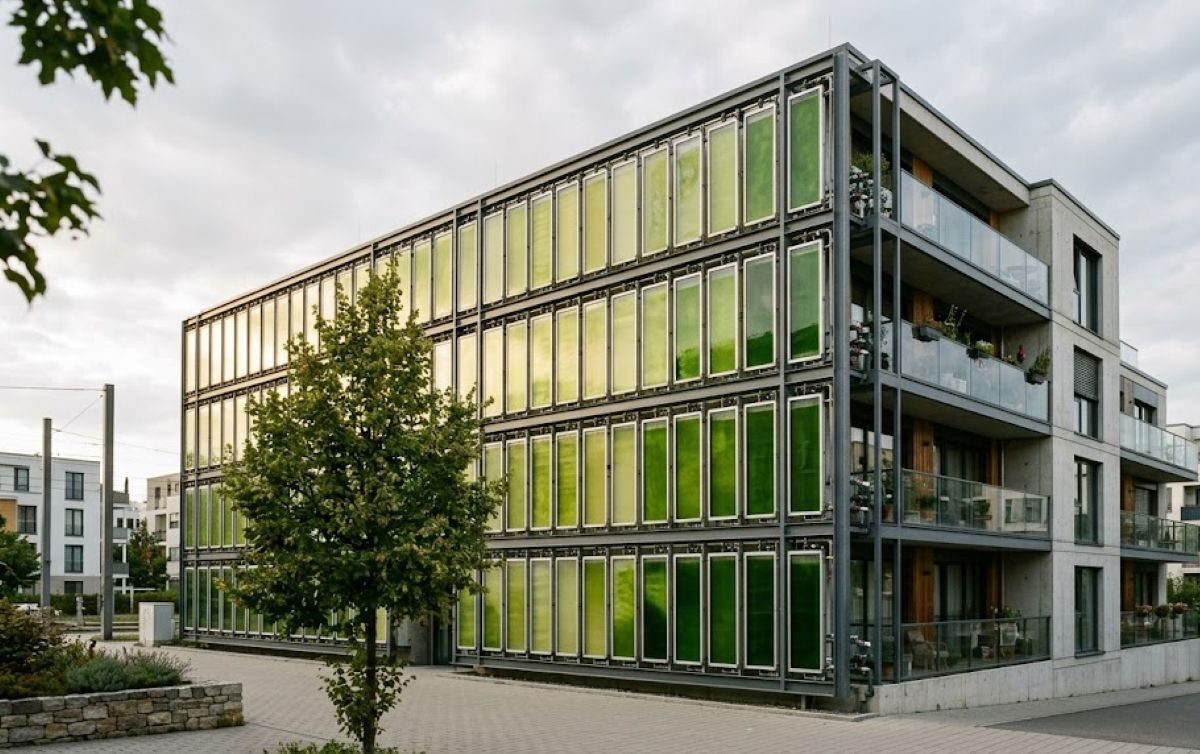
Arup, Colt International and SSC Strategic Science Consult installed the first bio-reactive facade on the BIQ house in Hamburg in 2013, and it is the only full-scale precedent of its kind. The system is 129 flat-panel photobioreactors, each 2.5 m by 0.7 m with a 24-litre cavity, covering 200 m2 across two elevations of a four-storey, 15-unit residential block, and it supplies about one third of the building’s thermal demand. Two years of monitoring reported in Ingenia gave combined output of 26,165 kWh per year (21,626 kWh heat, 4,539 kWh biomass) against 13,471 kWh of electricity consumed. Measured conversion was 21% of sunlight to heat and 4% to biomass, roughly half the design-stage model, and the cause identified was undersized ductwork that clogged and limited the fill head of the panels.
Parasitic electrical load, meaning the pumps, compressors, sensors and controls needed to keep a culture circulating, is where these systems are won or lost. What matters here is that the biology performed while the ductwork limited throughput, and a retrofit to widen it was scheduled for September 2015.
Wastewater
High rate algal ponds treating municipal wastewater remove about 90% of ammonium and 70% of chemical oxygen demand, with orthophosphate removal around 50%. Those figures come from the 2024 meta-analysis, which reports mean pilot conditions of 210 W/m2 irradiation, 18 °C, pH 8.2 and 7.7 days hydraulic retention. Solar radiation and ammonium concentration together explained about 80% of the variance in biomass productivity (R2 = 79.94%), with roughly 70 mg/L of ammonium needed to reach 1 g/L of biomass. Growing algae on wastewater in place of purchased nutrients cut cultivation cost from 2.71 to 0.73 USD per kg of biomass in one analysis cited there.
A 2025 review in Separation and Purification Technology puts harvesting and dewatering at 20 to 30% of total biomass production cost (Yang et al., 2025). Cultures sit at 0.5 to 1.0 g/L with individual cells 3 to 30 µm across, which makes membrane filtration attractive and fouling the recurring failure mode. Nutrient inputs otherwise account for up to 50% of production cost, which is the economic argument for wastewater-grown biomass. I think wastewater is the application where the carbon accounting is cleanest, because the counterfactual is an existing energy-intensive tertiary treatment step. As a result of this, the credit does not depend on how long the harvested biomass holds its carbon afterwards.
What happened to algal biofuel
Exxon Mobil began funding algae biofuel research in 2009, announced a USD 600 million programme, and spent more than USD 350 million before pulling back. Bloomberg reported in February 2023 that its main technical partner, Viridos, laid off 75 of its 130 staff that December after Exxon told the company to find other backers (Elgin and Crowley, 2023). The productivity metric both used was grams of lipid per square metre per day: wild strains produce slightly more than 1, the companies put the competitive threshold at 15, and the best outdoor result reached 9.1 in 2022 after 5.0 in 2020 and 6.8 in 2021. Internal documents seen by Bloomberg put a 10,000 barrel per day facility at roughly 50 square miles of land and USD 5 billion to build.
Chisti’s 2007 economics put recovered microalgal oil at about USD 2.80 per litre against a target of USD 0.48 per litre for parity with petrodiesel, in 2006 to 2007 prices. Biomass cost in that model fell from USD 2.95 per kg at 100 tonnes per year to USD 0.47 per kg at 10,000 tonnes per year in photobioreactors, so the gap is scale-sensitive rather than fixed. Algal oils are also chemically awkward as vehicle fuel, because they are rich in eicosapentaenoic acid (C20:5n-3) and docosahexaenoic acid (C22:6n-3), and European standard EN 14214 caps fatty acid methyl esters carrying four or more double bonds at 1% mol and iodine value at 120 g per 100 g. Partial catalytic hydrogenation resolves the specification problem, at additional processing cost the 2007 model did not carry.
The molecules that disqualify algal lipid as vehicle biodiesel, the long-chain polyunsaturates, are the same ones that make it commercially interesting to nutraceutical and pharmaceutical buyers, which I would say is the more sensible destination for that fraction in the near term.
Ranking these applications by how well the economics work today gives wastewater treatment and high-value bioproducts first, bioluminescent materials second at proof-of-concept, and fuel-scale cultivation last after USD 350 million of industrial testing. Pyrocystis lunula is already used as a whole-cell toxicity bioassay with an optical readout, and encapsulating it in alginate converts a single-use assay into a device that stayed responsive across four stimulation cycles over a month. The CU Boulder group has said its next step is testing whether the organism responds to other chemicals, which would move these constructs from lighting demonstrations into water quality monitoring. For readers assessing where to spend attention, I would say the nearest-term value here is reusable optical biosensing, and the peer-reviewed version of the CU Boulder work, published in Science Advances on 6 May 2026, is the document to read first.
Author Bio