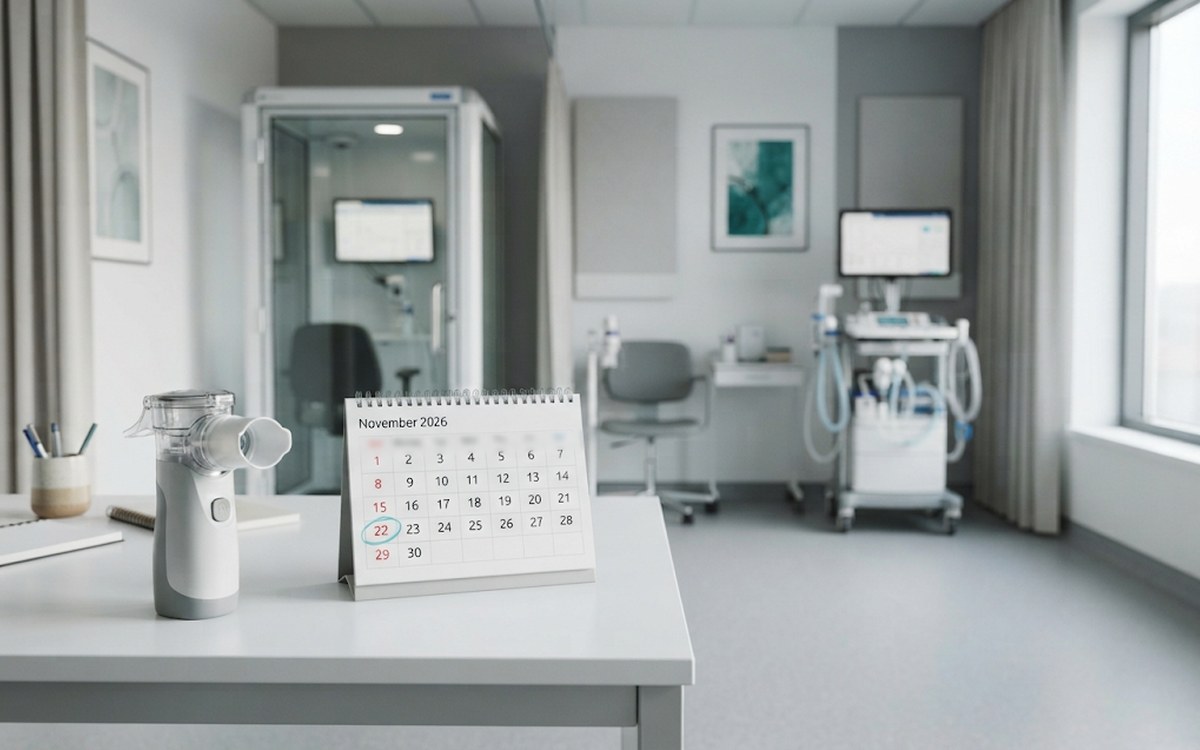
Molgramostim approval has not yet come from any regulator. As of 23 November 2026, the FDA has set no new action date. Savara said on 20 November 2026 that the FDA would not meet its 22 November goal date. The review is ongoing, and the agency has provided no revised date. In the UK, Savara expects a Medicines and Healthcare products Regulatory Agency (MHRA) decision by the end of 2026. In Europe, it expects a committee decision in the first quarter of 2027.
Molgramostim is an inhaled form of granulocyte-macrophage colony-stimulating factor (GM-CSF). Savara is developing it, under the proposed brand name Molbreevi, for autoimmune pulmonary alveolar proteinosis (aPAP). This article sets out what is known about each regulator’s timetable. It also sets out what remains unknown, and which events would settle the question.
Molgramostim approval in the US: when will the FDA act?
There is no firm answer yet. Savara’s announcement on 20 November 2026 says the FDA “will not meet” its target action date. That date was set under the Prescription Drug User Fee Act (PDUFA). The release adds that the review “is ongoing”. It also states that the agency has provided no revised action date. However, the release gives no reason for the missed date.
PDUFA goal dates are review performance goals agreed between the FDA and industry. The PDUFA VII commitment letter sets one such goal. The FDA aims to act on 90 per cent of priority original BLAs within six months. That clock runs from the 60-day filing date. A missed goal date therefore does not mean the application has been rejected. Equally, nothing in the public record yet shows when the agency will act.
Matt Pauls, Savara’s Chair and Chief Executive Officer, commented in the release. “We appreciate the FDA’s continued efforts on our application,” he said.
How the path to molgramostim approval unfolded
The current file is Savara’s second attempt. Its first BLA, submitted in March 2025, drew a refusal-to-file letter announced on 27 May 2025. According to Savara, the FDA found that application “not sufficiently complete to permit substantive review”. The agency requested additional chemistry, manufacturing and controls (CMC) data. Savara said the refusal was not the result of safety concerns. It added that the FDA did not request or recommend additional efficacy studies.
Savara announced on 20 February 2026 that the FDA had filed its new BLA. The application received priority review and an action date of 22 August 2026. On 6 March 2026, Savara said the FDA’s Day 74 letter indicated no plans to convene an advisory committee.
Then, on 15 April 2026, Savara announced a three-month extension to the review. The FDA had judged Savara’s responses to its information requests to be “a major amendment to the BLA”. That moved the goal date to 22 November 2026. According to Savara, the agency “did not cite any safety, efficacy, or manufacturing concerns” in its correspondence. Under the PDUFA VII letter, only one such extension can be given per review cycle.
What the November release does not say
The 20 November release does not repeat the April statement about safety, efficacy or manufacturing. It is silent on the cause of the delay. That silence is not evidence of a new concern. Nor is it evidence that no concern exists. Searches on 23 November 2026 found no public FDA statement on the application.
Meanwhile, analysts have offered their own readings. Jefferies analysts, as reported by BioSpace, said they still hold “high confidence” in approval. They pointed to potential FDA bandwidth issues and an early 2027 US launch. They also weighed manufacturing as a possible concern, given the earlier CMC refusal. That is one firm’s view, not a regulatory signal. BioSpace also quoted Guggenheim analysts, who said they have consistently believed the clinical data are sufficient for approval. They also believe Savara has addressed the remaining manufacturing questions.
Investors, by contrast, reacted sharply. BioSpace reported that Savara shares fell 18 per cent at market open on Friday 20 November, to $4.26.
When could molgramostim approval come in the UK and EU?
The UK may move first. Savara said on 7 April 2026 that the MHRA had accepted its marketing authorisation application. According to the company, the application is under accelerated review and qualifies for a 150-day assessment duration. Savara expects an MHRA decision in the fourth quarter of 2026. Searches on 23 November 2026 found no announced MHRA decision.
MHRA guidance explains how that timetable works. Its innovative medicines timetable allows a positive decision within 150 clock-on days. That applies if all issues are resolved after one round of questions. Regulatory clock-stops are excluded from the count. As a result, the calendar date depends partly on how quickly Savara answers any questions. Savara also reports holding MHRA Innovation Passport and Promising Innovative Medicine designations for molgramostim.
In Europe, Savara said on 30 March 2026 that the European Medicines Agency (EMA) had validated its application. The company expects a Committee for Medicinal Products for Human Use (CHMP) decision in early 2027. Savara has specified the first quarter. A positive CHMP opinion would then pass to the European Commission for a final decision. According to Savara, molgramostim holds orphan drug designation from both the FDA and the EMA. In the US, it also holds fast track and breakthrough therapy designations.
What the IMPALA-2 trial showed
All three applications for molgramostim approval draw on IMPALA-2, a Phase 3, double-blind, placebo-controlled trial (NCT04544293). Results were published in the New England Journal of Medicine in August 2025. The trial randomised 164 patients with aPAP, with 81 assigned to molgramostim and 83 to placebo. Patients inhaled 300 µg once daily for 48 weeks.
The primary endpoint was the change in haemoglobin-adjusted diffusing capacity for carbon monoxide (DLCO) at week 24. DLCO rose by 9.8 percentage points of predicted with molgramostim, compared with 3.8 with placebo. The difference was 6.0 points (95 per cent CI 2.5 to 9.4; P<0.001). At week 48, the gains were 11.6 and 4.7 points respectively.
Quality of life results were mixed. The total St George’s Respiratory Questionnaire score improved by 11.5 points with molgramostim, against 4.9 with placebo (P=0.007). However, the activity component showed no significant difference between the groups. On safety, the abstract reports similar proportions of patients with at least one adverse event in each arm. The same applies to serious adverse events, although the abstract gives no figures. Savara funded the trial.
The NEJM abstract describes aPAP as a rare disease caused by autoantibodies against GM-CSF. These lead to progressive surfactant accumulation and low blood oxygen. Cincinnati Children’s estimates that about 10 people in a million live with the condition. It describes whole-lung lavage as the primary current treatment. BioSpace reports that no FDA-approved treatment for aPAP exists.
Why the timing of molgramostim approval matters for Savara
The timing carries financial weight for a company with one lead asset. Savara’s quarterly report shows about $129.6 million in cash, cash equivalents and short-term investments at 30 September 2026. The filing also sets out two sources of funding tied to FDA approval. RTW Investments has agreed to pay $75 million on approval on or before 31 March 2027. Its Hercules loan terms also allow up to $75 million of extra borrowing after an approval milestone.
The case also sits within a wider debate on rare disease review. The FDA’s new rare disease framework lists risk-based review of CMC among its guiding principles. That theme is relevant here, because Savara’s first filing stalled on CMC data.
What would settle the question, and when
Three events would settle the timing of molgramostim approval. First, an FDA action, or a revised action date communicated to Savara. Second, the MHRA decision that Savara expects before the end of 2026. Third, the CHMP decision that Savara expects in the first quarter of 2027.
Until one of those arrives, the US date remains unknown. A UK decision could therefore come before any FDA action, if Savara’s timetable holds. Other pending files due in the same window appear in the FDA drug approval decisions tracker.