

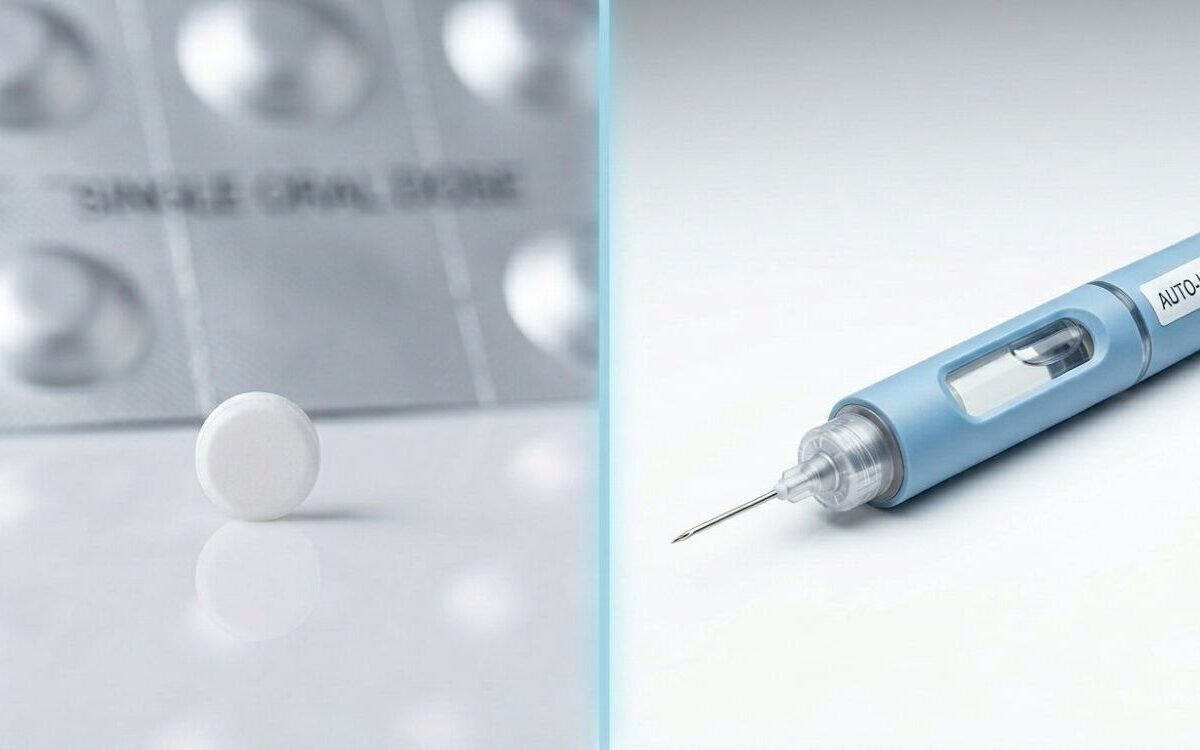
The arrival of two approved oral GLP-1 weight loss therapies in the space of four months has fundamentally redrawn the obesity treatment landscape in 2026. For years, the question of whether a daily pill could ever match the efficacy of a weekly injection was largely theoretical. Now, with Novo Nordisk’s oral semaglutide and Eli Lilly’s Foundayo both on pharmacy shelves in the United States, that question is being answered in real time.
The shift matters because oral GLP-1 weight loss options have the potential to reach millions of patients who have been reluctant to start, or unable to maintain, injectable therapy. But the clinical data tell a nuanced story, and the differences between oral and injectable formulations go beyond patient preference.
From Injection to Pill: The Science of the Shift
GLP-1 receptor agonists work by mimicking the glucagon-like peptide-1 hormone, which is released in the gut after eating. These medicines reduce appetite, slow gastric emptying, and regulate blood sugar. For most of their clinical history, the peptide structure of GLP-1 drugs meant they could only be administered by injection. Oral delivery of peptide drugs has long been complicated by degradation in the gastrointestinal tract before the active ingredient reaches systemic circulation.
Novo Nordisk addressed this with a specialised absorption enhancer in oral semaglutide, though the requirement to take the medicine on an empty stomach with no more than 120ml of water, and to wait at least 30 minutes before eating or taking other medications, reflects the ongoing challenge of peptide absorption. Foundayo (orforglipron) takes an entirely different approach. As a small-molecule, non-peptide oral GLP-1 receptor agonist, it can be taken at any time of day without food or water restrictions. That practical distinction has significant implications for real-world adherence and patient access.
For a foundational overview of how this drug class works, see GLP-1 receptor agonists: how they work and who they’re for.
Two Approvals, Four Months Apart
The FDA approved the oral Wegovy pill (once-daily oral semaglutide 25mg) in December 2025. Novo Nordisk launched the product in the United States in January 2026, marking the first time an oral GLP-1 treatment had been cleared specifically for weight management. The approval was based on the OASIS clinical trial programme and the SELECT cardiovascular outcomes trial, with the OASIS 4 study showing a mean weight loss of 16.6% at 64 weeks in adults with obesity or overweight, among participants who adhered to treatment.
On 1 April 2026, the FDA approved Foundayo (orforglipron) for adults with obesity or overweight with weight-related medical conditions, making it the first small-molecule oral GLP-1 receptor agonist to receive regulatory clearance anywhere in the world. The drug, originally discovered by Chugai Pharmaceutical and licensed by Eli Lilly in 2018, became available through LillyDirect almost immediately after approval. Phase 3 data from the ATTAIN-1 trial, which evaluated 3,127 adults with obesity over 72 weeks, showed a mean weight loss of 11.2%, with more than half of participants achieving at least 10% body weight reduction.
Both results are clinically meaningful. Both fall short, however, of the weight loss consistently achieved by injectable therapies.
The Efficacy Gap: Oral vs Injectable
Injectable tirzepatide (Zepbound), a dual GLP-1 and GIP receptor agonist, produced weight reductions of between 16% and 22.5% over 72 weeks in the SURMOUNT trials. Injectable semaglutide (Wegovy injection) achieved approximately 15% weight loss in Phase 3 studies. Against those benchmarks, oral agents currently sit at a level of efficacy that is meaningful but measurably lower.
The pharmacological explanation is straightforward. When a peptide drug is injected subcutaneously, it bypasses the gastrointestinal tract entirely and enters the bloodstream with high bioavailability. Oral peptide formulations, even optimised ones, absorb only a fraction of the dose. Small-molecule drugs such as orforglipron offer better oral bioavailability, but their receptor interaction profile may differ subtly from that of peptide GLP-1 agonists, which could account for some of the efficacy differential.
The clinical relevance of this gap depends heavily on the individual patient. For those who require maximal weight loss, such as people managing severe obesity alongside cardiovascular risk or obstructive sleep apnoea, injectable therapy may remain the medically preferred route. For patients who are needle-averse, who have difficulty adhering to strict dosing windows, or whose weight management goals do not require reductions of 20% or more, an oral GLP-1 weight loss regimen may be a well-matched and more sustainable choice.
New Research Into How Oral GLP-1s Act in the Brain
A study published in the journal Nature on 6 May 2026 offered a further dimension to the oral versus injectable debate. Researchers at the University of Virginia, supported by National Institutes of Health funding, found that oral small-molecule GLP-1 receptor agonists, including orforglipron, penetrate deeper into the brain than previously understood.
Using gene-edited mice with humanised GLP-1 receptors, the team found that oral small-molecule GLP-1 drugs activated the central amygdala, a region associated with desire and reward that sits deeper in the brain than the hypothalamic and hindbrain networks where injectable peptide GLP-1s have been shown to act. Once activated, the central amygdala reduced dopamine release into key reward-circuit hubs during hedonic, or pleasure-driven, feeding.
“We’ve known that GLP-1 drugs suppress feeding behaviour driven by energy demand,” said co-corresponding author Ali Guler, a Professor of Biology at the University of Virginia. “Now it seems oral small-molecule GLP-1s also dial back eating for pleasure by engaging a brain reward circuit.”
Lorenzo Leggio, clinical director of NIH’s National Institute on Drug Abuse, noted the importance of understanding the neural mechanisms as patient uptake increases. The finding raises questions about whether oral and injectable GLP-1 therapies may have meaningfully different modes of action beyond their delivery format. Researchers indicated that follow-up studies will examine whether these effects extend to substance use disorder.
Access, Adherence, and the Real-World Picture
The commercial arrival of oral GLP-1 weight loss medicines has introduced a new variable into the access and adherence conversation. Injectable GLP-1 therapies have faced persistent challenges in real-world settings, including supply shortages, high monthly costs, and discontinuation rates linked to side effects and needle aversion.
Oral formats remove the injection barrier. In the United States, Foundayo launched with a self-pay price of around $149 per month for the lowest dose, lower than the list prices of branded injectables such as Wegovy and Zepbound, though insurance and employer coverage will shape actual patient costs considerably. Analysts have cautioned that neither oral agent is likely to carry a significant price discount over time, given that the same manufacturers control both oral and injectable portfolios.
The daily oral dosing schedule also introduces adherence questions of a different kind. A once-weekly injection requires a patient to remember one dose per week. A daily pill demands consistency every day, and for oral semaglutide specifically, strict fasting conditions must be met. Early data from telehealth platforms suggest that adherence to oral GLP-1 weight loss programmes will vary significantly according to patient profile and support structures.
The Pipeline Continues to Evolve
The approved oral options represent only the first generation of what is likely to be a rapidly developing field. Structure Therapeutics reported Phase 2 data in March 2026 from its aleniglipron programme showing weight loss of up to 16.3% at 44 weeks, the highest efficacy yet reported for an oral small-molecule GLP-1 receptor agonist at that time point. The company received positive end-of-Phase 2 feedback from the FDA and has indicated that Phase 3 initiation is on track for the third quarter of 2026.
A further dimension emerged in May 2026, when the ATTAIN-MAINTAIN trial, published in Nature Medicine, found that patients who switched to orforglipron after achieving substantial weight loss on injectable GLP-1s maintained approximately 75–80% of that weight reduction. The phase 3b trial, led by Weill Cornell Medicine and NewYork-Presbyterian, enrolled patients from the SURMOUNT-5 study and represents the first head-to-head data on longer-term weight maintenance using an oral GLP-1 following injectable therapy.
Novo Nordisk has submitted oral semaglutide 25mg to the European Medicines Agency and other regulatory authorities, with decisions expected to shape availability in Europe and the United Kingdom over the coming 12 to 18 months. As of May 2026, neither oral Wegovy nor Foundayo has been approved by the UK’s Medicines and Healthcare products Regulatory Agency, meaning injectable options continue to define both NHS and private access in Britain. A May 2026 survey by The Food Foundation found that approximately 90% of UK patients are currently accessing GLP-1 therapies privately or off-label.
A Landscape Defined by Choice
The framing of oral versus injectable GLP-1s as a simple binary choice is, in practice, a clinical oversimplification. What 2026 has produced is a broader and more differentiated treatment landscape in which the right option depends on a patient’s weight loss goals, comorbidities, lifestyle constraints, and capacity for adherence to daily or weekly dosing protocols.
Injectable tirzepatide remains the most efficacious approved agent for maximum weight reduction. Injectable semaglutide has the longest real-world track record and a well-characterised cardiovascular benefit profile. Oral semaglutide offers a familiar molecule in pill form, with meaningful efficacy and cardiovascular data from the SELECT trial. Foundayo offers a genuinely new class of medicine with no fasting requirements and emerging evidence of distinctive central nervous system activity.
For the millions of people globally who live with obesity and have not yet started treatment, the arrival of oral GLP-1 weight loss options lowers one of the most frequently cited practical barriers to care. Whether that translates into sustained, equitable treatment uptake will depend on factors the science alone cannot resolve: cost, coverage, access, and clinical support.