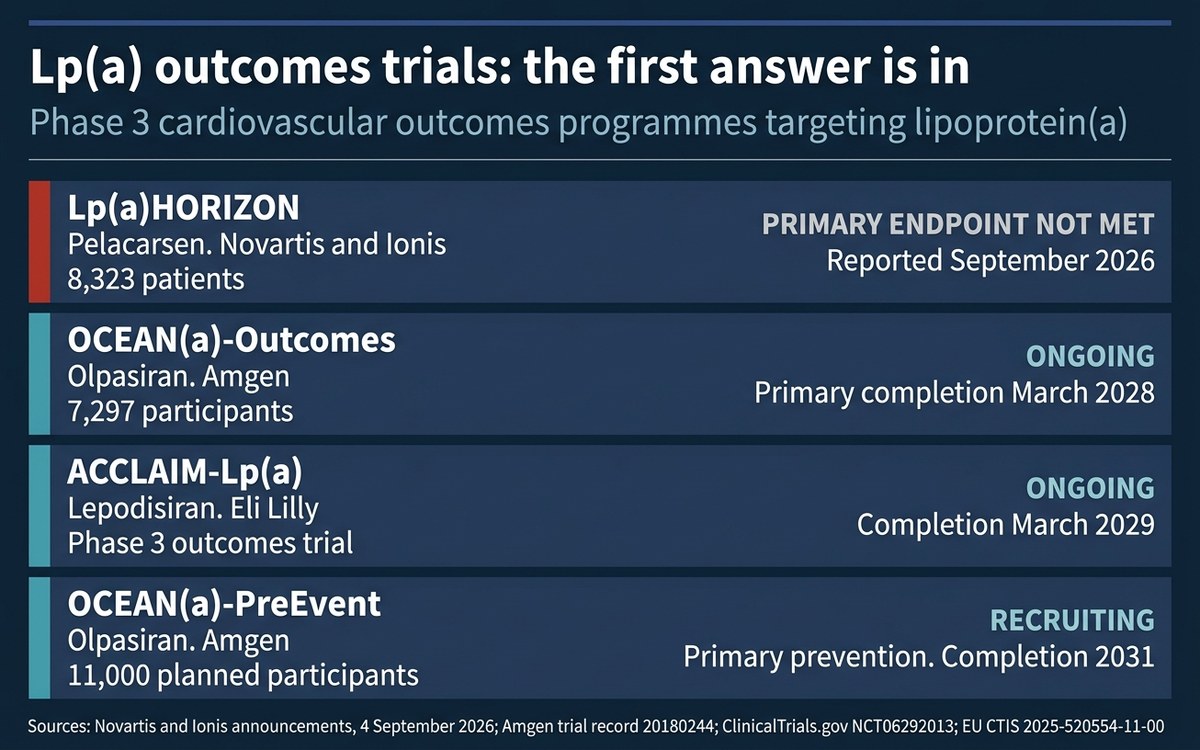
Novartis has reported that the pelacarsen trial missed its primary endpoint. The Phase III study, called Lp(a)HORIZON, enrolled 8,323 patients with established cardiovascular disease and elevated lipoprotein(a). The company announced the topline result on 4 September 2026. Pelacarsen lowered Lp(a) levels. It did not lower the risk of major cardiovascular events.
The consequences reach well beyond a single asset. Lp(a)HORIZON was the first pivotal Phase 3 trial of its kind, according to Ionis Pharmaceuticals. Amgen and Eli Lilly have committed large late-stage programmes to the same biological target. Those trials now carry the burden of proof.
What the pelacarsen trial actually reported
Pelacarsen is an antisense oligonucleotide aimed at LPA messenger RNA in the liver. Ionis discovered the molecule and conducted its early development. Novartis exercised an option to license it in February 2019. The pelacarsen trial used 80 mg by subcutaneous injection once a month.
The primary endpoint combined four outcomes. Those were cardiovascular death, non-fatal myocardial infarction, non-fatal stroke and urgent coronary revascularisation requiring hospitalisation. Novartis assessed that endpoint in the overall population, defined as Lp(a) at or above 70 mg/dL. It also assessed it in a subpopulation with Lp(a) at or above 90 mg/dL.
Shreeram Aradhye, President, Development and Chief Medical Officer at Novartis, commented on the outcome. He said that “lower Lp(a) levels were observed with pelacarsen”. He added that the findings “did not demonstrate that this translated into reduced cardiovascular risk”. That verdict applied to the overall study population. The Novartis topline results announcement said full data will be presented at an upcoming medical congress.
Ionis issued its own statement the same day. Brett P. Monia, chief executive of Ionis, said the company was disappointed. Pelacarsen “substantially lowered Lp(a) levels consistent with previous studies”, he said. The result “did not translate to cardiovascular risk reduction”, he added. The Ionis statement on the Lp(a)HORIZON result also said that pelacarsen “demonstrated an acceptable safety profile”.
The figures the pelacarsen trial announcement left out
The topline statement carried almost no quantitative detail. That gap is worth setting out precisely. Novartis gave no hazard ratio and no confidence interval. It gave no p value and no event counts. It did not state the median follow-up or the data cutoff.
Two further omissions matter more. Novartis did not report the size of the Lp(a) reduction achieved in the study. It also did not report a separate result for the 90 mg/dL subpopulation. The safety characterisation came from Ionis rather than from Novartis. Neither company published adverse event rates. Every quantitative claim about this dataset should therefore be treated as pending.
Why Lp(a) carried so much expectation
Elevated Lp(a) is inherited and common. Ionis describes it as affecting “approximately one in five people worldwide”. Published reviews put the share at roughly 20 to 25 per cent. Statins do not lower it. Diet and exercise do not lower it to any useful degree.
Genetic and epidemiological evidence has linked higher Lp(a) with atherosclerotic disease. That association made Lp(a) an unusually attractive target for drug developers. It did not prove that lowering Lp(a) changes outcomes in treated adults. Lp(a)HORIZON was designed to test exactly that proposition.
Earlier data set the expectation. A Phase 2 study published in the New England Journal of Medicine in 2020 reported dose-dependent reductions. Those ranged from roughly 35 to 80 per cent across the pelacarsen dose groups. The Phase III design was published in the American Heart Journal in September 2025. Leslie Cho of the Cleveland Clinic was its first author.
Cardiology has met this pattern before. A biomarker moves convincingly and the clinical endpoint does not follow. LSDN examined that problem when Novo Nordisk reported the ZEUS null result for ziltivekimab. The wider difficulty of biomarker-led prevention runs through our analysis of the evidence gap in precision prevention.
How analysts read the pelacarsen trial result
Analyst reaction converged on a single question. Did the mechanism fail, or was the suppression simply too shallow? Analysts at William Blair leaned towards the second explanation. They wrote that there “may be opportunity to consider deeper Lp(a) inhibition than pelacarsen from a given asset”. They tied that to patients with higher baseline Lp(a) levels. The same note carried a warning. It saw “meaningful risk” to the future of Lp(a)-driven cardiovascular trials.
Citi took a comparable position. Its analysts said they “would not declare the mechanism dead”. They added that “greater target suppression could matter if cardiovascular benefit requires crossing a biological threshold”. They also called for the detailed data. It would, they said, “distinguish a near-neutral result from a directional benefit that missed statistical significance”. Both notes are hypotheses rather than findings. Neither can be tested against the full dataset yet.
Reuters reported after-hours falls for Novartis, Ionis and Amgen on 4 September. The market read the pelacarsen trial as a class event rather than a single company event. Amgen has no approved Lp(a) product at risk. Its shares still moved.
What the result means for Amgen, Lilly and the class
Three large outcomes trials remain in progress. None will report soon. Amgen is testing olpasiran, a small interfering RNA, in OCEAN(a)-Outcomes. The company’s own trial record lists 7,297 participants. It gives a primary completion date of March 2028.
That study uses a narrower primary endpoint than Lp(a)HORIZON did. Amgen lists time to coronary heart disease death, myocardial infarction or urgent coronary revascularisation. The company has since opened a second Phase 3 study, OCEAN(a)-PreEvent. The EU registry record gives 11,000 planned participants across 17 countries. It tests olpasiran in people who have not yet had a cardiovascular event.
Eli Lilly is running ACCLAIM-Lp(a) with lepodisiran, another small interfering RNA. The ClinicalTrials.gov record gives primary completion in March 2029. That trial also enrols primary prevention patients alongside secondary prevention patients.
Both agents lower Lp(a) more deeply than pelacarsen did in Phase 2. Published reviews report reductions above 90 per cent for the small interfering RNA agents. Pelacarsen reached roughly 80 per cent at its highest Phase 2 dose. Those figures come from separate Phase 2 studies with different doses, assays and populations. That difference underpins the argument that the class is not finished.
It remains an argument rather than evidence. The threshold hypothesis has never been tested in a cardiovascular outcomes trial. The pelacarsen trial did not test it either, because it did not go that deep. That question waits for OCEAN(a)-Outcomes.
Novartis and Ionis already hold an option on deeper suppression. The two companies signed a next generation Lp(a) collaboration in August 2023. Novartis paid $60 million upfront and took on development and commercialisation. Ionis remains eligible for milestone payments and tiered royalties. Neither topline statement on 4 September mentioned that programme.
Lp(a) testing in the UK stays where it was
UK practice was already cautious on this marker. Lp(a) testing is not routine in general practice. HEART UK guidance on high lipoprotein(a) advises referral to specialist lipid clinics for measurement. It flags premature cardiovascular disease and a family history of raised Lp(a). Familial hypercholesterolaemia is a further reason to test.
That position sets the UK apart. Both sponsors note that US and European guidelines advise measuring Lp(a) once in a lifetime. The relevant UK guidance is the NICE guideline on cardiovascular risk assessment and lipid modification, NG238. HEART UK reports that the Lipoprotein(a) Taskforce is calling for specific Lp(a) recommendations to be added to it.
The pelacarsen trial result weakens one argument for that change. It does not settle the question. The case for measurement rests on risk stratification, not on a licensed therapy.
A unit problem complicates any UK reading of the study. HEART UK reports Lp(a) risk bands in nmol/L. Lp(a)HORIZON enrolled patients by mg/dL thresholds instead. The two units do not convert by a single fixed factor. That caveat should travel with every comparison.
British research sites are not outside the field. The UK research ethics record for OCEAN(a)-PreEvent lists Amgen as sponsor of the primary prevention study. That places UK investigators inside the programme now carrying the hypothesis.
The financial fallout for Ionis and Royalty Pharma
Royalty Pharma moved quickly to quantify its exposure. It funded a $500 million agreement with Ionis in January 2023. Of that sum, $150 million bought pelacarsen royalties. The remaining $350 million bought royalties on Spinraza. The company said it does not anticipate making any milestone payments to Ionis.
Royalty Pharma also set out its recovery path. Its Spinraza royalty interest reverts to Ionis once royalty payments reach $550 million. The Royalty Pharma update on its pelacarsen exposure described that as a 1.1 times return on the total funded. It reiterated a 2030 Portfolio Receipts target of $4.7 billion or more.
Ionis pointed instead to its own commercial base. Monia named Tryngolza, Dawnzera and Zanvastro as wholly owned medicines. He described the company as continuing to drive their independent commercialisation. The statement did not address financial guidance.
What to watch next
Three things will shape this field over the next two years. The first is the congress presentation of the full Lp(a)HORIZON dataset. That will show the Lp(a) reduction actually achieved. It will also show how the 90 mg/dL subpopulation behaved.
The second is the Novartis position on the programme itself. The topline statement did not address discontinuation. The third is OCEAN(a)-Outcomes in 2028. Nothing before it will resolve the depth of suppression question.
The pelacarsen trial has done something valuable and unwelcome at once. It converted a strong association into a tested intervention hypothesis. At this depth of suppression, that hypothesis did not hold. The rest of the field must now argue from data it does not yet have.