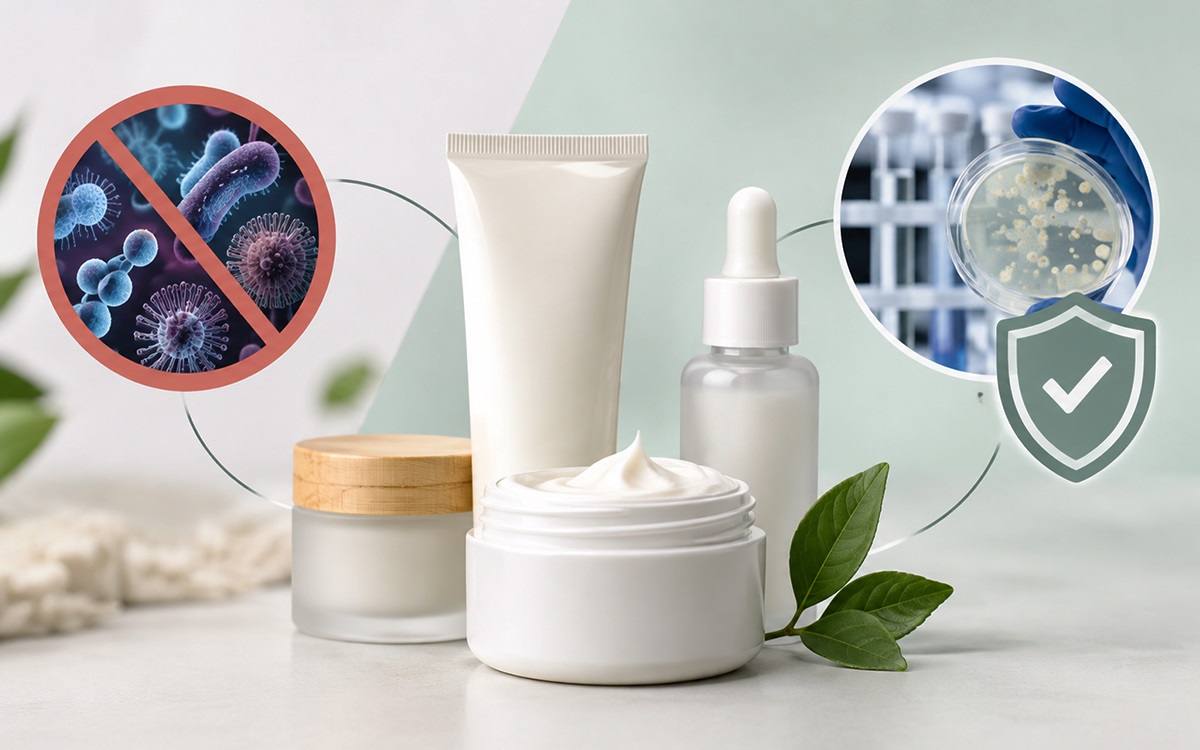
I have noticed that many shoppers want cosmetics without preservatives, so brands have launched preservative-free cosmetics and other “free-from” lines. The science of microbiology however stays the same. Any product that holds water and nutrients can feed microbes. If you take out a preservative without putting in something that can do the same job you simply shift the danger to another spot. In this article I will look at where contamination enters, how safety is proven under current rules and EU law and what can or cannot replace a normal preservative system.
Why cosmetics support microbial growth
Creams, lotions, shampoos and gels all contain water, fats, proteins, sugars and plant extracts. Bacteria such as Pseudomonas aeruginosa, the Burkholderia cepacia complex and Staphylococcus aureus, yeasts such as Candida albicans and moulds such as Aspergillus brasiliensis can all grow in these products if nothing stops them. When microbes grow the product spoils, it may smell bad, change colour or become thinner. It can also pose a health risk for products used near the eyes on damaged skin or by babies, older adults and people with weak immune systems [1,2]. A review of EU alert notices shows that microbial contamination is a frequent reason for cosmetic alerts [3].
Where contamination comes from
Contamination can enter at four places. Raw materials, such as natural extracts, clays and starches, may already carry microbes. Process water is the common source in water-based formulas and biofilms in pipes, tanks and filling lines can seed each batch. Equipment and the factory environment add risk when cleaning and sanitising are not verified. Finally consumers bring in microbes through fingers, applicators and splashes of water so the way the product is packaged matters as much as the ingredients [2,4].
The European legal frame
Regulation (EC) No 1223/2009 requires cosmetics to be safe under reasonably foreseeable conditions of use (Article 3) and requires a safety assessment before a product is placed on the market (Article 10) [5]. Annex I requires the Cosmetic Product Safety Report to state the quality of raw materials and the finished product, with particular attention to products for the eye area, mucous membranes, damaged skin, children under three, older people and immunocompromised persons. Preservation challenge test results are included [5]. Preservative-free cosmetics are therefore held to the same microbiological standard as any other product and must prove it.
Annex V lists the permitted preservatives with concentrations and conditions of use [5]. Entries are reviewed by the Scientific Committee on Consumer Safety (SCCS) and change over time. Methylisothiazolinone was prohibited in leave-on products by Regulation (EU) 2016/1198 and restricted in rinse-off products by Regulation (EU) 2017/1224 [6,7]. Regulation (EU) No 358/2014 banned five parabens [8], and Regulation (EU) No 1004/2014 lowered the limits for propylparaben and butylparaben [9]. Changes like these often push reformulation toward alternative strategies, each of which must be validated again.
Article 8 makes good manufacturing practice a legal requirement and compliance with the harmonised EN ISO 22716 gives a presumption of conformity [5,10]. Article 19 requires a date of minimum durability for products that last 30 months or less. For products that remain stable for longer than 30 months, the period after opening symbol is used instead, which should rest on in-use stability data [5].
How preservation is demonstrated
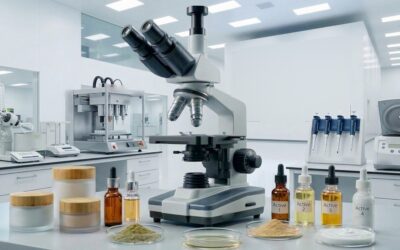
Challenge testing. ISO 11930 describes how to evaluate the antimicrobial protection of a cosmetic product [11]. The finished formula is inoculated with defined strains, typically P. aeruginosa, S. aureus, Escherichia coli, C. albicans and A. brasiliensis, and counts are followed over 28 days against acceptance criteria for log reduction at set time points. The test is a stress model, not a guarantee of safety in use and its result applies to the formula, packaging and storage conditions tested.
Risk assessment. ISO 29621 provides a framework for identifying low-risk products, such as those with very low water activity, high alcohol content or extreme pH [12]. Any such justification must be product specific and documented in the safety report.
Microbiological limits. ISO 17516 sets microbiological limits for finished products [13]. Category 1 (children under three, eye area, mucous membranes) has a lower limit for total aerobic mesophilic count than Category 2 (all other products). In both categories P. aeruginosa, S. aureus and C. albicans must be absent in the test portion. The SCCS Notes of Guidance apply the distinction [4].
Test methods. Detection and counting follow the ISO 21148 family, including ISO 21149, ISO 16212, ISO 22717, ISO 22718, ISO 18416 and ISO 21150 [14]. Validation of the method, which includes neutralising any antimicrobial activity in the sample, is essential. Without it a product that contains preservatives may look clean when it is not.
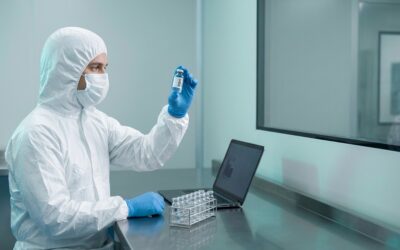
Manufacturing hygiene. ISO 22716 covers the quality system around the product: personnel hygiene, premises, water quality, equipment cleaning, sampling and batch records [10]. Monitoring of process water and validated sanitisation are often what make the difference. In the United States the Modernization of Cosmetics Regulation Act of 2022 tells the FDA to set manufacturing practice rules for cosmetics [15].
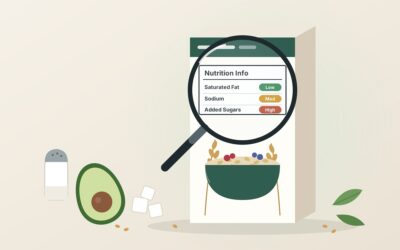
What “free-from” claims mean. Claims fall under Article 20 of Regulation 1223/2009. Regulation (EU) No 655/2013 sets out the common criteria: compliance, truthfulness, evidential support, honesty, fairness and informed decision-making [5,16]. The Commission’s technical document on claims warns against free-from statements that mislead consumers [17]. The document is not legally binding, but authorities and the Sub-Working Group on Claims treat it as the reference point. For claims about a functional group such as preservatives, it says the product should not contain any ingredient that belongs to that group, and that the claim should not be made where the product contains multifunctional ingredients that also perform the function the claim says is absent [17]. A “preservative-free” label on a formula that relies on a glycol or a medium-chain glyceryl ester for its antimicrobial effect therefore risks misleading the consumer, even when the ingredient is also a humectant or an emollient. The claim should reflect what is in the formula and what each ingredient is doing there. This is the same question the formulator faces in the hurdle section below.
Hurdle technology. Where conventional preservatives are reduced, formulators combine smaller barriers in place of one strong one [18].
pH and water activity. A pH outside the growth range of target organisms or a low water activity restricts growth. This works in balms, powders and oils but not in most emulsions, where the water phase is essential.
Chelating agents. Agents such as EDTA destabilise outer membranes and can enhance other antimicrobials but they do not preserve a product alone.
Packaging. Airless pumps, tubes and single-dose units limit consumer-borne contamination. They do not stop contamination from materials or the production line and their performance must be validated, not assumed.
Multifunctional ingredients. Glycols and medium-chain glyceryl esters add antimicrobial activity alongside their role as humectants or emollients. Their effect depends on concentration and formulation. It must be shown by challenge testing like any preservative system. Each hurdle has a scope and every combination has to be proven on the finished formula. This is also why these ingredients sit uneasily with a “preservative-free” claim: if the glycol or ester is in the formula partly to protect it, the label has to say so or the claim should not be made [17].
Lessons from pharmaceutical microbiology
The same logic applies in manufacturing: the control principles used in cosmetics are the same as those used for non-sterile medicines. Pharma readers will recognise the equivalents. In the European Pharmacopoeia, chapter 5.1.4 sets microbiological quality criteria for non-sterile preparations by route of administration, much as ISO 17516 does for cosmetics, and chapter 5.1.3 sets criteria for the efficacy of antimicrobial preservation, the counterpart of the ISO 11930 challenge test [19,20]. In the United States Pharmacopeia, general chapters <61> and <62> cover microbial enumeration and tests for specified microorganisms, <51> covers antimicrobial effectiveness testing, and <1111> gives acceptance criteria for non-sterile products [21]. Water quality, cleaning, bioburden monitoring and preservation efficacy testing are shared requirements across both sectors.
Conclusion
Reducing preservatives is a formulation goal, but it is a microbiological design problem, not a labelling decision. The route to low-preservative or preservative-free cosmetics runs through process hygiene, validated challenge testing on the finished product, suitable packaging and a safety assessment that documents each choice. “Free-from” should describe a proven strategy, not the absence of a function.
Author Bio