Abstract
Radial immunodiffusion (RID) can look almost outdated beside ELISA, multiplex assays, and automated analytical platforms. Yet that apparent simplicity may be exactly why the method still deserves attention. RID offers a direct, visually interpretable way to examine antigen-antibody interactions and quantitatively estimate antigen concentration. In this industry Q&A, a Creative Biolabs antibody research expert discusses the essentials of a reliable radial immunodiffusion protocol, explains why precipitin rings fail or become distorted, and examines how antibody quality and species reactivity influence experimental reliability.
Is Radial Immunodiffusion Really Obsolete?
Laboratory technologies rarely disappear simply because something faster arrives. Radial immunodiffusion is a good example.
While modern immunoassays can deliver greater sensitivity, automation, and throughput, RID has a different strength: researchers can directly observe the precipitation produced by antigen-antibody interaction.
Q: With so many advanced immunoassays available, does RID still have a meaningful role?
Creative Biolabs Expert: Yes, when the experimental question fits the method. RID should not be viewed as a replacement for high-sensitivity or high-throughput assays. Its value is its relatively straightforward quantitative principle and transparent endpoint. Researchers can see how concentration, diffusion, reagent quality, and incubation conditions influence the result.
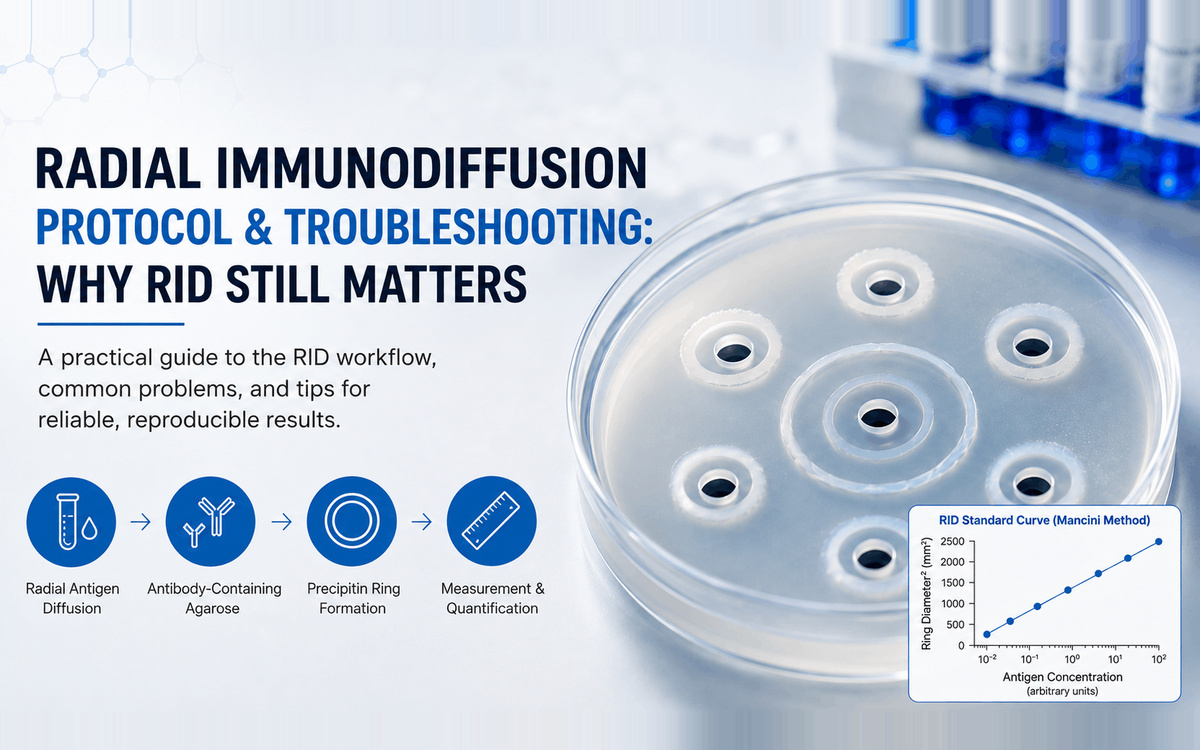
In a standard radial immunodiffusion protocol, an antibody of known specificity is distributed throughout an agarose gel. Antigen standards and unknown samples are introduced into wells. As antigen diffuses radially through the gel, antigen-antibody complexes form a visible precipitin ring when appropriate proportions are reached. For endpoint measurements, squared ring diameter is typically compared with a standard curve to estimate antigen concentration.
Why Can Such a Simple Assay Be Difficult to Reproduce?
Q: Where do RID experiments most commonly go wrong?
Creative Biolabs Expert: Researchers sometimes focus on the sample and overlook the assay environment. A radial immunodiffusion result depends on several interacting variables: antibody activity, antibody distribution in the agarose, gel integrity, sample volume, antigen concentration, incubation temperature, diffusion time, and measurement accuracy.
Gel preparation is especially important. The antibody should be distributed uniformly, while excessive temperature during preparation should be avoided because it can reduce antibody activity.
Sample loading should also be consistent. Even modest pipetting differences can affect diffusion and therefore ring dimensions when the assay is being used quantitatively.
The lesson is simple: a technically uncomplicated assay still demands controlled execution.
What Does It Mean When No Precipitin Ring Appears?
A missing ring is a common radial immunodiffusion troubleshooting problem, but interpreting it as a negative biological result can be premature.
Q: What should researchers check before concluding that their antigen is absent?
Creative Biolabs Expert: Start with the assay itself. Check whether the gel has been damaged or dehydrated, confirm antibody quality and concentration, verify that every well was loaded correctly, and make sure the sample concentration is within a suitable range.
Observation conditions can also matter. Precipitin rings may be difficult to see under poor lighting. Appropriate side illumination and contrast can make weak rings easier to distinguish.
Creative Biolabs’ troubleshooting guidance also identifies antibody exposure to excessive heat during gel preparation as a potential cause of absent or weak precipitation.
Why Are Some Rings Blurred, Oversized, or Irregular?
Q: Can ring appearance help identify the source of an experimental problem?
Creative Biolabs Expert: Often, yes. Different ring patterns can point toward different variables.
A blurred precipitin ring may result from uneven antibody distribution or reduced antibody activity. Researchers should check gel preparation, mixing, plate leveling, and preparation temperature.
An oversized or undersized ring may reflect an incorrect sample concentration or loading volume. Changes in incubation temperature can also influence diffusion. Pipette calibration and the accuracy of the instrument used to measure ring diameter should therefore be checked.
Multiple rings deserve particular attention because they can indicate sample deterioration, heterogeneous antigenic components, or nonspecific precipitation.
A noncircular ring can occur when high antigen concentrations in nearby wells cause localized antibody depletion. Diluting the sample and repeating the assay can help determine whether concentration is responsible.
Finally, a poor calibration curve may indicate incomplete diffusion. Creative Biolabs notes that additional incubation and remeasurement may be appropriate in some cases before the assay is discarded.
Is Antibody Quality the Hidden Variable in RID?
Q: How much of RID reproducibility ultimately depends on the antibody?
Creative Biolabs Expert: A great deal. The antibody is not merely another reagent, it is part of the measurement system. Changes in specificity, activity, affinity, or consistency can alter precipitation behavior and complicate quantitative interpretation.
This is one reason recombinant reagents have become important in immunological research. Creative Biolabs’ Hi-Affi™ recombinant antibody portfolio is positioned around properties including confirmed specificity, repeatability, batch-to-batch consistency, and sustainable recombinant supply.
Experimental context matters just as much. Researchers can select from dedicated human antibody products and mouse antibody products, but species origin alone should not determine reagent selection. Intended application, target specificity, species reactivity, sample matrix, and appropriate controls all need consideration.
Why Does Cross-Species Reactivity Matter?
Q: What changes when antibody research moves toward preclinical models?
Creative Biolabs Expert: Researchers increasingly have to consider whether target recognition translates between species. An antibody that recognizes a human protein cannot automatically be assumed to bind the corresponding mouse or nonhuman primate ortholog with equivalent behavior.
Creative Biolabs offers human/cyno/mouse cross-reactive antibody products for research requiring recognition across multiple species. Such reagents can help connect in vitro experiments with relevant preclinical models, although cross-reactivity and functional behavior should always be validated for the intended application.
What Can RID Teach the AI Era of Antibody Discovery?
The gap between a precipitin ring and AI-assisted antibody discovery appears enormous. At a fundamental level, however, both depend on understanding antibody-antigen recognition.
Q: Are there lessons from classical assays that remain relevant to next-generation antibody discovery?
Creative Biolabs Expert: Absolutely. New discovery technologies expand the number and complexity of candidates researchers can investigate, but they do not eliminate the need for experimental validation. Specificity, binding performance, reproducibility, and biological relevance still matter.
That perspective is reflected in Creative Biolabs’ webinar recording, Novel Platforms for Preclinical Antibody Discovery, featuring Ivelin Georgiev, PhD, Professor at Vanderbilt University Medical Center. The session explores wet-lab and AI-based platforms developed to address bottlenecks in conventional antibody discovery, including scalability, efficiency, failure rates, and difficult antibody phenotypes.
The comparison is instructive: sophisticated computational tools can broaden discovery, but reliable biology still depends on well-controlled experimental systems.
The Takeaway
RID remains relevant not because it competes with every modern immunoassay, but because it demonstrates a principle that applies across antibody research: experimental simplicity does not eliminate the need for rigor.
A trustworthy RID result depends on antibody quality, consistent gel preparation, appropriate antigen concentrations, controlled incubation, accurate sample loading, reliable calibration, and thoughtful interpretation of precipitin-ring morphology.
From classical immunodiffusion to AI-assisted antibody discovery, better results ultimately come from understanding both the technology and the biology behind the measurement.
Author Bio
Dr. Emily R. Coleman is a senior scientist at Creative Biolabs with a background in immunology, oncology research, and translational biotherapeutic development. Her work focuses on translating complex biological mechanisms into practical experimental strategies for next generation therapeutic discovery, with particular expertise in tumor immunology and antibody engineering.
At Creative Biolabs, she provides scientific insight across multiple R&D domains, including antibody discovery and development, gene and cell therapy research, and translational assay design. She is particularly focused on improving the connection between mechanistic biology and predictive preclinical models to support more effective therapeutic development across immune related disease areas.
About Creative Biolabs
Creative Biolabs provides antibody products, discovery platforms, engineering technologies, and preclinical research solutions for life science research. Its resources span recombinant antibodies, human and mouse antibody collections, multi-species cross-reactive antibodies, assay protocols and troubleshooting guidance, and experimental and computational approaches to antibody discovery.
Products and services referenced in this article are for research use only and are not intended for clinical use.