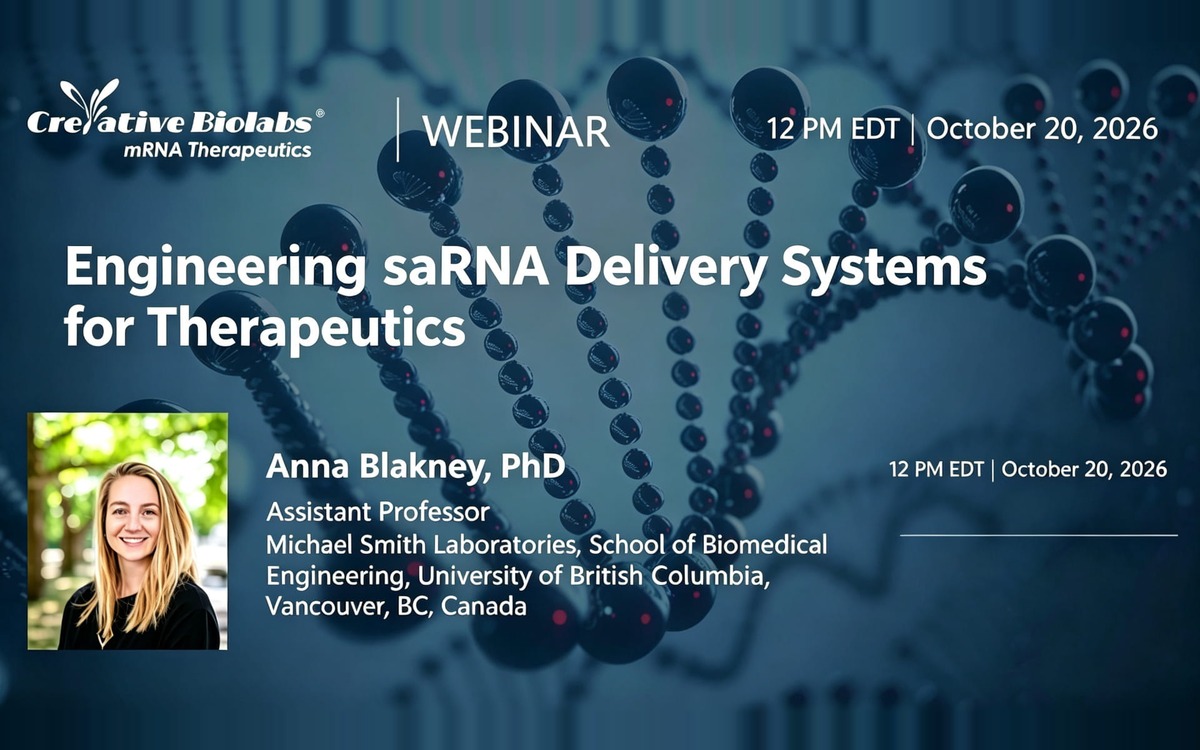
The next breakthrough in RNA therapeutics may depend less on making RNA more powerful and more on solving how efficiently it reaches and functions inside target cells. Creative Biolabs will host the upcoming webinar “Engineering saRNA Delivery Systems for Therapeutics” on October 20, 2026, featuring RNA delivery researcher Anna Blakney, PhD. The discussion will explore self-amplifying RNA (saRNA), molecular engineering, nanoparticle formulation, and strategies for achieving therapeutic activity at lower RNA doses.
The biggest bottleneck in RNA therapeutics may not be the RNA itself.
The success of conventional mRNA has demonstrated that transient genetic instructions can generate clinically meaningful biological responses. Yet simply increasing RNA dose is not necessarily the best route toward greater potency. Higher doses can increase manufacturing requirements while placing additional pressure on formulation, tolerability, stability, and delivery.
That creates a more consequential question: Can better RNA engineering and delivery achieve more with less?
Creative Biolabs will put that question at the center of its webinar “Engineering saRNA Delivery Systems for Therapeutics,” scheduled for 12 PM EDT on October 20, 2026.
Why Self-Amplifying RNA Changes the Delivery Equation
The webinar will feature Anna Blakney, PhD, whose research spans RNA engineering, biomaterials, vaccines, and therapeutic delivery.
Self-amplifying RNA differs from conventional non-replicating mRNA because it incorporates replication machinery that enables intracellular amplification of the RNA after cytoplasmic delivery. A peer-reviewed review by Blakney and colleagues identified antigen design, vector design, non-viral delivery systems, and manufacturing as four central pillars of saRNA vaccine development.
The amplification mechanism offers the possibility of obtaining substantial protein expression from smaller starting quantities of RNA. However, it also creates technical challenges. saRNA molecules are substantially larger than conventional mRNA, making RNA integrity, formulation, encapsulation, and delivery particularly important.
Research from McKay, Blakney, and colleagues provides an early demonstration of this relationship. In a Nature Communications study, a lipid nanoparticle-formulated self-amplifying RNA SARS-CoV-2 vaccine generated dose-dependent antibody and cellular immune responses in mice, supporting the potential of combining saRNA engineering with effective nanoparticle delivery.
saRNA Delivery Vehicles Are Part of the Therapeutic Design
The webinar will explore how nanoparticle systems can be engineered to improve saRNA expression, potency, and therapeutic performance.
Growing evidence suggests that LNP performance cannot be reduced to a single “standard” formulation. A 2024 Journal of Controlled Release study evaluating helper lipids in saRNA nanoparticles found that changes in phospholipid and ionizable-lipid combinations influenced characteristics including stability and expression. Notably, the authors also reported that in vitro performance did not necessarily predict ex vivo or in vivo behavior, reinforcing the need for context-specific formulation assessment.
This payload-specific approach is reflected in Creative Biolabs’ Custom mRNA Delivery Vehicle Development Service, which supports lipid-based, polymer-based, hybrid, and other delivery strategies. Its mRNA Vaccine Development Service further supports researchers investigating prophylactic and therapeutic mRNA vaccine programs.
Quality assessment is another consideration. A 2023 Scientific Reports study led by Blakney’s group highlighted the analytical challenges associated with long saRNA transcripts and described a droplet digital PCR approach for assessing transcript integrity and replication kinetics. Such findings illustrate why RNA design, manufacturing quality, characterization, and delivery need to be considered as an interconnected development workflow rather than isolated steps.
Creative Biolabs also provides a Custom saRNA Synthesis Service for small activating RNA, a separate RNA modality based on RNA activation. This should be distinguished from the self-amplifying RNA discussed in the upcoming webinar.
Moving Beyond the “One LNP Fits All“ Model
As RNA medicines expand into infectious disease, oncology, genetic disorders, and other therapeutic areas, delivery systems are increasingly becoming active determinants of performance rather than passive carriers.
The upcoming Creative Biolabs webinar offers researchers an opportunity to examine how molecular design and nanoparticle engineering can be coordinated, and why the future of RNA therapeutics may depend not simply on what an RNA molecule encodes, but on how efficiently the entire system is engineered to work.
Author Bio
Dr. Emily R. Coleman is a senior scientist at Creative Biolabs with a background in immunology, oncology research, and translational biotherapeutic development. Her work focuses on translating complex biological mechanisms into practical experimental strategies for next generation therapeutic discovery, with particular expertise in tumor immunology and antibody engineering.
At Creative Biolabs, she provides scientific insight across multiple R&D domains, including antibody discovery and development, gene and cell therapy research, and translational assay design. She is particularly focused on improving the connection between mechanistic biology and predictive preclinical models to support more effective therapeutic development across immune related disease areas.
About Creative Biolabs
Creative Biolabs is a biotechnology service provider supporting academic, pharmaceutical, and biotechnology researchers worldwide. Its capabilities span antibody discovery, vaccine development, mRNA and RNA technologies, cell and gene therapy, and related preclinical research. Through its mRNA platform, Creative Biolabs provides research services covering RNA design and synthesis, delivery-vehicle development, characterization, and vaccine and therapeutic development. Products and services described are intended for research use.