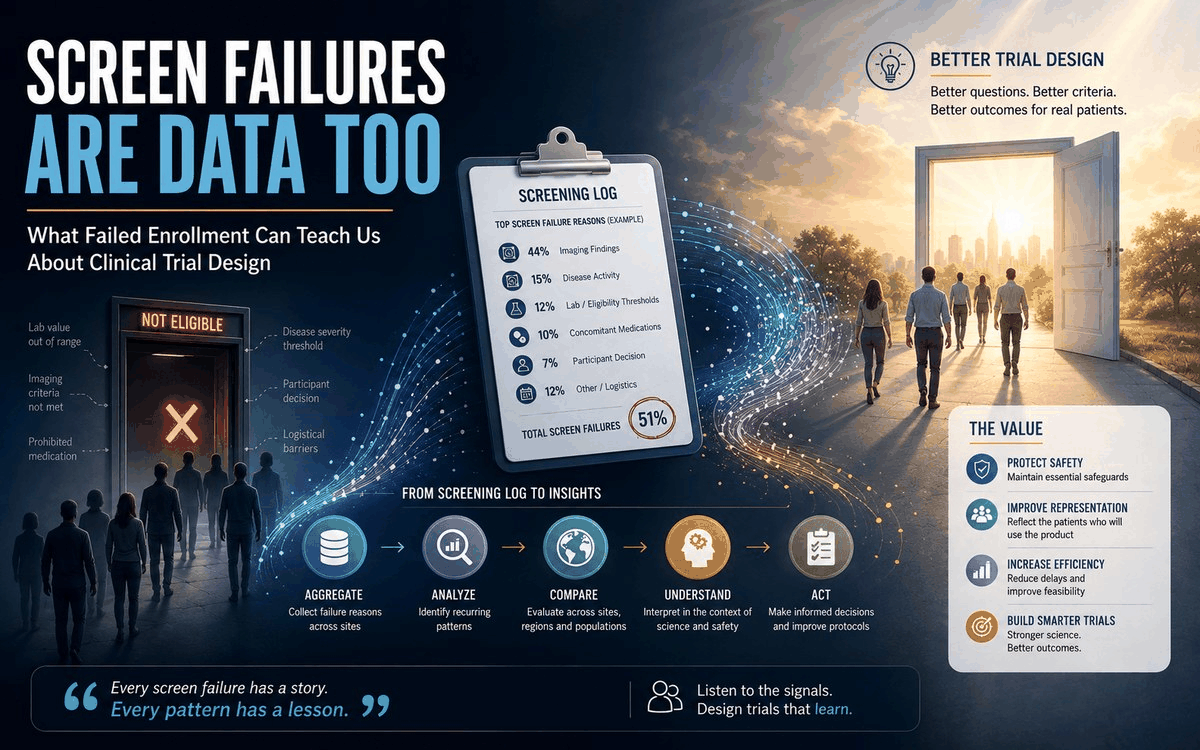
A single screen failure tells us something about a patient. A pattern of screen failures may tell us something about the trial.
Clinical research is very good at studying the patients who make it into a trial.
We analyze their baseline characteristics, laboratory results, treatment responses, adverse events, protocol deviations and outcomes. Their data eventually become tables, figures, clinical study reports, regulatory submissions and publications, and sometimes part of the evidence supporting a new treatment.
But there is another population we talk about far less: the patients who almost made it.
At an investigator site, these aren’t abstract numbers on a screening report. They are real patients who may have reviewed and signed an informed consent form, provided medical histories, undergone laboratory testing or imaging, rearranged work or transportation, and invested time in the possibility of participating in a study, only to discover that one element of the protocol makes them ineligible.
Maybe a laboratory value falls just outside the permitted range. A disease-severity score misses the threshold. Imaging doesn’t meet a protocol-defined requirement. A concomitant medication is prohibited. Or a clinical characteristic simply doesn’t fit the population envisioned when the protocol was written.
The screening process works exactly as intended: the patient is not enrolled.
The more interesting question is what happens to what we just learned.
When a metric becomes a signal
In many trials, screen failure is primarily treated as an operational outcome. The reason is documented, the screening log is updated, recruitment metrics change, and the site moves on to the next potential participant.
For an individual patient, that may be entirely appropriate. Eligibility criteria exist for important reasons. They protect participants, define the population being studied, reduce confounding and help ensure that a trial can answer the scientific question it was designed to answer.
But what happens when the same reason keeps appearing?
Recent evidence suggests this is worth paying attention to.
A 2026 systematic review of randomized trials in systemic sclerosis identified 10,043 screened patients, of whom 5,147 (51%) were considered screen failures. Among screen failures for whom reasons were reported, 72.5% were due to not meeting eligibility criteria. Yet the specific reasons patients failed those criteria were reported for only a subset.[1]
A large analysis of 17 Phase II and III inflammatory bowel disease trials involving 16,913 screened patients found screen-failure proportions of 44% in ulcerative colitis and 51% in Crohn’s disease. Clinical and endoscopic activity thresholds were among the major causes.[2,3]
The pattern isn’t limited to one therapeutic area. A 2024 analysis of 87 retina trials across six centers found that 497 of 962 screened patients (51.8%) were screen failures. Imaging findings alone accounted for 44.5% of those failures, with vision-based criteria accounting for another 14.7%.[4]
None of these findings proves that the protocols were poorly designed. And a high screen-failure rate, by itself, does not mean eligibility criteria are unnecessarily restrictive. But they show why the information underneath the percentage matters.
One patient failing because of an unavoidable safety concern is an individual circumstance. Multiple sites repeatedly seeing otherwise plausible candidates miss the same protocol-defined threshold is something different.
That is where a metric can start becoming a signal.
The protocol should be allowed to learn too
There is an obvious danger in this argument: concluding that we should simply loosen eligibility criteria until more patients qualify.
We shouldn’t.
Some exclusions are essential. Particularly in early development, uncertainty around an investigational product may justify a deliberately narrow population. Organ-function requirements, prohibited medications, disease characteristics and other restrictions may be necessary to protect participants or preserve the interpretability of the study. Patient safety has to remain the priority. But protecting necessary eligibility criteria does not mean treating every criterion as untouchable once recruitment begins.
I think the better question is:
Can we explain why this criterion exists, and does the information emerging during screening continue to support where we drew the line?
If sites repeatedly report candidates narrowly missing the same laboratory cutoff, that deserves attention. If one disease-specific criterion excludes far more of the real-world population than feasibility assessments predicted, that deserves attention. If patients consistently decline participation after learning about the same procedure, travel expectation or visit schedule, that deserves attention too.
None of those observations automatically warrants a protocol amendment. But each warrants a question.
That approach also fits the broader regulatory direction. FDA’s December 2025 guidance encourages sponsors to consider eligibility criteria, enrollment practices and trial designs that improve participation and help study populations better reflect the people likely to use the drug.[5]
The goal isn’t broader eligibility for its own sake. It is making sure exclusions remain scientifically and clinically defensible.
The patients we exclude shape the evidence too
Screen failure matters for another reason that goes beyond recruitment efficiency. Patients who fail screening don’t contribute to the efficacy or safety dataset. But their absence still helps determine who that evidence represents.
If common comorbidities, medications, ages, functional characteristics or disease presentations repeatedly prevent otherwise relevant patients from participating, the final trial population can gradually move away from the population clinicians will eventually encounter in practice.[5]
That doesn’t make the evidence invalid. Controlled clinical trials necessarily define populations. But it makes understanding who was excluded, and why, scientifically meaningful. And this is an area where our reporting could improve.
The systemic-sclerosis review found that only 52.9% of the randomized trials examined reported patient flow before randomization. Even among trials that reported screen failures, detailed reasons were incomplete.[1]
That matters because “did not meet eligibility criteria” tells us the outcome, but not necessarily the lesson.
Was it disease severity? A laboratory value? A concomitant medication? A comorbidity? An imaging finding?
Those distinctions are exactly what we need if screening data are going to tell us anything useful about trial design.
From screening log to feedback loop
I don’t think solving this requires another enormous layer of trial bureaucracy. It starts with recognizing that not all screen failures are equivalent. Study teams could prospectively categorize failure reasons in a way that distinguishes safety-critical exclusions, disease-specific criteria, laboratory or imaging thresholds, concomitant medications, participant decisions and logistical barriers.
Then we need to look beyond individual patients, and sometimes beyond individual sites.
- Are several sites encountering the same exclusion?
- Are patients repeatedly missing a numerical threshold by a small margin?
- Is one criterion eliminating substantially more candidates than feasibility projections suggested?
- Are participants disproportionately declining after learning about a particular procedure or visit requirement?
- Do patterns differ meaningfully across regions or patient populations?
The value comes from aggregation.
One simple way to think about this is as a conceptual equation:
Screen-Failure Signal Strength ∝ Frequency × Consistency × Cross-Site Reproducibility × Clinical Relevance
- Frequency: How often is the same eligibility criterion responsible for a screen failure?
- Consistency: Does the same pattern continue to appear over time, rather than occurring as an isolated cluster?
- Cross-site reproducibility: Is the same issue being observed independently at multiple sites?
- Clinical relevance: Are otherwise plausible candidates repeatedly being excluded, and does the criterion meaningfully affect the population the trial is intended to study?
This is not intended as a validated statistical formula. Rather, it is a practical way to think about when an isolated screen failure begins to look like a meaningful pattern. The more frequently and consistently the same issue appears, and particularly when it appears independently across multiple sites, the harder it becomes to dismiss as local noise.
Even then, the signal has to be interpreted against the scientific and safety rationale for the criterion itself. A frequently triggered exclusion may be doing exactly what it was designed to do. The purpose of identifying the signal is not to automatically change the protocol; it is to recognize when a pattern deserves review.
One investigator reporting difficulty with an eligibility criterion may represent a local issue. The same observation emerging independently across multiple sites begins to look different.
And importantly, not every signal needs to result in change.
A medical review might confirm that the criterion remains essential. The pattern could reveal a training or interpretation problem rather than a protocol problem. It could change recruitment strategy. It might expose an unrealistic feasibility assumption. In some circumstances, accumulating evidence could contribute to a protocol amendment.
Even when nothing should change in the ongoing study, the information can improve the next one.
That’s the shift I would like to see:
Screen failure should not only be counted. It should be interpreted.
The patients who almost participated still have something to teach us
We will never eliminate screen failures, nor should that be the goal. A well-designed eligibility criterion is supposed to exclude a participant when enrollment would be unsafe or scientifically inappropriate. In those cases, a screen failure is evidence that the protocol is doing its job.
But there is a difference between an eligibility criterion doing its job and an eligibility criterion repeatedly revealing an assumption worth revisiting. The only way to recognize that difference is to look beyond the screen-failure rate and examine the pattern underneath it.
Clinical trials generate information before the first participant is randomized. We simply don’t always treat it as information. We spend enormous effort learning from the patients who enter our trials. Perhaps we should become equally curious about the patients who almost did.
Because when one patient fails screening, the protocol may simply be working exactly as intended.
But when the same kind of patient fails again and again, we should be willing to ask a harder question:
“Why didn’t these patients fit the protocol, and is there anything the protocol should learn from them?”
Author Bio