

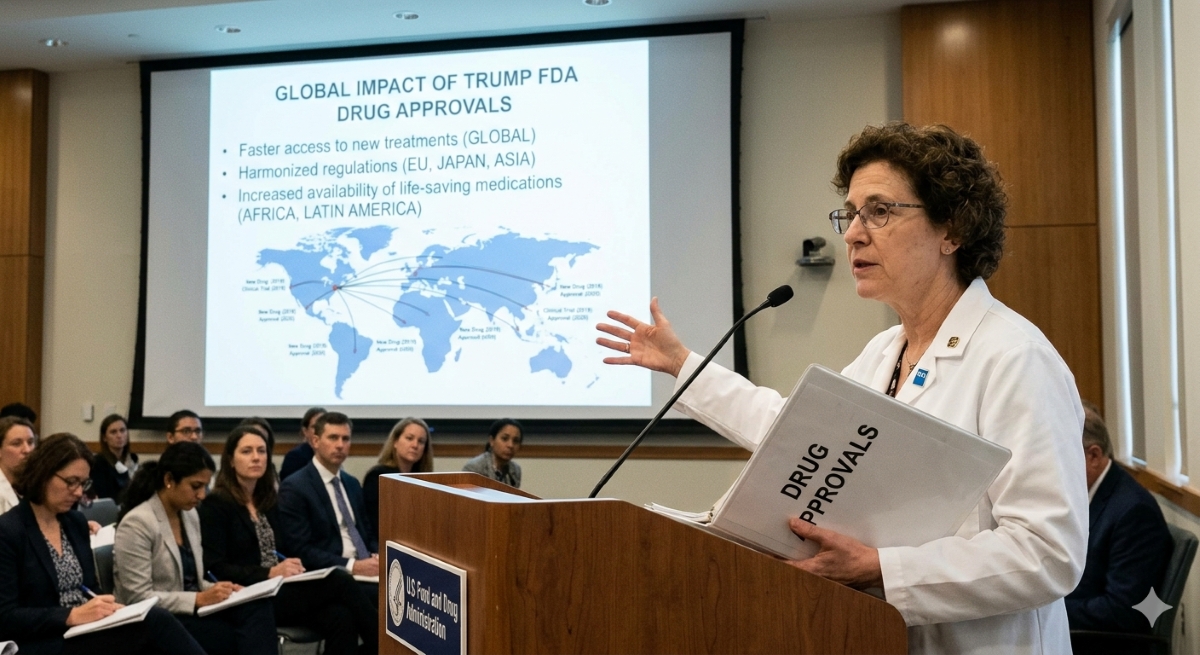
Trump FDA Drug Approvals: How US Regulatory Upheaval Is Reshaping the Global Pharmaceutical Industry
The United States Food and Drug Administration has long been regarded as the gold standard of drug regulation. When a medicine receives FDA approval, it carries a credibility that opens doors to markets around the world. But since the start of Donald Trump’s second term in January 2025, the agency has been subjected to a wave of political, structural, and personnel changes that are sending shockwaves far beyond Washington. For pharmaceutical companies, regulators, and patients worldwide, Trump FDA drug approvals are now a source of profound uncertainty.
A Workforce in Disarray
The most immediate and visible change at the FDA has been the dramatic reduction in its workforce. On 1 April 2025, the Department of Health and Human Services terminated 3,500 FDA employees as part of a sweeping government efficiency drive led by Elon Musk’s Department of Government Efficiency (DOGE). Combined with earlier dismissals of probationary staff and the voluntary departure of several senior officials, the agency has lost a significant portion of its institutional knowledge and operational capacity.
Among those who resigned was Peter Stein, former Director of the Office of New Drugs, a departure that deepened organisational instability at a critical time. The loss of experienced reviewers has created procedural bottlenecks that are already being felt by companies awaiting decisions on drug applications.
According to a law firm analysis published by Skadden, Arps, Slate, Meagher and Flom, the layoffs are “likely to have the greatest impact on products in development, because the agency may not be able to issue as much guidance as it had previously, or provide feedback and updates on applications.” The firm also warned that “approval dates are likely to be less predictable.”
James Shehan, chair of the FDA Regulatory Practice at law firm Lowenstein Sandler, was blunt in his assessment of DOGE’s approach:
“I challenge anyone to say that it makes good sense to start [cuts] with your new people and the people who have been promoted.”
Missed Deadlines and Mounting Backlogs
The consequences of the staffing crisis have begun to materialise in the form of missed approval deadlines. In April 2025, Vanda Pharmaceuticals announced that the FDA had cited the workforce reduction in its request to delay a hearing relating to one of Vanda’s drug candidates. The company subsequently sued the agency, alleging that the FDA had not followed the law in issuing its complete response letter. The FDA also failed to meet its decision deadline for a rare disease drug from Stealth BioTherapeutics and missed a scheduled review for a GlaxoSmithKline antibody treatment.
Most prominently, the FDA declined to approve Novavax’s SARS-CoV-2 vaccine on schedule, with Commissioner Marty Makary insisting that the vaccine undergo repeat efficacy testing. On an earnings call in May 2025, Novavax CEO John Jacobs confirmed the agency had formally requested post-marketing commitments before any approval could proceed.
The Prescription Drug User Fee Act (PDUFA), which funds a significant portion of the FDA’s review work through industry fees, has also been disrupted. Staff responsible for managing the programme have been caught up in the cuts, leaving new drug applications facing delays from incomplete fee processing and raising the risk of the agency breaching statutory deadlines.
The Makary Vision: Speed Over Rigour?
Appointed as FDA Commissioner earlier in 2025, Dr Marty Makary has positioned himself as an agent of modernisation. His stated agenda includes cutting red tape, reducing animal testing requirements in favour of newer technologies, expanding the use of real-world evidence, and reducing the default number of required clinical trials from two to one for most drug applications.
In December 2025, the FDA announced it would no longer block companies from submitting real-world data in drug and device applications, removing what Makary described as overly burdensome consent requirements.
“Right now, they say that they’ve been admitting real-world data into applications, but the requirements have been so onerous that only 12 drugs in the last 14 years have had real-world data in their approval application,” Makary told Fox Business.
These changes reflect a broader ambition to accelerate the pathway from laboratory to patient. But critics argue that the drive for speed risks undermining the scientific rigour that makes FDA approval meaningful in the first place. The worry is compounded by the influence of Health and Human Services Secretary Robert F. Kennedy Jr., whose scepticism towards vaccines and preference for more extensive placebo-controlled testing has introduced what many industry observers regard as an ideologically driven element into what should be a purely scientific process.
Legal experts at international law firm A&O Shearman noted that “businesses face a less predictable FDA, and will likely seek more clarity on the speed and level of oversight, approval pathways, and post-market surveillance they can expect.”
America First and the Threat to Global Harmonisation
The Trump administration’s broader “America First” trade and industrial policy has added another layer of complexity to the global drug approval landscape. Several executive orders signed in the early months of 2025 directly target pharmaceutical supply chains, with the aim of reshoring drug manufacturing and reducing US dependence on overseas suppliers.
FDA Deputy Commissioner Grace Graham highlighted the scale of that dependence, noting that 73% of all FDA-registered manufacturing facilities for active pharmaceutical ingredients, and 52% of finished drug manufacturing facilities, are located outside the United States, with China as a leading supplier. The vulnerability of those supply chains has also been thrown into sharp relief by geopolitical events beyond Washington’s control, as explored in the analysis of the threat posed by a Strait of Hormuz closure to global medicine supplies. The administration has pledged to reverse this trend, streamlining domestic product reviews while increasing reporting requirements and costs for foreign manufacturers.
This approach is in direct tension with decades of effort to harmonise regulatory standards across borders. The US withdrawal from the World Health Organization, formally completed in January 2026 following notice given on the first day of Trump’s second term, has complicated collaborative programmes such as the Medical Device Single Audit Programme and the International Medical Device Regulators Forum, both of which rely on multilateral cooperation to reduce duplicative inspections and align global standards. Regulatory experts attending the RAPS Regulatory Intelligence Conference in 2025 warned that these moves risk creating a leadership vacuum on the global regulatory stage that other agencies may move to fill.
European Regulators Step Into the Gap
For many pharmaceutical companies, the uncertainty surrounding Trump FDA drug approvals has prompted a fundamental rethink of their market entry strategies. A&O Shearman reported that major US pharma companies are already seeking initial regulatory approvals in Europe rather than at home, in order to preserve their global commercial prospects and avoid the reputational risk of a US approval process perceived as politically compromised.
The European Medicines Agency has been quietly consolidating its position as a rigorous and predictable alternative. In 2025, the EMA recommended 104 new medicines for approval, of which 38 contained a new active substance. On 11 December 2025, political agreement was reached on the most significant overhaul of EU pharmaceutical legislation in over two decades, with formal adoption expected in 2026. The reforms include expanded EMA oversight, streamlined approval procedures, enhanced post-market surveillance, and a centralised EU portal for regulatory submissions.
The contrast in trajectories is stark. While the FDA grapples with workforce instability and ideologically charged policy shifts, the EMA is investing in greater scientific rigour, AI-assisted quality control in assessment reports, and stronger transparency mechanisms. Analysts at TRiBECA Knowledge observed that both FDA and EMA approval rates were lower in 2025 than in 2024, though the circumstances driving each agency’s decline were markedly different.
Smaller Companies Bearing the Brunt
The uncertainty is not felt equally across the pharmaceutical sector. Large multinational companies with deep regulatory expertise and substantial legal resources are better placed to navigate a less predictable FDA. Smaller biotechnology firms, which typically rely heavily on direct engagement with the agency throughout the drug development cycle, face a disproportionately difficult environment.
Jacqueline Berman, a partner at law firm Morgan Lewis, noted that the impact of the FDA’s staffing changes is “happening on an individual, case-by-case basis, because different teams were impacted in different ways.” For a small biotech awaiting a critical approval, delays in reviewer engagement can mean delays to funding rounds, partnership agreements, and ultimately patient access to potentially transformative treatments.
The disruption to the FDA’s AI-assisted review tools has also created unexpected complications. Reports emerged in mid-2025 that the agency’s AI platform was producing inaccurate outputs, making the review process more difficult rather than less. As of mid-2025, the FDA was not requiring any personnel to use the technology, treating it as optional while issues were addressed.
What Comes Next
The full consequences of the transformation underway at the FDA will take time to become clear. Commissioner Makary insists that the trains are running on time, and the administration points to record approval numbers during Trump’s first term as evidence that a leaner, faster FDA is achievable. In 2017, a record 55 novel drugs were approved, compared to just 22 in the preceding year.
But the structural conditions that enabled those approvals, including a well-staffed agency with established institutional relationships and clear policy frameworks, may be harder to replicate in the current climate. The draft White House budget for fiscal year 2026 proposed a reduction in FDA funding to $6.8 billion, a decrease of $271 million (3.9%) from the previous year. Whether a reduced and restructured agency can sustain meaningful oversight while simultaneously accelerating approvals remains the central question for the global pharmaceutical industry.
For companies, patients, and regulators outside the United States, the answer matters enormously. The FDA’s credibility has historically functioned as a kind of global regulatory passport. If that credibility is perceived to have been compromised, the ripple effects will be felt in every market that has relied upon it.