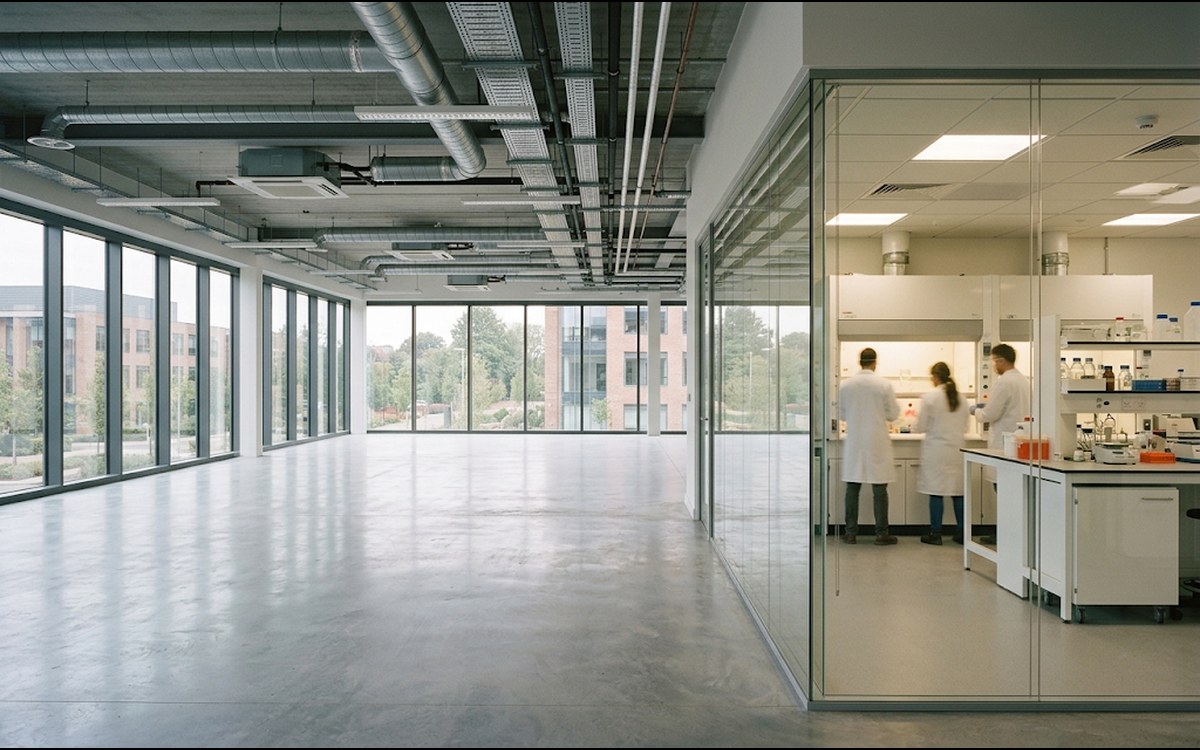
UK lab space demand reached a record in 2026. So did UK lab space vacancy. CoStar data shows national laboratory vacancy hit a record 14.3% in the second quarter of 2026. That is more than double the level of two years earlier. Yet some regional science parks say their labs are operating near capacity. The two pictures describe different parts of the market. The gap between them now shapes where life science companies can find room to grow. The problem, in short, is mismatch rather than overall shortage.
What do the UK lab space figures show in 2026?
On the demand side, the numbers are strong. According to CoStar, rolling four-quarter take-up exceeded 1.2 million sq ft by early August 2026. A single 300,000 sq ft pre-let at Cambridge Biomedical Campus lifted the total.
That pre-let is GSK’s new research and development centre. The company has described the project as a £400 million investment commitment. Prologis is the development partner for three interconnected buildings on Discovery Drive.
Cambridge has also recovered ground against Oxford. Patrick Scanlon is senior director of market analytics at CoStar Europe. He noted that Oxford took around half of the UK lab space acquired in 2025. This year Cambridge has rebounded, with year-to-date leasing above 180,000 sq ft by early August. Scanlon said that was nearly double Oxford’s total.
Cushman & Wakefield tracks the Golden Triangle of London, Oxford and Cambridge each quarter. Its method differs from CoStar’s, so the two sets of figures should not be blended. In its second-quarter Life Science Marketbeat, the firm recorded 175,000 sq ft of take-up. That was 8% below the five-year quarterly average and 57% below the first quarter.
London led with 98,300 sq ft across five deals. Cambridge followed with 48,500 sq ft and Oxford with 28,200 sq ft. A further 779,200 sq ft was under offer at the end of June. That included the 300,000 sq ft at Discovery Drive.
Rents have so far held firm. Prime quoting rents were unchanged for a fifth consecutive quarter, Cushman & Wakefield reports. London stood at £140 per sq ft, Cambridge at £77 and Oxford at £70. However, the firm marks the outlook for all three markets as under pressure.
Why is UK lab space vacancy rising in the Golden Triangle?
The answer lies mainly in the supply of new UK lab space. In the Golden Triangle, vacancy now exceeds 25%, according to CoStar. It reports that the rise follows 1.8 million sq ft of new space delivered over two years.
More space is still arriving. A further 1.4 million sq ft is due by the end of 2026. Over 40% of it is uncommitted. CoStar expects vacancy to rise further this year before levelling off in 2027 as completions slow.
The longer-term pipeline is shrinking, however. Fewer than 130,000 sq ft has started on site in 2026, one of the lowest totals on record. The UK pipeline has fallen to about 3 million sq ft. That is down roughly 13% since the start of the year. Scanlon said “geopolitical risks, economic uncertainty and rising construction costs are expected to slow development.”
Cushman & Wakefield’s construction data points the same way. It recorded 2.9 million sq ft under construction in the Golden Triangle at the end of June. That was the lowest level since the first quarter of 2024. Only 20% of the space was pre-let or under offer.
Land for future lab space is still being assembled. In October 2025, The Crown Estate acquired 221 acres next to the Harwell Science and Innovation Campus in Oxfordshire. It says the Harwell East site could feature up to 4.5 million sq ft. The planned mix covers office, laboratory and advanced manufacturing space.
Why are regional science parks reporting labs near capacity?
Away from the largest schemes, some operators describe a tighter UK lab space market. Sciontec, whose Liverpool portfolio includes Liverpool Science Park, reports a 38% year-on-year rise in deals. The company says demand for its city centre lab and office space is at an all-time high. It also says its laboratories are operating at near capacity.
Leanne Katsande, Head of Commercial at Sciontec, pointed to the wider economic backdrop. “Despite wide-spread economic challenges, we have experienced increasing interest in our city centre workspaces,” she said.
Recent lettings there have been small, at roughly 1,100 to 1,600 sq ft each.
Sciontec’s answer is new supply. It plans HEMISPHERE, a 150,000 sq ft, eight-storey lab and office building at Paddington Village. Construction is due to start on site in May 2027.
These figures sit awkwardly beside the national UK lab space data. They also fit a wider pattern of growth across regional life science clusters outside London, Oxford and Cambridge.
A 2026 report on North East England describes similar pressure. The report is titled Unlocking Laboratory Space for the North East Life Sciences Sector. It is published through the North East Combined Authority’s growth hub. It finds that purpose-built lab space is limited, especially in city centres. Some existing commercial labs are full, while others are priced beyond the reach of many firms.
What kind of UK lab space do early-stage companies need?
The North East report identifies a specific gap. It finds a shortage of small-scale lab space for early-stage businesses graduating from incubators. Occupiers cited high base rents and inflexible lease terms. Many were reluctant to commit to long leases. The report therefore recommends flexible leasing models to reduce upfront risk.
Fit-out is a second barrier. According to the report, landlords and contractors can over-specify labs or overestimate regulatory complexity. Visibility is a third. Firms struggle to find suitable premises because available space is hard to see. To address this, the report proposes a single “front door” and a centralised regional database of sites.
This is the core of the mismatch. A large speculative floor in Cambridge does little for a small spin-out leaving an incubator in Newcastle or Liverpool. The national vacancy rate measures total UK lab space. It does not show whether units of the right size sit in the right places.
How is UKSPA positioning science parks as infrastructure?
The UK Science Park Association (UKSPA) is pressing that argument with policymakers. Its strategy for 2026 to 2029, published in July, sets five priorities. They include defining and championing the sector, building a stronger national voice and connecting local networks to national policy. The first priority aims to create a shared identity, standards and evidence base for the sector.
The strategy’s stated destination is clear. UKSPA wants science parks and innovation clusters recognised as national and economic infrastructure.
Chief executive Ruth Hall set out the case in June. She wrote that UKSPA’s more than 200 members support over 6,000 businesses and 140,000 high-value jobs. She noted that government is prioritising outcomes such as growth, intellectual property and exports over occupancy. She also linked that approach to the Industrial Strategy and to the devolution of regional investment decisions.
What should UK lab space watchers look for next?
Several moments in the coming weeks will test these themes.
Lab Innovations, 4 to 5 November
Lab Innovations takes place at the NEC Birmingham on 4 and 5 November 2026.
UKSPA Autumn Conference, 19 to 20 November
The UKSPA Autumn Conference follows at the University of Nottingham Innovation Park. Sessions will cover regional innovation ecosystems and strategies for sustainable economic growth.
Next quarterly market data
CoStar’s next figures will show whether vacancy keeps climbing as the remaining 2026 completions land. In Liverpool, HEMISPHERE is scheduled to start on site in May 2027.
For now, the UK lab space market holds two truths at once. There is plenty of empty space, but not always of the right size, type or location.