
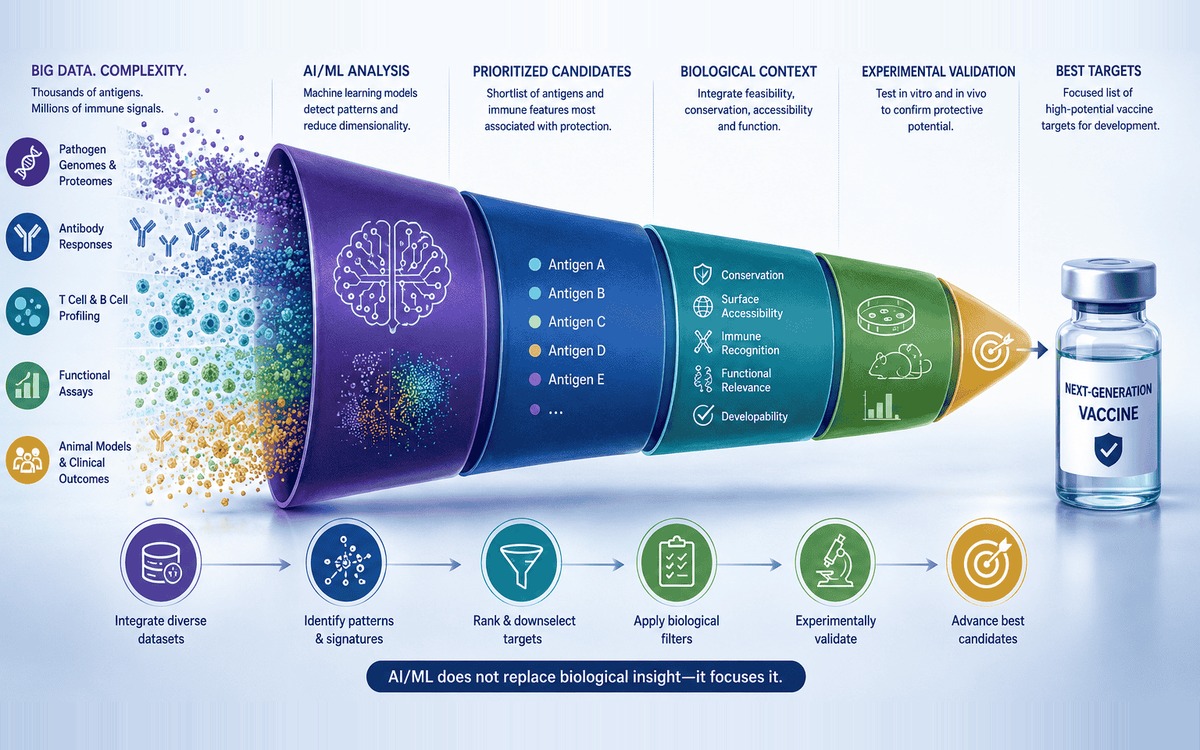
Modern vaccine research has entered an era of colossal data abundance. Researchers can now examine complete pathogen genomes and proteomes, measure hundreds of thousands of antigen-specific antibody responses, characterize immune-cell states at single-cell resolution and connect these measurements with functional assays, animal model datasets and clinical outcomes. Vaccine target selection now draws on more evidence than at any point in the field’s history.
Yet the ability to generate more data has not automatically translated into easier vaccine target selection. In many cases, it has created a new problem: how do we parse out biologically meaningful signals from the background noise of a complex immune response?
A pathogen may encode thousands of proteins, hundreds of which can be recognized by the immune system. A high-dimensional immune-profiling study may produce tens or hundreds of thousands of measurements. Only a small fraction, however, are likely to represent targets or immune features that contribute meaningfully to protection.
This is where machine learning (ML) and computational approaches become invaluable – not by selecting vaccine antigens autonomously, but by helping researchers decide which candidates warrant the most rigorous biological investigation.
More data does not necessarily mean better vaccine target selection
Historically, vaccine antigens have often been selected because they are abundant, conserved, surface-exposed or strongly immunogenic. These remain important considerations, but they alone cannot be considered equivalent to protection.
A highly immunogenic antigen may simply reflect its abundance or prolonged exposure. Also, a strong response could be a marker of disease rather than effective immunity. Conversely, a comparatively modest response may be biologically important if it consistently appears in people who control infection, in protected vaccine recipients or in experimental models with favorable outcomes.
The question, therefore, is not simply: Which antigens generate the strongest responses? A more informative question is: Which antigens and immune functions are selectively associated with control, resistance or protection?
Answering this requires comparisons across biologically meaningful groups. These might include individuals with active disease versus controlled infection, progressors versus non-progressors, responders versus non-responders, or animals receiving protective versus non-protective vaccination.
A candidate becomes more compelling when several observations align. For example:
- It is preferentially recognized in protected rather than diseased populations.
- The association is reproduced in an independent cohort or experimental model.
- The antigen is accessible to the relevant arm of immunity.
- Responses to it demonstrate biologically relevant functions.
- It is conserved across clinically important pathogen strains.
- It can be expressed, formulated and manufactured successfully.
- Animal studies provide evidence of causality.
Once a dataset is generated across these groups, conventional one-feature-at-a-time analysis can become limiting. Immune variables are frequently correlated, differences may be modest, and multiple-testing penalties can obscure patterns distributed across combinations of features. Here, ML methods can help delineate these multivariate signatures. Thus, while ML models can help prioritize these steps, they cannot replace these steps. The role of AI-ML is to make the validation process more focused and efficient.
Generating a “hit-list”
The appropriate role of ML in vaccine target selection is that of a hypothesis-generation and prioritization tool, not as an autonomous decision-maker. Methods such as LASSO regression [1], elastic net [2], and partial least-squares discriminant analysis [3] can compress thousands of potential antigens into smaller, more manageable panels while preserving or even enhancing predictive performance. The choice of method should depend on the biological question, sample size, feature structure and intended use of the results. These methods are particularly valuable for identifying compact combinations of immune features that could potentially distinguish between biologically meaningful states.
Importantly, predictive performance is not the only consideration. A model that separates two groups with high accuracy may still have limited biological value if it relies on unstable features, cohort-specific confounders or variables that cannot be experimentally validated.
For vaccine target discovery, the most useful output is often not a single “winning” antigen. It is a ranked and biologically useable shortlist that can be tested through cellular assays, functional immune measurements and animal models.
A proteome-wide profiling study from tuberculosis
Tuberculosis illustrates the target-selection challenge particularly well. Mycobacterium tuberculosis encodes approximately 4,000 proteins, yet only a limited group of antigens has dominated vaccine and diagnostic development. The only available vaccine is BCG, which was developed over a century ago, and has limited to no protective efficacy in adults.
In a recent proteome-wide study, we mapped antibody recognition across nearly the complete M. tuberculosis proteome in populations representing different outcomes following exposure or vaccination [4]. These included individuals with active tuberculosis, people with controlled latent infection, highly exposed individuals who remained persistently negative by conventional tests (resisters), and non-human primates that received either standard intradermal BCG or protective intravenous BCG vaccination.
The initial screen illustrates why data reduction is necessary. In one human cohort, normalized antibody measurements were obtained for 3,963 antigens. Hundreds showed detectable reactivity, and 109 differed between active and latent tuberculosis using the study’s predefined criteria. Yet antibody binding to only six LASSO-selected proteins could separate the two clinical groups with greater than 90% accuracy within that dataset [4].
That result should not be interpreted as proof that six proteins are sufficient for a vaccine or even that they would retain the same predictive value in a larger independent population. Instead, it demonstrates how computational selection can transform a proteome-scale dataset into a manageable set of hypotheses.
Importantly, the study then went beyond a single comparison. Data were integrated across human cohorts and a non-human-primate vaccination model to identify antigens preferentially recognized in states associated with better control of infection. Thirty-six antigens were enriched across latent infection, apparent resistance and protective intravenous BCG vaccination [4].
This cross-population convergence is often more informative than simply identifying the most immunogenic proteins. It highlighted targets repeatedly associated with distinct forms of immune control, despite differences in host population, exposure history, sample type and vaccination context.
The risk of learning the wrong pattern
ML can identify patterns even when those patterns are not biologically meaningful. That capability is both its strength and its greatest risk. The models that emerge from such analyses are only as good as their inputs. Garbage-in-garbage-out remains the law.
Small cohort sizes combined with thousands of variables create ideal conditions for overfitting. A model may perform well during internal cross-validation but fail when applied to a new population.
Cohort composition can introduce additional bias. Age, sex, geography, ancestry, prior infection, comorbidities, treatment status and sample-processing procedures may all influence immune measurements. If these factors differ systematically between outcome groups, a model may learn cohort structure rather than protective biology.
Data leakage is another concern. Feature selection must be performed within the training process rather than on the complete dataset before validation. Otherwise, information from the test samples can indirectly influence the model and inflate performance.
Batch correction and data harmonization are also necessary when combining studies, but they require caution. Excessive correction may remove genuine biological differences, while inadequate correction may leave technical artifacts that appear predictive.
Finally, association is not causation. An antigen enriched in protected individuals may contribute directly to protection, but it could also be a surrogate marker of another immune mechanism.
Validation is non-negotiable
The most productive model for AI-enabled vaccine discovery is a closed experimental loop.
High-throughput platforms first generate broad datasets spanning antigens, immune functions and host responses. Computational models then identify patterns and prioritize a smaller set of candidates. Biological knowledge is used to evaluate their plausibility, accessibility, conservation and relationship to pathogen biology. Selected targets undergo functional testing and experimental vaccination. The results are then often returned to the model to refine subsequent predictions. In this framework, negative results are not failures. They improve the next iteration by revealing which computational associations did not translate into biological activity.
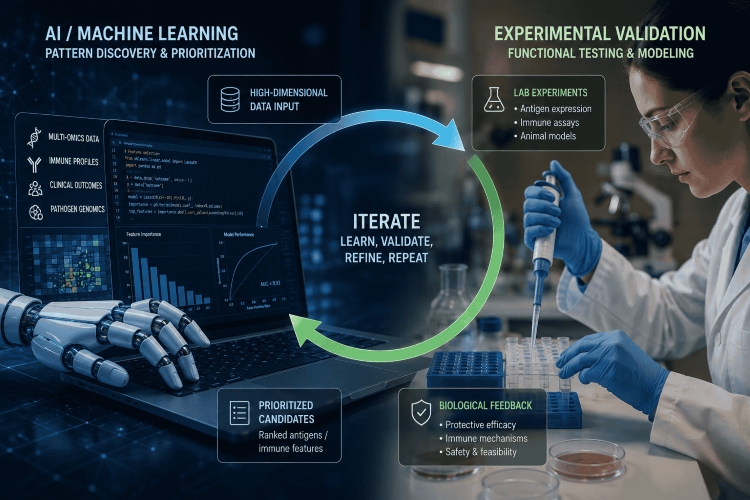
The closed experimental loop: computational models prioritise candidates, laboratory testing validates them, and the results refine the next round of predictions.
Future target-selection platforms may increasingly integrate pathogen sequence diversity, structural accessibility, antigen expression during infection, B- and T-cell recognition, immune-function measurements, host genetics and clinical outcomes. More advanced models may help uncover nonlinear interactions among these layers.
The central challenge in next-generation vaccine discovery is not finding the model capable of processing the most data. It is designing a workflow in which computation and experimentation continually challenge and improve one another.
AI will not independently discover the next successful vaccine antigen. What it can do is narrow a vast and noisy search space, identify unexpected patterns and direct limited experimental resources toward the candidates with the strongest combined evidence.
That is where its immediate value lies: not in replacing scientific judgment, but in making that judgment more informed, systematic and testable.
Author Bio