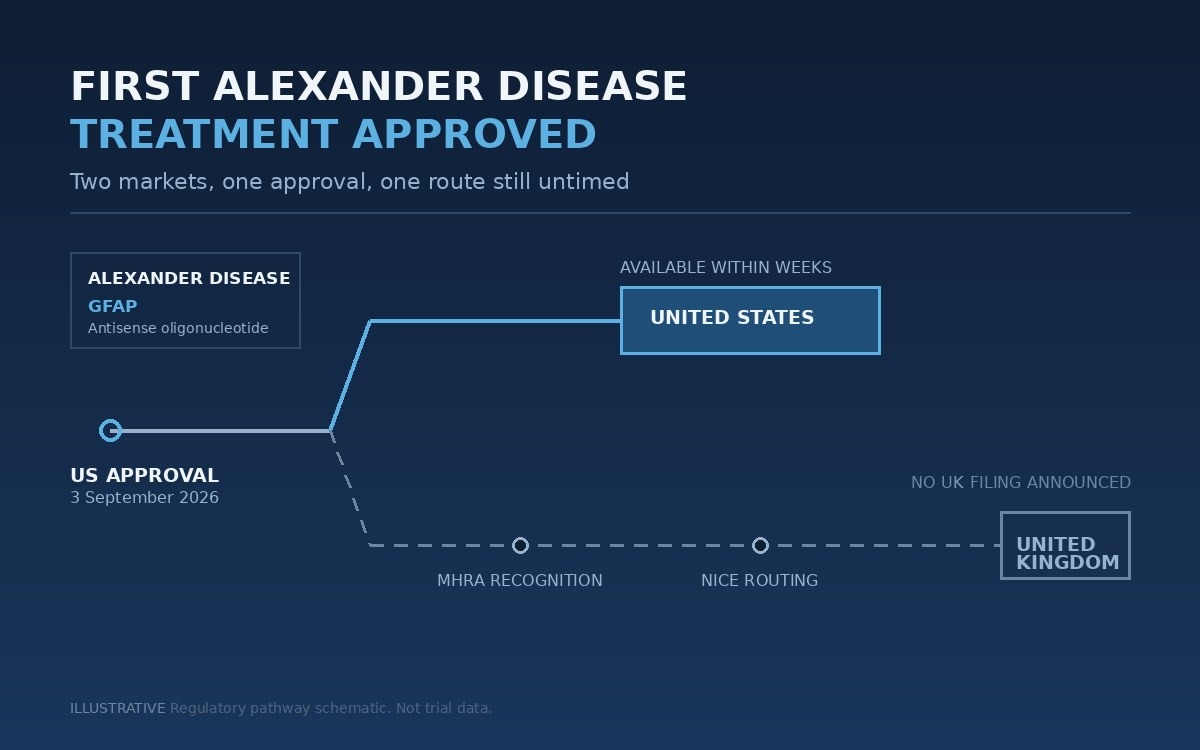
The United States Food and Drug Administration has approved the first Alexander disease treatment. Zanvastro (zilganersen) was cleared on 3 September 2026 for paediatric and adult patients. Ionis Pharmaceuticals developed the antisense oligonucleotide. The decision arrived 19 days ahead of the 22 September action date. For UK readers, the sharper question is what reaches patients here, and when.
What the FDA approved
Zanvastro reduces production of glial fibrillary acidic protein, known as GFAP. Mutations in the GFAP gene cause Alexander disease. The protein accumulates in astrocytes and damages surrounding brain tissue. Dosing is 50 mg by intrathecal injection every 12 weeks. It uses the same drug class as Biogen’s tau candidate diranersen, which reported cognitive benefit in July.
The first Alexander disease treatment covers a condition with very different clinical courses. GeneReviews records neonatal, infantile, juvenile and adult onset forms. Infantile onset accounts for 42 per cent of reported cases. Adult onset accounts for 33 per cent and juvenile onset for 22 per cent. Prognosis varies sharply between them. The neonatal form is typically fatal within two years.
Emily Freilich, Director of the Division of Neurology I at CDER, set out the gap. She said families had faced “no approved treatment options, only supportive care while the disease progresses”. The quote comes from the FDA announcement of 3 September.
The agency had granted orphan drug, fast track, breakthrough therapy and rare paediatric disease designations. The application was cleared under priority review. Ionis also received a rare paediatric disease priority review voucher on approval.
The evidence behind the Alexander disease treatment
The registrational package is small, as ultra-rare packages usually are. Ionis describes NCT04849741 as a Phase 1-3 multiple ascending dose study. The FDA describes a multicentre randomised controlled study of 49 patients aged two years and over. An open-label substudy covered four further patients under two years old. Ionis describes 54 participants aged 1.5 to 53 years, across 13 sites in eight countries.
Participants were randomised 2:1 to zilganersen or control for 60 weeks. Two dose cohorts were studied, at 25 mg and 50 mg. The 50 mg cohort supplied the pivotal analysis.
The primary endpoint was percentage change from baseline in gait speed. It used the 10-Meter Walk Test (10MWT) at week 61, in patients aged five and over. Ionis reported a least squares mean difference of 33.3 per cent (p=0.041). The company frames that result as stabilisation rather than recovered function.
Among children aged two to four, a broader motor measure favoured treatment. Ionis reported a 22.9 point difference on the Gross Motor Function Measure-88. That p value was nominal, at 0.034. Plasma GFAP fell 33.6 per cent at week 61, also on a nominal p value.
What the topline does not settle
Patient-reported secondaries were mixed rather than uniform. On the Most Bothersome Symptom measure, 32 per cent on zilganersen rated themselves much better. No control patient did. However, 5 per cent on zilganersen rated themselves much worse, against 31 per cent on control.
The Patient Global Impression of Severity margin was narrow. Improvement or no change was reported by 83 per cent on treatment and 76 per cent on control.
Ionis reports that most adverse events were mild or moderate in severity. Serious treatment-emergent events occurred in 37.5 per cent of treated patients. The pooled control figure was 47.1 per cent.
The published label for the Alexander disease treatment carries a warning for aseptic meningitis. One patient had a serious case that recurred in the open-label extension period. That patient needed a dose interruption and intravenous dexamethasone pretreatment. Cerebrospinal fluid white cell and protein levels still rose with continued exposure. The patient remained asymptomatic and did not stop treatment. The FDA lists vomiting, back pain, cough, headache and post-lumbar puncture syndrome as common reactions.
Why the UK route runs through Recordati
Ionis does not hold commercial rights outside the United States. It licensed zilganersen to Recordati on 25 June 2026 for all other countries. Recordati paid 30 million dollars upfront. The agreement carries milestones and tiered royalties up to the mid-20 per cent range. Recordati took responsibility for regulatory filings and commercialisation outside the US. That includes support for country-specific early access pathways.
The UK filing decision therefore sits with an Italian rare disease specialist, not with Ionis. Ionis says the two companies are preparing submissions in Europe and Japan, expected in 2027. Neither company has named the UK. LSDN found no announced MHRA submission as at 6 September 2026. The EMA granted zilganersen orphan drug designation in 2019.
A US approval does shorten the theoretical UK path for the first Alexander disease treatment. The FDA is one of seven Reference Regulators under the MHRA International Recognition Procedure. Recognition A runs to a 60-day timetable with no clock stop. It applies where the reference regulator approved the product within the previous two years. Zanvastro meets that condition until 3 September 2028.
A patient population in dispute
Sizing the UK opportunity is harder than the headline suggests. GeneReviews records a single population-based prevalence estimate for Alexander disease. That figure is one in 2.7 million.
A UK Biobank analysis complicates it. Gagliardi and colleagues found 106 carriers of pathogenic or likely pathogenic GFAP variants. The cohort covered roughly 470,000 participants, a carrier frequency near one in 4,435. Modelling on the UK population produced an estimated prevalence of 6.8 per 100,000. The paper is framed around adult onset disease in particular. The authors attribute the gap to underdiagnosis or to incomplete penetrance. They do not choose between the two explanations.
That distinction is not academic in England. NICE routes ultra-rare technologies through its Highly Specialised Technologies programme. The routing criteria have applied since 1 April 2025. They require a point prevalence of one in 50,000 or less in England. They also require that no more than 300 people in England are eligible.
The classical estimate sits comfortably inside both thresholds. The modelled UK Biobank prevalence of 6.8 per 100,000 does not clear the first. Which epidemiology a submission relies on would shape how an Alexander disease treatment is routed. LSDN found no published NICE position on Alexander disease as at 6 September 2026.
Diagnosis, not supply, may prove the binding constraint. The pattern is familiar from other inherited neurological conditions, where treatments arrived before diagnostic pathways caught up.
The commercial picture
Ionis has now put a price on the first Alexander disease treatment. Kyle Jenne, chief global product strategy officer, gave the figure on a company call on 4 September. The list price is 285,000 dollars per dose. At quarterly dosing that is about 1.14 million dollars a year, before rebates or discounts. Jenne also put the US patient population at around 300 people.
Zanvastro is the company’s first commercial product from its own neurology pipeline. Brett Monia, chief executive of Ionis, called it “our first independent launch” from that pipeline. The company says Zanvastro will be available in the United States in the coming weeks.
Analyst views diverge on what that supports. William Blair estimated peak global sales of 295 million dollars in April, before approval. After approval the firm modelled 160 million dollars in peak US sales in 2040. Its analyst called the price higher than expected but did not expect payer resistance.
H.C. Wainwright reiterated a Buy rating and a 115 dollar price target, as reported by Investing.com. The firm raised its probability of approval to 100 per cent from 75 per cent. These are single-source analyst views rather than company guidance.
The priority review voucher may be the more liquid asset here. Congress set the programme’s sunset at 30 September 2029. The FDA records that provision in the Consolidated Appropriations Act, 2026, enacted on 3 February 2026. Vouchers have historically changed hands above 100 million dollars.
What to watch next
Three things will decide whether the first Alexander disease treatment reaches UK patients. The first is a Recordati filing, and which recognition route it takes. The second is whether the epidemiology settles before any NICE submission. The third is whether the NHS can absorb a price set at US levels.
One point of continuity is worth noting. Amy Waldman, the pivotal study’s lead investigator at Children’s Hospital of Philadelphia, co-authors the GeneReviews chapter on the disease. The same small clinical community that described Alexander disease has now delivered its first therapy. Whether UK patients see it depends on decisions taken in Milan and London.