Two B7-H3 ADC readouts landed in the same Seoul session on 13 September 2026. Both reported a survival win in relapsed small cell lung cancer. Both trials ran entirely in China. Neither dataset, on its own, is a filing package for the FDA, the EMA or the MHRA.
Two B7-H3 ADC trials report on the same day
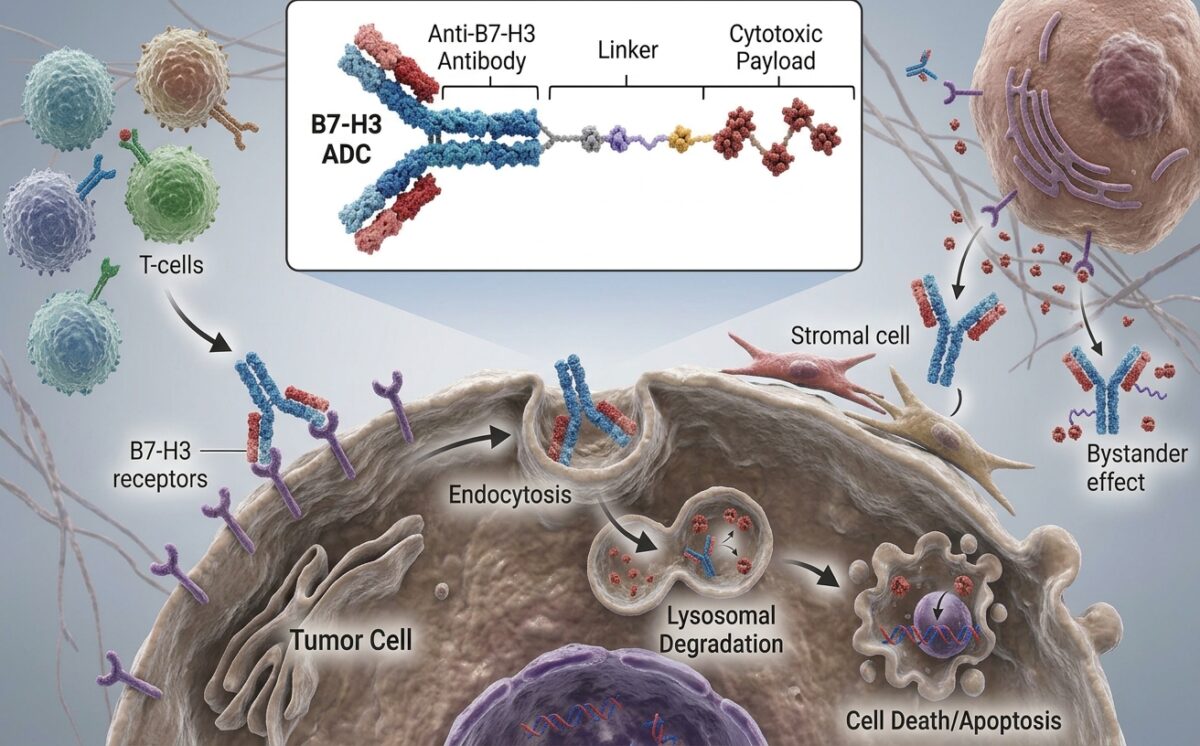
The IASLC World Conference on Lung Cancer ran in Seoul from 12 to 15 September 2026. Hansoh Pharmaceutical presented the Phase III ARTEMIS-008 study of risvutatug rezetecan, known as Ris-Rez. MediLink Therapeutics presented the Phase III TAISHAN-302 study of tambotatug pelitecan, known as Tam-Peli. Both compounds target B7-H3, and both were compared against topotecan. GSK holds the Ris-Rez rights outside Greater China. It issued a stock exchange announcement on 14 September 2026.
The two B7-H3 ADC programmes reached Seoul by the same commercial route. GSK licensed Ris-Rez from Hansoh in 2023 for 185 million US dollars upfront. Roche licensed Tam-Peli from MediLink in January 2026. In each case the Chinese originator kept the home market and ran the pivotal study. That pattern now shapes much of the Western oncology pipeline. LSDN examined it in its analysis of Asia’s shift from pharma’s factory to its source.
What ARTEMIS-008 reported
ARTEMIS-008 randomised 461 patients in China on a one to one basis. Patients had limited or extensive stage disease that progressed after first-line platinum therapy. More than 80 per cent had already received a PD-(L)1 inhibitor. Ris-Rez was given at 8.0 mg/kg every three weeks. Topotecan was given at 1.2 mg/m2 on days one to five of each 21 day cycle.
Median overall survival reached 18.5 months on Ris-Rez against 10.3 months on topotecan. The hazard ratio was 0.46, on a 95 per cent confidence interval of 0.35 to 0.62. The p value fell below 0.0001. Median progression-free survival was 7.2 months against 3.0 months. The objective response rate was 58.3 per cent against 12.6 per cent. Median follow-up was 12.2 months at a data cutoff of 6 June 2026.
GSK and Hansoh announced the ARTEMIS-008 topline on 10 July 2026. Seoul supplied the figures behind it. Professor Jie Wang presented the data in the Presidential Symposium. He chairs medical oncology at the National Cancer Center of the Chinese Academy of Medical Sciences. He is also the principal investigator of ARTEMIS-008. Hansoh published the interim results in full on the same day.
What TAISHAN-302 reported
TAISHAN-302 enrolled 451 patients across 85 sites in China. Tam-Peli was dosed at 2.0 mg/kg every three weeks, capped at 200 mg. Median overall survival reached 13.3 months against 9.4 months on topotecan. The hazard ratio was also 0.46, on a confidence interval of 0.35 to 0.62. Median progression-free survival was 7.4 months against 2.8 months. That gave a hazard ratio of 0.29.
The objective response rate was 59.1 per cent against 9.7 per cent. Data cutoff was 20 May 2026 and median follow-up was 9.4 months. Roche reported the result through its own media channel. It said the paper published simultaneously in the New England Journal of Medicine. Crossref dates that paper to 12 September 2026, with Yuanyuan Zhao as first author.
Two companies, two claims to a first
Hesham Abdullah is Senior Vice President and Global Head of Oncology R&D at GSK. He called it the first Phase III overall survival data for a B7-H3 ADC. GSK applies that claim across every tumour type. The wording is narrower than it first reads, and the narrowness matters.
MediLink had already claimed a different first. In May 2026 it reported the Phase 3 TAISHAN-301 study in nasopharyngeal carcinoma. MediLink called that the first positive Phase 3 result worldwide for any B7-H3 ADC. That study met a confirmed response rate endpoint rather than a survival endpoint. China’s Center for Drug Evaluation accepted the resulting application on 18 July 2026. LSDN reports both claims as made and takes no position on either.
Safety was reported unevenly across the two releases
Grade 3 or higher treatment-related events hit 60.9 per cent of Ris-Rez patients. The topotecan arm recorded 78.2 per cent. The most common events were haematological. They included reduced neutrophils, white cells, lymphocytes and platelets, plus anaemia. Hansoh described interstitial lung disease as mostly grade 1 or 2. It said no grade 4 or fatal cases occurred. It published no incidence rate for the event.
MediLink did publish one. Interstitial lung disease or pneumonitis of any grade affected 4.9 per cent of Tam-Peli patients. The topotecan arm recorded 1.4 per cent. Grade 3 events ran at 0.9 per cent in each arm, with no grade 4 or 5 cases. Grade 3 or higher treatment-related events affected 46.4 per cent against 74.7 per cent. MediLink reported no treatment-related deaths in the Tam-Peli arm.
Only one of the two B7-H3 ADC releases therefore carries a quantified lung toxicity rate. LSDN draws no inference from that gap and found no explanation for it. Readers should also note that the two studies were separate. Their adverse event rates were never designed to be compared with one another.
Why a China-only dataset is not a filing package
The FDA set out its expectations in a draft guidance issued in September 2024. It is titled Considerations for Generating Clinical Evidence from Oncology Multiregional Clinical Development Programs. Richard Pazdur directs the FDA Oncology Center of Excellence. He framed the purpose as ensuring that multiregional trial data apply to US patients. The agency notes that foreign data may not support a regulatory decision. That risk rises where trial populations differ materially from the US population.
GSK appears to have read the room. Its own announcement headline places the result in China. Its global Phase III study, EMBOLD SCLC-301, carries the identifier NCT07099898. That study covers late-line extensive stage disease, and GSK says pivotal data are expected next year. GSK also says more than 1,000 patients have now received Ris-Rez across the programme.
Roche sits further back in the same race. Levi Garraway is its Chief Medical Officer and Head of Global Product Development. He said the data support plans to start global Phase III trials quickly. As at 14 September 2026, LSDN found no named or registered Roche global study for Tam-Peli. Ris-Rez, by contrast, holds FDA breakthrough therapy designation in relapsed or refractory disease. It also carries EMA PRIME and orphan designations.
The comparator England barely funds
Both B7-H3 ADC trials measured their benefit against topotecan. England funds that drug narrowly. NICE technology appraisal TA184 recommends oral topotecan only where two conditions are met. Re-treatment with the first-line regimen must be inappropriate. The combination of cyclophosphamide, doxorubicin and vincristine must also be contraindicated. The same appraisal does not recommend the intravenous formulation.
ARTEMIS-008 used an intravenous topotecan schedule. The Roche release does not specify the route used in TAISHAN-302. A survival gain over intravenous topotecan therefore does not translate cleanly into an English pathway. That is an LSDN observation about the comparator. It is not a NICE position on either new medicine.
NICE has already turned down one small cell innovation
Amgen announced a UK conditional marketing authorisation for the DLL3 bispecific tarlatamab in January 2025. The authorisation covers third-line use. NICE then published technology appraisal TA1091 on 20 August 2025. Its recommendation is blunt. Tarlatamab should not be used for extensive stage small cell lung cancer, it says. The population covered is disease progressing after two or more lines, including platinum chemotherapy.
The same appraisal describes the English pathway plainly. Second-line options are the CAV combination or topotecan. Beyond two lines, the committee recorded that no treatments are approved. Cancer Research UK counts around 50,200 new lung cancer cases a year in the UK. Amgen puts small cell disease at roughly 15 per cent of lung cancers. That arithmetic implies somewhere near 7,500 UK cases a year.
What the B7-H3 ADC class has and has not proved
Biological risk in the B7-H3 ADC class has fallen sharply in one morning. Two independent Phase III studies, on two different molecules, produced the same hazard ratio for death. That is a strong signal in a tumour type with almost no second-line progress in decades. It also supports the licensing thesis behind GSK’s Nuvalent acquisition and its lung cancer strategy.
GSK also has a second Phase III hit on the same target. Hansoh reported on 28 July 2026 that ARTEMIS-011 met its progression-free survival endpoint. That study ran in relapsed osteosarcoma after at least two prior lines. No figures were released. The class case therefore rests on more than one tumour type, and still on Chinese trials.
Geographic and health-economic risk has not fallen at all. Three things are now worth watching closely. First, the EMBOLD SCLC-301 readout expected in 2027. Second, whether Roche names and starts a global study. Third, whether either B7-H3 ADC sponsor tests a regulator’s appetite for Chinese data alone. Until a reference regulator acts, the MHRA International Recognition Procedure has nothing to recognise.
There is a market footnote. GSK shares traded higher in London on the morning of 14 September 2026, on a single trade report. GSK released two positive lung cancer datasets that same morning. LSDN therefore publishes the direction of the move only. It attributes no part of that move to either result.