At first glance, the EU’s updated rules on fragrance allergens seem straightforward. More ingredients need to be listed on cosmetic labels. For formulators and brands, though, the real work begins long before the label is printed. It starts with supplier data, runs through some unforgiving arithmetic, and in some cases ends with changes to the formula itself. It also reaches beyond cosmetics, into the chemistry of contact allergy and the rules for topical medicines. This piece covers what the rule requires, why tiny thresholds make it a formulation question, and where it meets the wider life sciences.
What changed, and when
Under the EU Cosmetics Regulation, (EC) No 1223/2009, a perfume blend can appear on the ingredient list as a single word, “parfum” or “aroma”. The exception is the group of fragrance substances listed in Annex III, which must be named individually once they pass a set level [1]. After the Scientific Committee on Consumer Safety (SCCS) found that many more fragrance substances can sensitise people [2], Commission Regulation (EU) 2023/1545 added 56 entries to that group [3].
The count needs a moment’s care, because two different numbers circulate. Annex III now carries 80 entries for fragrance allergens requiring individual labelling: 24 that were already listed, plus the 56 new ones [4]. The SCCS, working from clinical experience, identified 82 substances as established contact allergens in humans, made up of 54 individual chemicals and 28 natural extracts [2]. Neither figure is an error. Two of the original 26, hydroxyisohexyl 3-cyclohexene carboxaldehyde (HICC) and butylphenyl methylpropional (Lilial), were banned outright, for their sensitising and reprotoxic properties respectively, and moved to Annex II [1][4]. They no longer carry a labelling entry at all. Several entries also cover groups of related materials, natural extracts above all, so the two counts are not directly interchangeable [4]. A supplier declaration is safest when it covers the full SCCS list of 82 substances rather than what remains of the old 26.
The thresholds did not change: 0.001% in leave-on products such as creams and perfumes, and 0.01% in rinse-off products such as shampoos. Both apply to the finished product, not to the fragrance concentrate [3][5].
Since 31 July 2026, products placed on the EU market must carry the updated labelling. Units placed on the market before that date may be sold until 31 July 2028 [3][5]. The rule applies to each individual unit, not to a product line, so an old formula gains no exemption. A unit counts as placed on the market when it is first made available in the EU, so stock that has not yet left the manufacturer’s or importer’s hands does not qualify for the transition [6].
Why the arithmetic decides everything
The allergen level in a product is the fragrance dose multiplied by the allergen’s share of the fragrance. With thresholds this low, small shifts matter.
Take a face cream with 1% fragrance, where one allergen makes up 0.1% of the blend. The allergen sits at exactly 0.001%, on the leave-on line, so it does not need naming. Raise its share to 0.15% and it reaches 0.0015%, which does. A perfumer who nudges one material up, or a brand that raises the dose for a stronger scent, can cross the line without adding a single new ingredient. A shower gel with 1.5% fragrance and 0.5% of an allergen lands at 0.0075%, under the rinse-off threshold. At 2% fragrance and 0.6%, it reaches 0.012%, over it.
Fine fragrance is the extreme case. At a 15% dose, an allergen needs to make up only about 0.007% of the concentrate, roughly 70 parts per million, to reach the threshold. For most perfumes, the question is not whether allergens will appear on the label, but how many.
Allergens do not only come from the perfume
Essential oils and plant extracts contain many of the same molecules used in perfumery, so a product with no added “parfum” can still need allergen declarations [3][5]. A brand that adds a botanical for its marketing story may have to declare what that botanical brings with it.
All sources count together. If the fragrance contributes 0.0006% of an allergen and a botanical oil adds another 0.0006%, the total of 0.0012% must be declared, even though neither ingredient crosses the line alone. This is easy to miss when each supplier’s data sits in a separate file.
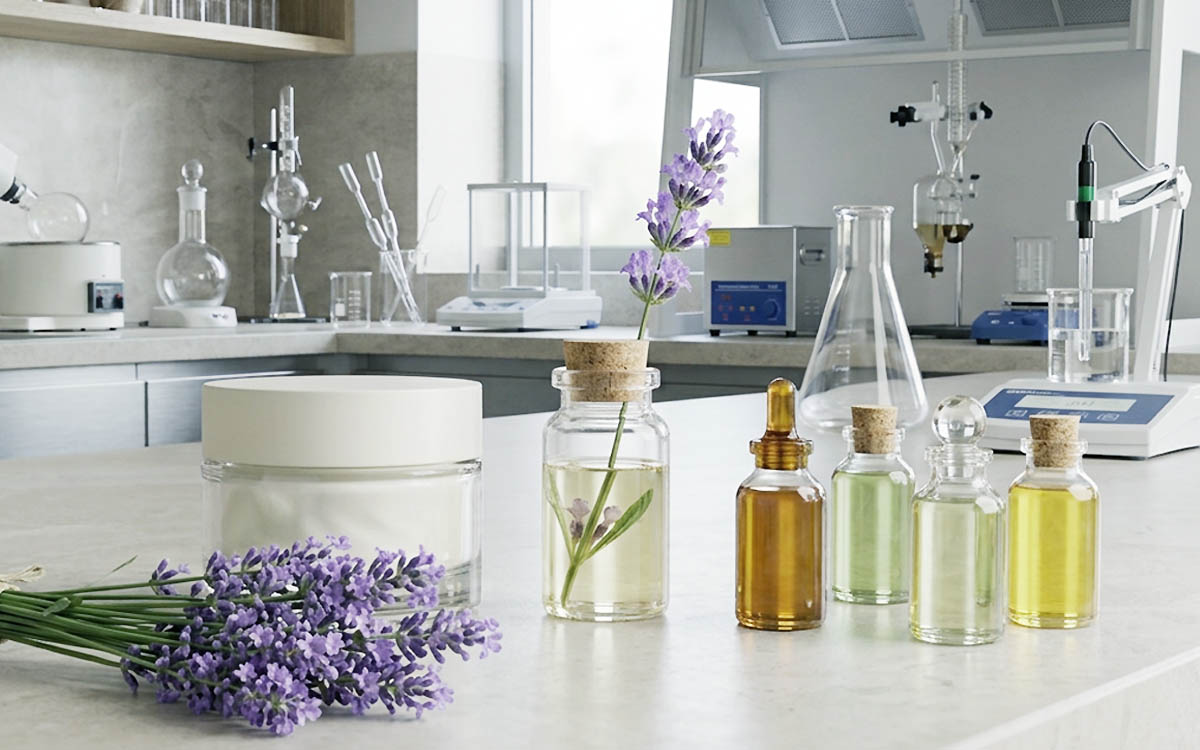
Natural materials also vary. Lavender oil from one harvest differs from the next, shaped by growing conditions and processing. A label must hold true for every unit filled, so brands need maximum values from suppliers, not typical ones. AGES, the Austrian health and food safety agency, uses lavender as its worked example: where Lavandula hybrida oil is used at 1.3% in the finished product and linalool makes up 45% of that oil, linalool alone lands at 0.585%, well above either threshold, so both the oil and the linalool must be named [4].
The link to medicines, and the science behind the list
Topical medicines work to a zero threshold
Fragrance allergens are not only a cosmetics problem. The same materials appear as excipients in topical medicines, such as ointments, creams and gels, and European Medicines Agency guidance treats them more strictly, not less. If the allergen is present at all, the leaflet must say so, in the form “This medicine contains fragrance with <allergen(s)>. <Allergen(s)> may cause allergic reactions” [7][8]. The European Commission guideline on excipients in the package leaflet sets a threshold of zero for “fragrances containing allergens” in topical medicines [7].
The reasoning is about skin, not dose. Topical medicines may be applied to damaged or diseased skin, which is more permeable and more readily sensitised, so the committee argued that a cosmetic-style cut-off was the wrong instrument [8]. Set the two regimes side by side. In a leave-on cosmetic, an allergen can sit at up to 10 parts per million before it must be named [3]. In a topical medicine, the threshold is zero, and any amount triggers the leaflet statement [7].
That comparison, and the longer cosmetics list behind it, matters for two practical reasons. First, the medicines annex still prints the original list of 26 and cross-refers to Annex III, with a note that readers must check whether Annex III has since been amended, because any amendment applies to the excipients guideline as well [7]. In principle, the 56 additions therefore reach topical medicines too. Teams working from an older copy of the annex may not have revisited their fragrance declarations. Second, many of the additions are natural extracts and their constituents rather than synthetic perfume materials [3]. A topical product that uses a botanical oil for its own sake, and is never described as fragranced, may still need its declarations checked against the guidance. For a supplier serving both sectors, a single dossier characterised against the full list can answer the cosmetic and the pharmaceutical question together.
Why linalool and limonene count as allergens at all
The other reason these substances are on the list is chemistry rather than policy. Linalool and limonene are modest sensitisers as sold. They become potent ones on exposure to air. Oxidation produces hydroperoxides, and these degradation products behave as strong sensitisers in predictive animal tests and provoke frequent reactions in dermatitis patients [2][9]. The SCCS calls such materials prehaptens, substances that acquire sensitising properties outside the body, and takes the view that they should be treated as equivalent to known contact allergens [2][9]. This is why it rates linalool and limonene as established contact allergens, with the evidence stronger for their oxidised forms than for the pure substances [2]. A specification sheet that reports only the parent molecule can therefore be correct and misleading at the same time.
For a formulator, this moves the question from the fragrance oil to the container. Antioxidant status, peroxide value, headspace, how long a cream sits in a warm warehouse and how often a jar is opened all bear on how much oxidised material a consumer actually meets. For anyone writing the dossier, ask suppliers about stabilisation alongside percentages, and treat an older batch of oil as a different material from a fresh one.
What good supplier data looks like
Two documents are often confused. An IFRA certificate confirms that a fragrance complies with IFRA usage standards. An allergen declaration breaks the material down against the listed substances so that levels can be calculated [6]. Older declarations on fragrance allergens may cover only the original 26. Current labelling needs all 80 entries, and asking for all 82 substances the SCCS identified is the safer brief [2][4].
Brands should ask suppliers, in writing [10]:
-
Does the declaration cover the full list, all 80 Annex III entries, ideally all 82 substances the SCCS identified?
-
Are the figures maximum values or typical values?
-
Does the data apply to the exact grade being purchased?
-
Will the supplier send an update if the composition changes?
For products rich in essential oils or herbal extracts, testing the finished product, usually by gas chromatography with mass spectrometry, confirms what is actually present. It costs money, but far less than relabelling stock.
Declare or reformulate
Each allergen above the threshold leaves two options. Naming it keeps the formula and the scent intact, but lengthens the ingredient list and can unsettle shoppers. Bringing the level down keeps the label short, but means a lower dose or a reworked fragrance, and a scent that loses a few materials rarely smells the same. Many brands do both, reformulating where a small change clears the threshold and declaring where the scent cannot be touched.
Either way, the paperwork follows. The product information file (Article 11) should hold the new supplier data and calculations, and the safety report (Article 10) should reflect the real composition [1]. The CPNP notification filed under Article 13 is a separate question, and a commonly misunderstood one. The obligation is to update the notification without delay when the information filed under Article 13 changes, and the names printed in the ingredient list are not among that information [1][11]. A product that gains a few allergens on pack and nothing else does not need to be notified again [11]. A reformulation that alters the frame formulation does, so that is the trigger to watch [11]. None of this is difficult, but each step needs an owner, and each depends on the supplier data arriving first.
What a name on the label means
For shoppers, a named allergen is information, not a warning. Fragrance allergy usually develops through repeated skin contact, and the label lets people who already know their trigger avoid it. Every product still needs a safety assessment before sale [1].
Until July 2028, identical formulas can carry different labels depending on when each unit was placed on the market [3][5]. A missing allergen name on an older unit does not prove the substance is absent. Anyone with a known fragrance allergy should keep that in mind during the transition, and check with the brand when unsure.
The new names on the pack are the visible part of this rule. The real work sits in the specification sheet, the dose calculation and, increasingly, the stability of the oils themselves.
Author Bio