

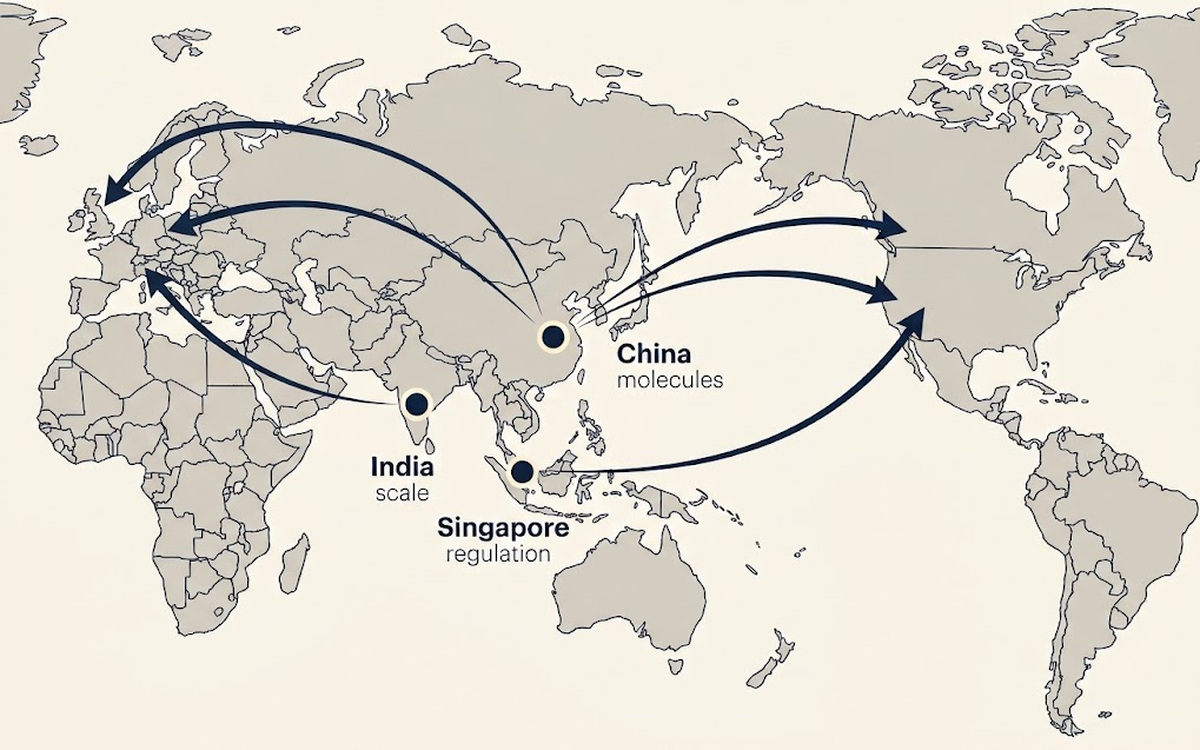
APAC biopharma has stopped being a cost line in somebody else’s budget. For two decades the region supplied ingredients, capacity and inexpensive trial sites. The companies that used them were headquartered elsewhere. That relationship has now inverted.
The clearest single marker came on 30 January 2026. AstraZeneca agreed to pay CSPC Pharmaceutical Group up to $18.5 billion for eight obesity and type 2 diabetes programmes, taking exclusive rights outside Greater China. The molecules were Chinese. So was the once-monthly delivery platform. So was the artificial intelligence used to design them. AstraZeneca bought the science, not the factory slot.
That transaction sits inside a much wider pattern. Chinese biotechs signed roughly $60 billion in cross-border out-licensing deals in the first quarter of 2026 alone. The figure comes from China’s National Medical Products Administration. China now registers more drug trials each year than the United States. India has committed public money to biologics rather than generics. Singapore has become the region’s specialist manufacturing and regulatory anchor.
The organising thesis here is straightforward. Asia has moved from being the industry’s factory floor to being a principal source of drugs, capital and clinical data. Each major market embodies a different part of that shift. What follows sets out how, country by country, and what it means for Western companies.
China: from fast follower to first mover
China is the clearest expression of the APAC biopharma transition. The change there is both the fastest and the best documented.
Start with volume. China listed more than 7,100 clinical drug trials in 2024. The United States listed roughly 6,000. Those figures come from World Health Organization registry data compiled by the Information Technology and Innovation Foundation. The gap has widened since.
Speed matters as much as scale. McKinsey analysis published in early 2026 found Chinese patient recruitment running two to five times faster than US and EU benchmarks in late-stage development. The consultancy credited a dense contract research ecosystem, well-resourced sites and a deep clinical talent pool. Discovery programmes also run at roughly one-third to one-half of global development costs.
The character of the work has changed too. A decade ago Chinese activity was dominated by generics and biosimilars. Today the country’s biotechs originate first-in-class candidates. Antibody-drug conjugates, bispecific antibodies and metabolic disease are the strongest areas. We have covered the trial-volume reversal and what it signals for global development capacity.
Policy has followed the science. On 15 May 2026 the NMPA issued its Implementation Measures for Drug Trial Data Protection. Jones Day describes the instrument as establishing a tiered regulatory data protection regime, formalising a framework that had existed only in outline since 2002. Innovative drugs receive six years of protection. Improved drugs receive four years. Qualifying first generics receive three. Imported and domestically manufactured products are treated equally.
The revised Implementing Regulations of the Drug Administration Law, promulgated by the State Council on 27 January 2026 and effective from the same date as the Measures, went further. They introduced statutory market exclusivity of up to seven years for orphan drugs. Paediatric medicines received up to two years.
That matters commercially. Domestic innovators can now layer administrative exclusivity on top of patent protection. The effect is to raise the underlying value of a Chinese-origin asset. Our earlier analysis of China’s data exclusivity and IP reforms set out the scenarios that have since played out.
Deal flow reflects all of it. Cross-border out-licensing by Greater China companies reached a record $137.7 billion in 2025, according to data provider PharmCube. That was nearly ten times the 2021 total. The NMPA put the first quarter of 2026 alone at about $60 billion, a rise of roughly 73% year on year. Tom Barsha, head of Asia Pacific mergers and acquisitions at BofA Securities, told Reuters that total licensing-out value was on track to double again. He put the timeframe at 18 to 24 months.
The AstraZeneca agreement with CSPC remains the largest single example, and our breakdown of the $18.5 billion China obesity deal sets out the terms in full. The agreement followed a separate AstraZeneca commitment to invest $15 billion in China through 2030. On the evidence of the past 12 months, the Chinese biotech sector shows little sign of slowing.
Capital has followed execution. The Hang Seng Biotech Index rose more than 64% during 2025, against roughly 28% for the broader Hang Seng Index. Sovereign wealth funds from Singapore and Abu Dhabi have joined Chinese state capital in the sector. The money is no longer only Western money chasing Asian assets.
Balance is warranted. In August 2026 STAT reported growing scrutiny of investigator-initiated trials, following two undisclosed paediatric deaths in Chinese gene-editing studies. Those studies have long driven Chinese research throughput. Questions have been raised about patient safety and transparency. Regulators are now tightening a system that partly explains the speed advantage. Foreign sponsors should expect data-quality diligence to become harder, not easier.
India: scale advantage moves up the value chain
India embodies a different part of the APAC biopharma shift. Its advantage was never speed. It was scale, cost and regulatory familiarity with Western markets.
The country supplies around a fifth of the world’s generic medicines by volume. It is also the third-largest producer of active pharmaceutical ingredients, holding roughly 8% of the global API market. Those figures come from the India Brand Equity Foundation. The base is not going anywhere. What has changed is the ambition built on top of it.
The Union Budget for 2026-27 proposed Biopharma SHAKTI. The programme carries an outlay of ₹10,000 crore, about $1.1 billion, over five years. Its purpose is domestic capability in biologics and biosimilars rather than small-molecule generics. The scheme funds three new National Institutes of Pharmaceutical Education and Research. Seven existing institutes will be upgraded. A network of more than 1,000 accredited clinical trial sites is planned. The Central Drugs Standard Control Organisation gains a dedicated scientific review cadre.
Commercial evidence points the same way. In April 2026 Sun Pharmaceutical Industries agreed to acquire New Jersey-based Organon. The all-cash transaction was valued at $11.75 billion and is expected to close in early 2027. Sun Pharma describes it as the largest acquisition ever made by an Indian biopharmaceutical company. Indian firms are now buyers of Western assets, not only suppliers to Western buyers.
Capability is deepening alongside scale. Biocon has built a global biosimilars business with products approved in the United States and Europe. Divi’s Laboratories and Laurus Labs anchor complex API manufacturing. India’s domestic pharmaceutical market carries an upgraded 2026 growth forecast of 11.3%, on industry estimates.
The wider numbers are substantial. India’s bioeconomy reached about $165.7 billion in 2024. The Economic Survey for 2025-26 put annual sector turnover at ₹4.72 lakh crore in the last financial year, across more than 10,500 manufacturing units.
Constraints remain, and honesty about them matters. India’s biologics infrastructure is thinner than its small-molecule base. Discovery-stage output lags China by a wide margin. Regulatory timelines, though improving, still trail Singapore and the more mature APAC biopharma jurisdictions. Biopharma SHAKTI is a response to those gaps rather than proof they have closed, and its outlay is spread across five years from the 2026-27 financial year.
Singapore: the region’s APAC biopharma specialist hub
Singapore plays a third role. It is small and expensive, and it cannot compete on volume. It competes instead on regulatory credibility, advanced modalities and access.
The scale of state commitment is unusual. Singapore’s Research, Innovation and Enterprise 2030 plan commits S$37 billion to science and technology development, a 32% increase on its predecessor. Health and biomedical sciences form a core pillar. The Economic Development Board puts biomedical manufacturing output at S$38.1 billion in 2023 and over S$32 billion in 2024. The country hosts regional headquarters for more than 80 leading companies. It also has 60 manufacturing plants and 30 research centres.
Regulatory standing underpins the position. The Health Sciences Authority achieved Maturity Level 4 in the World Health Organization’s assessment framework. That is the highest available rating for a medicines regulator. For a multinational choosing where to anchor an Asian filing strategy, the designation carries real weight.
Capability has moved decisively towards complex modalities. AstraZeneca is building a US$1.5 billion antibody-drug conjugate facility, announced in 2024 and due to be operational by 2029. Novartis expanded its biologics site at a cost of US$256 million. WuXi Biologics committed US$1.4 billion over ten years. The Economic Development Board reports that the biopharmaceutical manufacturing talent pool has grown by 55% in a decade, reaching around 9,500 professionals. Radiopharmaceuticals have become a further specialism, with new imaging infrastructure and a heavier regulatory calendar shaping the second half of 2026.
Computational capability is being built alongside the plant. Singapore’s National AI Strategy commits S$120 million to an AI for Science programme and aims to triple the local AI talent pool to 15,000. Eli Lilly and MSD have both anchored digital hubs in the country.
Singapore also functions as the gateway into APAC biopharma. Flagship Pioneering and MPM BioImpact have established regional hubs there. Chinese companies increasingly use it as an international base. In April 2026 Everest Medicines agreed to acquire Singapore-headquartered Hasten Biopharmaceuticals (SG) for $250 million, in a transaction still subject to closing conditions. Our profile of Singapore’s rise as a life science powerhouse covers that dual role in more depth.
Physical infrastructure supports the specialism. Tuas Biomedical Park handles commercial manufacturing, while Biopolis concentrates research tenants. Sponsors frequently use a Singapore filing as the reference point for wider regional submissions, which shortens sequencing across APAC biopharma markets.
The picture is not uniformly positive. BioNTech confirmed on 31 March 2026 that it will close its Singapore manufacturing site by the end of February 2027, affecting 85 staff. MSD announced the closure of one of its own Tuas sites in March 2026. High-cost hubs remain exposed when demand shifts.
The next tier: Southeast Asia and beyond
Beneath the three anchor markets sits a broadening second tier. This is where APAC biopharma capacity is diversifying fastest.
Malaysia, Thailand and Singapore are members of the Pharmaceutical Inspection Co-operation Scheme. That membership matters for sponsors assessing inspection standards, and it is one of the clearer markers separating the second tier from the rest of the region.
Vietnam is the more interesting recent entrant. Its population of more than 100 million offers treatment-naive patients in oncology and infectious disease. Competing-trial density is lower than in Thailand, South Korea or India. Enrolment of two to four patients per site per month is achievable in common solid tumour indications. Regulatory timelines remain slower than Thailand or Malaysia. Sponsors therefore tend to pair Vietnam with a faster-approving anchor country.
The wider regional market is growing steadily. Market research estimates put Asia-Pacific pharmaceutical sales at about $407 billion for 2026. Singapore’s own pharmaceutical output was projected to grow 7.2% in 2026, according to trade credit insurer Atradius. Manufacturing investment is spreading beyond the traditional APAC biopharma centres as sponsors seek redundancy.
The strategic logic is diversification rather than replacement. Sponsors want a regional footprint that does not depend on a single jurisdiction. That instinct has strengthened as policy risk around China has risen. Our analysis of India, Brazil and Southeast Asia as emerging pharma powerhouses compares these markets on cost, capability and regulatory maturity.
The supply chain re-rating
Sourcing gravity moved east long before innovation did. What changed in 2026 is that Western companies started pricing the concentration risk that shift created. The APAC biopharma supply base is now the industry’s default rather than its overflow capacity.
Two US policy instruments now shape the calculation. The BIOSECURE Act was signed into law on 18 December 2025 as part of the defence authorisation for the 2026 fiscal year. It restricts federal procurement and grants involving designated biotechnology companies of concern. The first official designation list is due by 18 December 2026. In June 2026 the Department of Defense added WuXi AppTec to its list of Chinese military companies operating in the United States, a step that can precede designation. WuXi AppTec challenged the listing, and on 7 August 2026 a federal court in Washington granted a preliminary injunction barring enforcement of the designation while the case proceeds, finding the department’s stated rationales deficient.
Tariffs compound the effect. A presidential proclamation issued on 2 April 2026 invoked Section 232. It imposed duties on patented pharmaceuticals and associated ingredients, with a 100% default rate. Lower rates apply to companies with approved onshoring plans or agreed pricing arrangements. Products from the EU, Japan, South Korea, Switzerland and Liechtenstein face reduced rates, and the United Kingdom a smaller surcharge. Generic medicines and biosimilars are exempt. The duties took effect on 31 July 2026 for seventeen named companies and apply to all other importers from 29 September 2026.
Pressure is still building. On 21 May 2026 Representative John Moolenaar, who chairs the House Select Committee on the Chinese Communist Party, urged Treasury Secretary Scott Bessent to designate biotechnology a prohibited sector under the Comprehensive Outbound Investment National Security Act. He argued that out-licensing and co-development risk accelerating Chinese dominance of the pharmaceutical innovation supply chain. On 2 June 2026 he and Debbie Dingell introduced the Biotech Investment National Security Act, which would write biotechnology into the screening regime directly.
Europe is exposed to the same shift from a different angle. The EU exported €366.2 billion of medicinal and pharmaceutical products in 2025, according to Eurostat, a record. Contract manufacturers outside China are now pressing for clarity on where in-licensed assets will actually be made. Speaking to Pharmaceutical Technology, Saharsh Davuluri of Neuland Laboratories framed the open question as who determines the manufacturing plans once a Western company licenses a Chinese asset.
The practical consequence is clear. Where a molecule is developed and manufactured now carries legal weight beyond cost. Our examination of how the sourcing channel moved east sets out the pricing dynamics behind that repositioning.
What APAC biopharma means for Western companies
Three implications follow, and they are not symmetrical.
The first is competitive. Western pipelines increasingly contain Asian science. Evaluate estimated that China-sourced assets accounted for almost 40% of all licensing deals in 2025, against 3% in 2020. AstraZeneca has signed a run of agreements with Chinese partners, of which the CSPC collaboration is the third with that company alone. Announcing the deal, Sharon Barr, AstraZeneca’s executive vice president and head of BioPharmaceuticals R&D, said CSPC’s technology had the potential to transform the treatment of obesity, pointing to adherence and convenience as key barriers it addresses.
John Stanford, executive director of Incubate, put the commercial reality plainly in an interview with Pharmaceutical Executive. Chinese innovation is bringing genuinely new molecules and modalities to market, he said, and global players are taking note.
The second is financial. Licensing a de-risked Asian asset costs less than acquiring a Western one. That is precisely why it is happening. Analysts at PitchBook characterised the dynamic as buying de-risked innovation hubs at a fraction of the cost of full M&A. Tony Ren, head of Asia healthcare research at Macquarie Capital, forecast 40% to 50% growth in Chinese out-licensing during 2026. That is a more cautious view than some peers, but still substantial. Upfront payments are rising sharply as the arbitrage narrows.
The third implication is strategic and harder to resolve. A company licensing a Chinese-origin asset inherits several questions. Manufacturing provenance is one. FDA acceptance of single-country trial data is another. Exposure to designation risk under BIOSECURE is a third. These are diligence problems rather than deal-breakers. They need answering before signature rather than after.
Western companies are responding in three broad ways. Some are building direct APAC biopharma capability, as AstraZeneca has in both China and Singapore. Others are structuring assets through NewCo vehicles to manage provenance risk. A third group is diversifying sourcing across India and Southeast Asia. The uncomfortable conclusion is that the region is no longer optional. Ignoring APAC biopharma means accepting a structurally shorter pipeline.
Outlook for the rest of 2026
Four signals are worth watching before the year closes.
The first is the BIOSECURE designation list, due by 18 December. Its scope will determine how far commercial licensing is affected, rather than federal contracting alone.
The second is Section 232 in full effect from 29 September, the seventeen largest importers having been covered since 31 July. The question is how many companies secure reduced rates through onshoring commitments or pricing agreements.
The third is the operational rollout of Biopharma SHAKTI in India. Announced money and deployed money are different things. Guidelines and the first call for proposals will indicate the real pace.
The fourth is whether Chinese out-licensing sustains its first-quarter pace. A full-year figure above the 2025 record would confirm the trend. A slowdown would suggest the repricing of Asian assets has begun to bite.
A fifth signal sits behind all of them. Investor appetite for Asian assets has so far absorbed every policy shock thrown at it. Neither BIOSECURE, the Section 232 proclamation nor the push to extend outbound investment screening materially slowed deal flow through the first half of 2026. Whether that holds through a designation list is the genuine test.
None of these changes the underlying direction. APAC biopharma has completed the move from supplier to source. The open question is no longer whether Asia originates innovation. It is how the rest of the industry organises around that fact.