
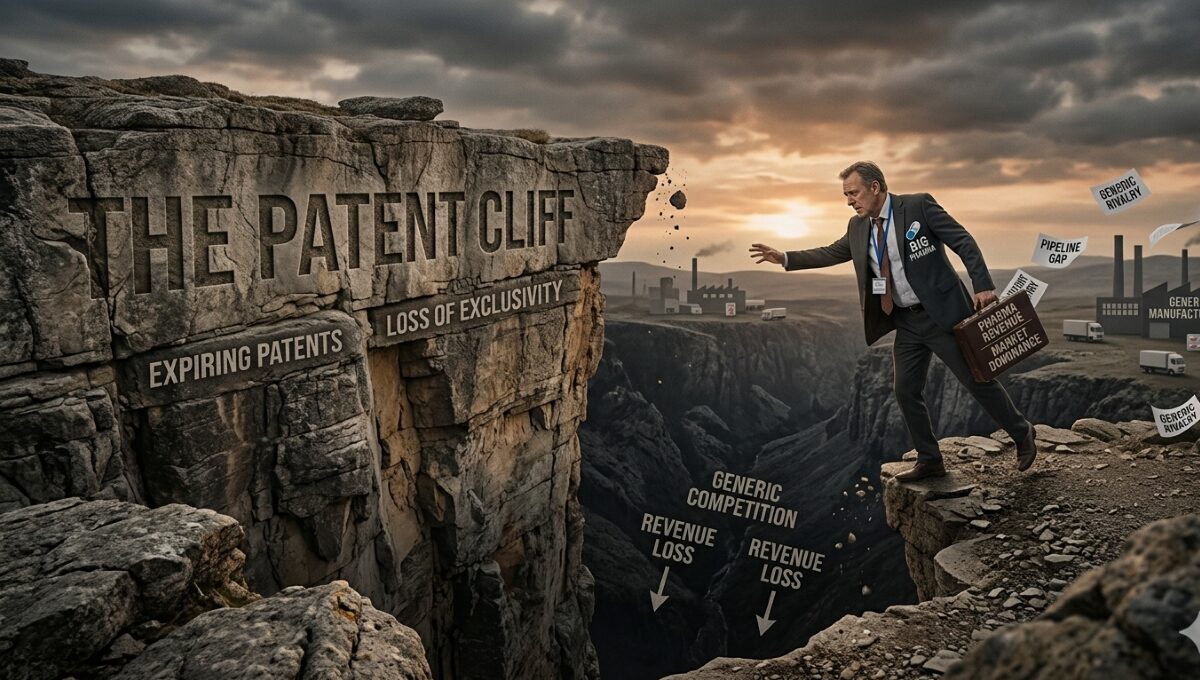
The global pharmaceutical industry is approaching what many analysts are calling the largest patent cliff biologics in its history. This pharma patent cliff biologics analysts have long anticipated is now arriving in force. Between 2025 and 2030, drugs collectively generating more than $200 billion in annual revenue will lose their market exclusivity, exposing a generation of blockbuster biologics to biosimilar competition for the first time. The consequences will be felt across every dimension of the industry, from the balance sheets of the world’s largest drug companies to the treatment options available to patients in markets that have long struggled to afford biologic therapies.
Unlike the patent expirations of previous decades, which were dominated by small-molecule drugs losing exclusivity almost overnight, the coming wave is heavily weighted towards complex biological medicines. These are not simple chemical compounds that can be replicated in a generic laboratory. They are large protein molecules manufactured through living cell systems, and their complexity means that biosimilar competition unfolds differently, and more slowly, than standard generic entry. Understanding how that dynamic will play out globally is now among the most strategically significant questions in life science.
The Scale of What Is at Stake
The numbers define the magnitude of the challenge. According to analysis published by GeneOnline, the global pharmaceutical industry faces a combined $236 billion patent cliff between 2025 and 2030, with approximately 190 drugs set to lose patent protection, including 69 blockbusters generating more than $1 billion in annual sales. Projections published by DrugPatentWatch extend the horizon further, estimating that total revenue at risk could exceed $300 billion by 2030, and reach $400 billion by 2033 as foundational patents on the most valuable therapies lapse.
The drugs at the centre of this wave are among the most clinically significant and commercially successful medicines ever developed. Merck’s pembrolizumab, marketed as Keytruda and currently the world’s best-selling cancer drug, recorded $29.5 billion in sales in 2024 and is expected to peak at around $35 billion before its core US patents expire in 2028, with European exclusivity following around 2031. Bristol Myers Squibb’s nivolumab, sold as Opdivo, faces a similar timeline, with the company’s own planning documents listing estimated minimum market exclusivity dates of 2028 in the United States, 2030 in the EU, and 2031 in Japan. Sanofi and Regeneron’s dupilumab, marketed as Dupixent, generated €13.1 billion in sales in 2024, representing approximately 30% of Sanofi’s total revenue that year, with key patents expiring around 2030 to 2031.
Bristol Myers Squibb faces what analysts describe as the steepest proportional cliff of any major pharmaceutical company, with approximately 47% of its revenues at risk by 2030. Eliquis and Opdivo together account for roughly 45% of the company’s total revenues.
A Different Kind of Competition
The patent cliff for biologics does not unfold with the same speed or severity as it does for small-molecule drugs. When a conventional chemical medicine loses exclusivity, generic competitors can enter immediately with identical copies, and the original product typically loses 80% to 90% of its market share within months due to automatic pharmacy substitution. Biologics decline more gradually. Because biosimilars cannot be substituted at the pharmacy counter without a physician’s instruction in most markets, and because oncologists and specialists are often cautious about switching stable patients to a different product, market erosion typically runs at 30% to 70% in the first year in Europe, and considerably less in the United States.
The experience with AbbVie’s Humira (adalimumab), which lost US exclusivity in January 2023, illustrates both the opportunity and the limitations of biosimilar competition. Since that date, ten biosimilar versions have entered the US market, some priced as much as 85% below Humira’s list price. Yet AbbVie retained approximately 77% of its market share as of mid-2024, largely through aggressive contracting and rebate arrangements with pharmacy benefit managers that gave the incumbent product a structural advantage on insurance formularies.
In Europe, the picture has been very different. Biosimilars for adalimumab had been available since 2018 and achieved substantially higher uptake. Pegfilgrastim biosimilars, to give another example, captured more than 90% of volume market share in Spain and over 85% in Italy and the United Kingdom in 2021, while the equivalent figure in the United States sat at around 40%. The structural differences between European tender-based procurement and the US rebate-driven formulary system go a long way towards explaining why biosimilar adoption consistently runs faster and deeper on one side of the Atlantic than the other.
The Oncology Biosimilar Wave
The most closely watched drugs in the coming cliff are the checkpoint inhibitor immunotherapies, a class that transformed cancer treatment over the past decade. Writing in the Centre for Biosimilars in January 2025, analysts identified pembrolizumab and nivolumab biosimilars as likely to begin launching around 2028 and beyond, with the addressable oncology biosimilar market expected to reach approximately $25 billion by 2029.
At least seven companies are developing biosimilar candidates for pembrolizumab alone, including Samsung Bioepis, Amgen, Sandoz, Celltrion, Bio-Thera, and several Indian manufacturers. Samsung Bioepis has advanced furthest, initiating a phase 3 clinical trial for its candidate SB27 in a randomised, double-blind, multicenter study evaluating efficacy and safety in patients with metastatic non-squamous non-small cell lung cancer.
The challenge for biosimilar developers entering the checkpoint inhibitor space is formidable. Pembrolizumab is not a single drug in practice; it is authorised across dozens of cancer indications, each with its own clinical evidence base, prescribing community, and reimbursement arrangement. Gaining the clinical credibility to be adopted across that range of indications will require sustained investment and regulatory engagement well beyond initial approval.
Merck’s response to the approaching cliff is instructive. In September 2025, the FDA approved Keytruda Qlex, a subcutaneous formulation of pembrolizumab. According to BioPharma Dive, analysts believe the subcutaneous version will significantly offset revenue losses from biosimilar entry, with one analyst noting that factoring in Qlex, the anticipated revenue profile for 2028 and 2029 no longer looks like a sharp decline. Bloomberg Intelligence predicts that meaningful revenue erosion for pembrolizumab may not materialise until around 2033 rather than immediately after the 2028 patent expiry, translating to approximately $22 billion more in retained revenue than a more pessimistic scenario would suggest.
The Biosimilar Development Gap
Despite the scale of the opportunity, a troubling gap exists between the number of biologics approaching patent expiry and the number of biosimilar programmes in development. According to DrugPatentWatch, approximately 90% of biologics coming off patent will have no biosimilar competition in development at the time exclusivity lapses. While 118 biologics are expected to lose exclusivity, representing a potential $234 billion addressable market, only around 12 molecules currently have biosimilars in active development. The commercial and regulatory complexity of developing a biologic copycat, combined with the market access challenges demonstrated by the Humira experience in the United States, has deterred many potential developers from entering the space. The pharma patent cliff biologics face is unprecedented in both scale and complexity.
This sustainability gap has significant implications for healthcare systems and patients. The cost-saving promise of biosimilar competition can only be realised if developers invest in building comparable products and navigate the regulatory and commercial barriers to actually getting them onto formularies and into clinical practice.
Industry Response: Lifecycle Strategies and Pipeline Diversification
The pharmaceutical companies most exposed to the patent cliff are not waiting passively for their revenues to erode. Across the industry, lifecycle management has become a critical discipline, and the strategies being deployed to extend the commercial life of at-risk biologics are increasingly sophisticated.
Reformulation represents one of the most effective defensive options. Moving a biologic from intravenous to subcutaneous administration can secure new intellectual property, improve patient convenience, and make biosimilar substitution less straightforward. Merck’s Keytruda Qlex exemplifies this approach. Bristol Myers Squibb has pursued a similar strategy with a subcutaneous formulation of Opdivo. Beyond formulation, companies are investing in new combination regimens, expanded indications, and co-development partnerships to diversify revenue beyond their at-risk assets.
AbbVie’s experience offers the clearest precedent. Having constructed a portfolio of more than 130 additional patents covering manufacturing methods, formulations, and future variants for Humira, the company maintained US exclusivity for six years beyond its core patent expiry and retained a dominant market share even after biosimilar entry began. The approach, often described as “patent thicket” strategy, has been widely criticised as anti-competitive, but it has unquestionably been commercially effective.
Looking ahead, Merck is investing across twenty pipeline programmes in areas including cardiometabolic disease, infectious disease, ophthalmology, and immunology, in an explicit effort to build the next generation of revenue to replace Keytruda’s contribution. Bristol Myers Squibb is simultaneously restructuring operations and accelerating new asset development. The ability to execute on that pipeline diversification will determine whether these companies can weather the cliff or face a prolonged period of financial strain, a pressure already reflected in biopharma M&A activity in 2026, which has reached record levels as dealmaking accelerates in direct response to the approaching cliff.
Global Markets: Who Benefits, and When?
The potential benefits of biosimilar competition are not evenly distributed across global markets. In Europe, well-established tender procurement systems, clear interchangeability frameworks, and prescribing incentives for biosimilar adoption mean that price reductions and access improvements tend to materialise relatively quickly after market entry. European markets are already seeing preparation for the next wave, with regulators and payers actively engaging biosimilar developers ahead of key patent expirations.
In the United States, the structure of the drugs market means that biosimilar adoption remains slower and more contested, even when products are technically available and legally approved. The rebate and formulary dynamics that allowed AbbVie to protect Humira’s share for years are likely to repeat for other biologics unless there are significant changes to how pharmacy benefit managers manage formulary decisions. Legislative efforts in 2025 to protect biosimilar manufacturers from costly patent litigation through a bipartisan bill on skinny labelling represent a step in the right direction, but the commercial barriers remain significant.
In Asia, the picture is one of growing opportunity. South Korea in particular has emerged as a significant biosimilar manufacturing power, with companies including Samsung Bioepis and Celltrion already competing in European and US markets. The Korean biosimilar market is positioned at the intersection of a $200 billion patent cliff, rising global biologics demand, and improving regulatory frameworks in key Asian markets including Japan and Australia. According to analysis by KIS Korea, the global biosimilar market grew from $2.2 billion in 2016 to $32.7 billion in 2024, and the addressable market is expected to expand substantially as the 2025 to 2030 cliff gathers momentum.
For low- and middle-income countries, the scale of the incoming patent cliff represents a transformative opportunity to improve access to biological medicines that have historically been unaffordable for public health systems. Biosimilar competition at scale could, in principle, bring medicines for cancer, autoimmune disease, and diabetes within reach of far larger patient populations. Whether that potential is realised will depend on regulatory capacity, pricing negotiations, and the willingness of biosimilar developers to pursue markets with lower absolute returns alongside the higher-margin opportunities in the US and Europe.
What the Next Five Years Will Reveal
The period from 2025 to 2030 will define the biosimilar industry for a generation. The drugs losing exclusivity are not peripheral products; they are the defining therapeutics of modern oncology and immunology, embedded in clinical practice across dozens of indications and relied upon by millions of patients worldwide. The transition that begins with Keytruda in 2028 will test whether the regulatory frameworks, market access systems, and commercial strategies built around biosimilar competition can deliver on their promise of lower costs and broader access at the scale that is now required.
The lessons already learned from Humira, from pegfilgrastim, and from the early waves of oncology biosimilars in Europe suggest that the outcome will vary considerably by market, by product, and by the strategic choices of both innovators and biosimilar developers in the years ahead. For life science investors, healthcare systems, and patients alike, those choices will matter enormously.