
CAR-T therapy is one of the most discussed cancer treatments of the past decade, and one of the most widely misunderstood. The name is an acronym. The science involves genetic engineering. The price runs to hundreds of thousands of pounds per patient. This guide explains what CAR-T therapy actually is, how it is manufactured, which cancers it treats, what can go wrong, and where the field is heading. No prior immunology is assumed.
What is CAR-T therapy?
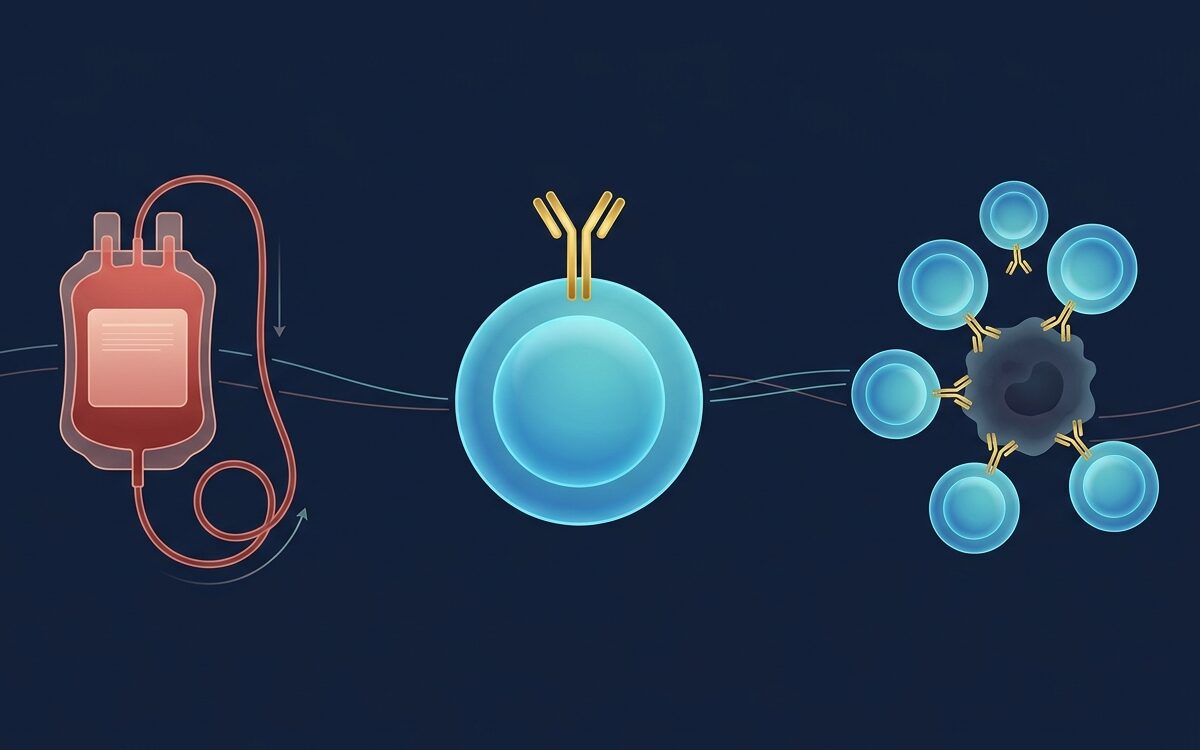
CAR-T therapy is a treatment that removes a patient’s own immune cells, genetically reprogrammes them to recognise cancer, and returns them to the body. CAR stands for chimeric antigen receptor. The T refers to the T cell, a white blood cell that patrols the body and destroys infected or abnormal cells. The synthetic receptor added to those cells works as a targeting system.
Cancer cells frequently evade T cells because the immune system fails to recognise them as dangerous. The chimeric antigen receptor solves that problem. It is engineered to lock on to a specific protein sitting on the surface of the cancer cell. Once the modified T cell binds to that protein, it activates and kills the target.
Most approved products aim at one of two proteins. CD19 appears on the surface of B cells, which is why CD19-directed therapies treat B-cell leukaemias and lymphomas. B-cell maturation antigen, usually shortened to BCMA, appears on plasma cells, which is why BCMA-directed therapies treat multiple myeloma.
Clinicians often call CAR-T therapy a living drug. Unlike a tablet or a standard antibody infusion, the treatment is a population of cells that multiplies inside the patient and can persist for years afterwards.
How CAR-T therapy is made
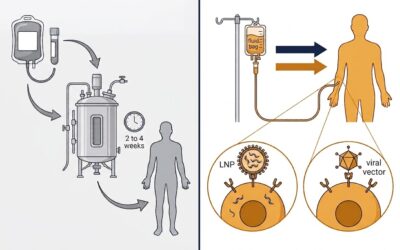
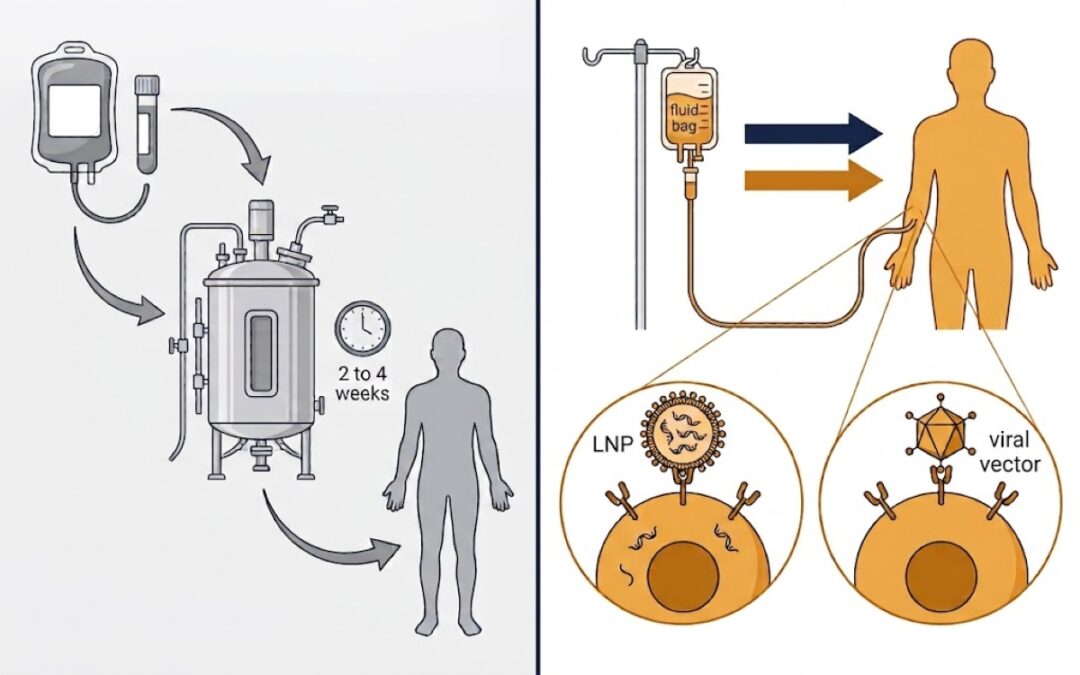
Treatment begins with leukapheresis. Blood is drawn from the patient and passed through a machine that separates out white blood cells. The remainder is returned to the body.
The collected cells then travel, usually frozen, to a specialist manufacturing facility. There a viral vector, most often a lentivirus, inserts the gene encoding the chimeric antigen receptor into the T cells. The modified cells are cultured until hundreds of millions of them exist.
After quality testing, the finished product returns to the treating hospital. Before infusion, the patient receives lymphodepleting chemotherapy, typically fludarabine and cyclophosphamide. This clears space in the immune system so the engineered cells can expand properly.
The full sequence, known in the field as vein-to-vein time, usually takes several weeks. That delay matters clinically. Patients with fast-moving disease can deteriorate while they wait, and some never receive the infusion for which they were approved.
Which CAR-T therapies are approved
Seven CAR-T products hold United States marketing approval. Kymriah (tisagenlecleucel) came first, cleared in August 2017 for younger patients with B-cell acute lymphoblastic leukaemia. Yescarta (axicabtagene ciloleucel) followed in October 2017 for large B-cell lymphoma.
Tecartus (brexucabtagene autoleucel) and Breyanzi (lisocabtagene maraleucel) later extended the CD19 approach into mantle cell lymphoma and further lymphoma settings. Abecma (idecabtagene vicleucel) and Carvykti (ciltacabtagene autoleucel) target BCMA in relapsed or refractory multiple myeloma.
The seventh product, Aucatzyl (obecabtagene autoleucel), was developed by London-based Autolus and approved in November 2024 for adults with relapsed or refractory B-cell precursor acute lymphoblastic leukaemia. Elias Jabbour of MD Anderson Cancer Center, US lead investigator on the pivotal FELIX study, described adult ALL as an “extremely aggressive cancer” in the company’s approval announcement.
Labels continue to widen. In February 2026 Kite announced that the FDA had removed a limitation of use from the Yescarta label. That restriction had previously excluded patients with relapsed or refractory primary central nervous system lymphoma, a disease which Kite puts at a five-year survival rate of approximately 30%. The change lifts an exclusion rather than adding a new approved indication.
Eligibility is narrow. In almost every approved setting, CAR-T therapy is reserved for patients whose disease has relapsed or has stopped responding to standard treatment. It is not a first-line option, and patients must be well enough to tolerate lymphodepleting chemotherapy.
What can go wrong with CAR-T therapy
CAR-T therapy carries serious risks, and two toxicities dominate. The first is cytokine release syndrome, an inflammatory reaction caused by the engineered cells doing their job. Symptoms range from fever to dangerously low blood pressure and organ dysfunction. Across non-Hodgkin lymphoma studies of Yescarta, cytokine release syndrome occurred in 90% of 422 patients, with grade 3 or higher events in 9%.
The second is immune effector cell-associated neurotoxicity syndrome, or ICANS. Patients may become confused, lose the ability to write coherently, or in severe cases suffer seizures. Both toxicities are usually reversible and are managed with tocilizumab, corticosteroids and supportive care.
There is a third, rarer concern. In January 2024 the FDA required a class-wide boxed warning covering the risk of secondary T-cell malignancies after treatment. The FDA concluded at the time that the risk was likely to be very low, while cautioning that cases may be underreported. David Porter, who leads cell therapy and transplantation at Penn Medicine’s Abramson Cancer Center, has said publicly that for the vast majority of patients receiving CAR-T cells the potential benefits far outweigh the small risk of secondary T-cell cancers.
Because CD19-directed products also destroy healthy B cells, patients can develop prolonged low antibody levels and become vulnerable to infection. Immunoglobulin replacement is sometimes required.
How long does CAR-T therapy last
For a subset of patients, the answer appears to be years. Researchers at the University of Pennsylvania reported in Nature in 2022 on two patients with chronic lymphocytic leukaemia. Both achieved complete remission in 2010. More than a decade after infusion, their CAR-T cells were still detectable and both remained in remission.
Those results are not typical, and they are not directly comparable with response rates drawn from other diseases and trial designs. In the FELIX trial supporting Aucatzyl, 42% of the 65 evaluable patients achieved complete remission within three months, and 63% achieved complete remission at any point. Relapse, antigen escape and loss of cell persistence remain the central limitations of the modality. CAR-T therapy can be curative for some patients and ineffective for others, and predicting which is which remains difficult.
What CAR-T therapy costs and who receives it
Cost shapes access everywhere. Aucatzyl carries a UK list price of £372,000 per infusion, supplied to the NHS at a confidential discount. American list prices for the class sit broadly in the same range. The drug is only part of the bill, since hospital admission and toxicity management add substantially to the total.
In England, NHS England commissions CAR-T therapy as a directly commissioned specialised service delivered through a limited number of accredited centres. NICE has recommended several indications, including relapsed or refractory diffuse large B-cell lymphoma and B-cell ALL in both younger and older adults. When NICE backed Aucatzyl, it recommended the therapy only for adults aged 26 and over, and estimated that around 150 people would become eligible over three years.
Regulatory burden has eased in parallel. In June 2025 the FDA eliminated Risk Evaluation and Mitigation Strategy programmes for the six approved BCMA- and CD19-directed products that carried them. Site certification and mandatory on-site tocilizumab stocking ended. Driving restrictions fell from eight weeks to two, and the post-infusion proximity requirement fell from four weeks to two. Aucatzyl, approved without a REMS, has since been brought into line: its label now advises avoiding driving for at least two weeks after each infusion. Vinay Prasad, then Director of the Center for Biologics Evaluation and Research, called REMS “a useful safety system” while arguing that periodic reassessment determines whether it remains necessary. Richard Pazdur, then Director of the FDA’s Oncology Center of Excellence, noted that clinicians now have “greater experience identifying and managing toxicities”. The change was not universally welcomed. Some clinicians have questioned whether shortened monitoring windows are appropriate as treatment expands beyond experienced academic centres.
CAR-T therapy beyond cancer
The most striking recent development lies outside oncology. Because CD19-directed cells strip out B cells, the same approach can be applied to autoimmune diseases driven by rogue B-cell populations.
A German team led by Georg Schett at Friedrich-Alexander University Erlangen-Nürnberg published a case series in the New England Journal of Medicine in 2024. It covered 15 patients with refractory autoimmune disease. Eight had systemic lupus erythematosus, three had idiopathic inflammatory myositis and four had systemic sclerosis. All received a single infusion of CD19 CAR-T cells. Immunosuppressive therapy was stopped completely in every patient, and all those with lupus met standard remission criteria. Median follow-up was 15 months.
Those findings have triggered a wave of trials testing the approach in rheumatology. Several programmes now combine cell therapy with gene editing to make donor-derived cells usable in any patient, a trend covered in our analysis of CRISPR gene editing in 2026.
Where the field goes next
Three directions dominate the next phase. Allogeneic products, made from healthy donor cells and held ready for use, would remove the manufacturing wait. In vivo approaches deliver the genetic instructions directly into the bloodstream so the body builds its own CAR-T cells. Solid tumours, where results have so far been poor, remain the hardest target.
None of these is yet approved. Every licensed CAR-T therapy remains autologous, made individually for one patient. What has changed is the trajectory. CAR-T therapy began as a last-resort experiment in a handful of leukaemia patients. It is now licensed across seven products, an emerging option in autoimmune disease, and the subject of billions in acquisition spending, most recently Gilead’s $7.8 billion acquisition of Arcellx, completed in April 2026.