Why closing the gap between clinical nutrition advice and the food labels in the supermarket aisle is a data problem before it is an education problem.
Around 11 million deaths in 2017 were attributable to dietary risk factors, according to the Global Burden of Disease study published in The Lancet [1]. Food matters at that scale. For many people it also meets medicine in a very ordinary moment: taking a tablet with dinner.
Medicine is not taken in a clinic. It is taken at a kitchen table, and the instructions that come with it assume a person who can recognise, in real food, the thing the instruction names. Very little on a supermarket shelf is designed to help with that.
The instructions are sound. They just assume a lot.
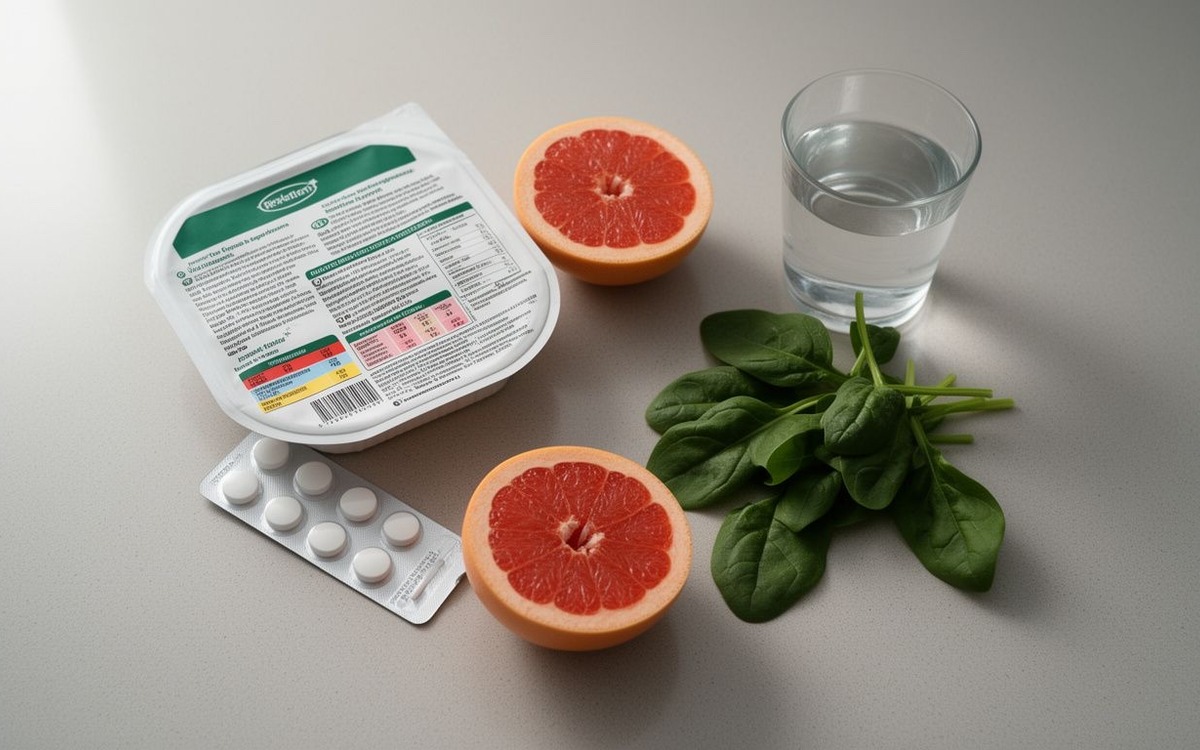
Take three of the most common. For atorvastatin, the NHS says to “avoid having too much grapefruit juice as it can increase the chance of side effects” and not to “have more than 1 or 2 small glasses of grapefruit juice a day” [2]. For warfarin, “foods high in vitamin K, such as broccoli, spinach and other green leafy vegetables, can affect how warfarin works”, and the advice is not to cut them out but to keep eating them and “talk to your warfarin clinic for advice” [3]. For levothyroxine, the instruction is timing: “take it on an empty stomach 30 to 60 minutes before your first meal of the day, any drink with caffeine, such as tea or coffee, or any other medicine” [4].
Each is clear and correct. Each also quietly assumes that the person can spot grapefruit inside a “tropical juice blend”, knows which greens carry vitamin K and which do not, and can hold a 30-minute rule in their head at 7 am on a weekday. The grapefruit case is not small: a 2013 review in the Canadian Medical Association Journal counted “more than 85 drugs” that are “known or predicted to interact with grapefruit”, and found that the number able to cause serious adverse effects “has increased from 17 to 43” between 2008 and 2012 [5].
This is one place where adherence can quietly go wrong. NICE’s guideline on medicines adherence estimates that “between a third and a half of all medicines prescribed for long-term conditions are not taken as recommended” [6]. Not all of that is food. But some of it may be a person who has been told to change how they eat, has looked at a label, and could not find the thing they were told to look for.
What food labels actually give you
UK food labels are better than most people think. Food law requires 14 allergens to be declared, and “allergens present in the product must be emphasised each time they appear in the ingredients list” [7]. Since 1 October 2021, food prepacked for direct sale, the sandwich made on site and wrapped before you arrive, must also carry “the name of the food and the ingredients list with the 14 allergens required to be declared by law emphasised within it” [8]. The front-of-pack traffic lights, where a manufacturer chooses to use them, sit on fixed thresholds: red for salt means “more than 1.5g of salt per 100g”, red for sugars “more than 22.5g of total sugars per 100g” [9]. A 2020 systematic review found that front-of-pack labelling “encourages healthier food purchasing” [10].
So the label is a real dataset. It is just not the dataset the leaflet needs.
The mandatory nutrition declaration covers energy, fat, saturates, carbohydrate, sugars, protein and salt [11]. Vitamin K is not on it, so a warfarin patient cannot read consistency off a pack. Grapefruit is not one of the 14 allergens, so it is not emphasised; it sits in plain type inside a juice blend. Timing is not a field at all. And every figure is “per 100 grams or per 100 millilitres and sometimes per portion”, with the NHS’s own warning that “the manufacturer’s idea of a portion may be different from yours” [9].
Then there is precautionary labelling. “May contain” was meant to communicate cross-contact risk. A stakeholder review in Allergy found that “there is a poor relationship between the presence or absence of PAL and actual reaction risk”, that this “has led to a loss of trust in PAL”, and that the result has been “increased risk-taking by consumers who often ignore PAL” [12]. A warning with no information about magnitude becomes noise, and people learn to filter noise.
What breaks when you try to use the label as data
I have spent this year reading ingredients lists, allergen statements and nutrition panels as a data source rather than as a shopper, turning them into a decision a person can make in a shop. In general terms, this is what breaks.
Ingredients are free text. “Spices”, “flavourings” and “vegetable oil” are legal, common and opaque. A synonym problem sits on top: chorizo is pork, casein is milk, “seasoning” can be anything. Any system that matches a doctor’s instruction to a label needs a synonym table nobody sees and that has to be right every time.
The two sides are structured differently. The medicine side is surprisingly good: the NHS Medicines A to Z is written to a consistent pattern with a section on food and drink for each medicine, and regulator-published prescribing information is available in structured form. The food side is half-structured at best. Joining them is the whole job, and almost nobody’s job.
Per-100 g is not a serving. A red salt light is a property of the food, not of the amount on the fork. A person on a sodium limit needs the arithmetic done for the portion they are about to eat, not the reference amount.
The instruction type matters more than the food. “Avoid” (grapefruit and some statins), “keep steady” (vitamin K and warfarin) and “separate in time” (levothyroxine and breakfast) are three different products. A design that flattens all three into a red cross teaches people the same lesson as “may contain”: ignore it.
The system must know what it does not know. If the data can check for milk, it can say the food is free of milk. If it cannot check for something, the honest output is “noted, not verified”, and the honest colour is amber. Every green tick not backed by a checkable rule is a loan against the person’s trust, and they call it in all at once.
Design for the aisle, not the clinic
The fix is not another leaflet. It is product design that treats the moment of decision as the unit of work. A person holding tonight’s dinner in one hand and tonight’s tablets in the other needs three things: the specific food the instruction is about, named in the words on the pack; the type of instruction, avoid, keep steady or separate; and a route to a human when the answer is “it depends”.
That last one is not a disclaimer. It is a feature. The clinician holds context that no label will ever carry: the dose, the reason, the other medicines, what the last blood test said. A product that reads food labels well should make the pharmacist conversation shorter and better informed, not replace it.
For pharmaceutical teams, the ask is structured food-and-drink guidance published alongside the leaflet, so it can be read by software rather than transcribed by it. For dietetics, it is an instruction taxonomy that survives contact with a supermarket. For health tech, it is the unglamorous work: synonym tables, portion arithmetic, and the discipline to say “not verified” out loud.
Diet is linked to around one in five adult deaths worldwide [1]. Food and medicine meet at the kitchen table every day. The least we can ask is that the label and the leaflet are talking about the same thing.
Anyone with a question about their own prescriptions and food should speak to their pharmacist or prescriber.
Author Bio