Two changes are reshaping what goes on the front of a US food package. The first, a new definition of the “healthy” nutrient content claim, is already law, with enforcement starting on 25 February 2028 [1]. The second, mandatory front-of-pack labelling in the form of a “Nutrition Info box”, is still a proposal, and its final form is now less certain than it was a year ago [2][3].
For formulators and brand owners, the two are connected. Both turn on the same three nutrients: saturated fat, sodium and added sugars. A recipe decision made today for one rule will show up under the other. This article sets out what each rule requires, where the front-of-pack labelling proposal stands as of October 2026, and what food makers of every size can do now.
What changed: the new “healthy” claim
FDA published its final rule redefining “healthy” on 27 December 2024, replacing criteria that had stood since 1994 [1]. The effective date was pushed back from 25 February to 28 April 2025, but the compliance date did not move: 25 February 2028 [4]. Brands may use the new criteria now and must meet them by that date.
The old definition was built on individual nutrients. It capped total fat and cholesterol and required minimum levels of nutrients such as vitamins, fibre or protein. The new rule takes a food-based approach. To carry “healthy” (or “healthful”, “healthier” and similar terms), a product must meet two tests per Reference Amount Customarily Consumed (RACC) [5]:
- Food group content. It must contain a minimum amount of at least one food group, expressed as a “food group equivalent”. For a grain product, that is 3/4 oz whole-grain equivalent; for dairy, 2/3 cup equivalent; for fruit or vegetables, 1/2 cup equivalent [5].
- Limits on nutrients to limit. It must stay under set ceilings for added sugars, sodium and saturated fat, expressed as a percentage of the Daily Value (DV).
The limits vary by category, and the differences are where most reformulation work will fall. Selected categories are shown below:
| Category (per RACC) | Minimum food group | Added sugars | Sodium | Saturated fat |
|---|---|---|---|---|
| Grains | 3/4 oz whole-grain eq. | 5 g (10% DV) | 230 mg (10% DV) | 1 g (5% DV) |
| Dairy | 2/3 cup eq. | 2.5 g (5% DV) | 230 mg (10% DV) | 2 g (10% DV) |
| Vegetables or fruits | 1/2 cup eq. | 1 g (2% DV) | 230 mg (10% DV) | 1 g (5% DV) |
| Mixed product (e.g. trail mix) | 1 total eq., 1/4 from 2+ groups | 5 g (10% DV) | 345 mg (15% DV) | 2 g (10% DV) |
| Meal (e.g. frozen dinner) | 3 total eq., 1/2 from 3+ groups | 10 g (20% DV) | 690 mg (30% DV) | 4 g (20% DV) |
Source: FDA [5]. Saturated fat inherent in seafood, nuts, seeds and soy products is excluded from the limit.
The effect cuts both ways. Foods with no added ingredients other than water, such as plain vegetables, fruit, nuts, eggs and seafood, qualify automatically. Salmon, avocados, nuts and olive oil, excluded under the old fat limits, can now use the claim [5]. Products that once qualified, such as fortified white bread and heavily sweetened yogurts and cereals, no longer do [6].
Two further points matter for compliance teams. The rule requires manufacturers to keep records showing that a product meets the criteria where this is not clear from the mandatory label [1]. FDA is also still developing an optional “healthy” symbol, which has not yet been released [5].
The proposed front-of-pack Nutrition Info box
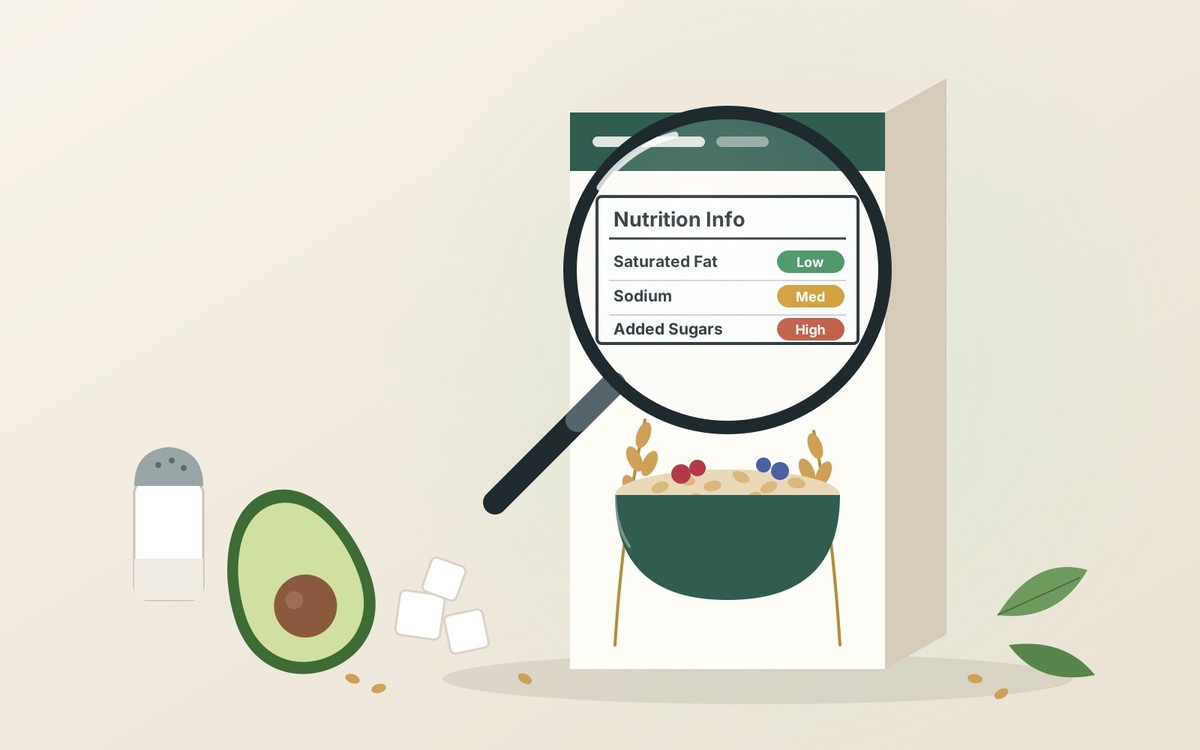
On 16 January 2025, FDA proposed requiring a standardised “Nutrition Info” box on the front of most packaged foods [2][7]. The box would show three nutrients per serving: saturated fat, sodium and added sugars. Each would carry its %DV and a plain-language rating [7]:
- Low: 5% DV or less
- Med: 6% to 19% DV
- High: 20% DV or more
These bands are not new. They mirror the 5/20 rule FDA has long taught consumers for reading the Nutrition Facts panel. What changes is that the verdict moves to the front of the pack, where shoppers see it first. In practice, a serving with 460 mg of sodium or more (20% of the 2,300 mg DV) would read “High”.
The proposal would place the box in the top third of the principal display panel [8]. It would apply to most foods that already carry a Nutrition Facts label. Foods exempt from nutrition labelling under 21 CFR 101.9(j) would also be exempt from the box [9]. Because every covered product would display the ratings, FDA proposed that “Low” and “High” in the box would not count as voluntary nutrient content claims [9].
Compliance would be staggered. Businesses with $10 million or more in annual food sales would have three years after the final rule takes effect; smaller businesses would have four [8]. The same proposal would also revise the existing “low sodium” and “low saturated fat” claim definitions [12], a detail that is easy to miss when the box gets the headlines.
Where the proposal stands (October 2026)
At the time of writing (October 2026), the front-of-pack labelling rule is still a proposal. No final rule has been published, and nothing on a package has to change yet.
The comment period, first due to close in May 2025, was extended and closed on 15 July 2025 [2]. FDA had projected a final rule for spring 2026; that date passed. The federal government’s 2026 regulatory agenda now lists the final rule for December 2026 [2].
The content of the final rule is less settled than the date. In March 2026, FDA Commissioner Martin Makary said the agency did not like the front-of-package plan it inherited. FDA’s Deputy Commissioner for Human Foods, Kyle Diamantas, said changes might require the rule to be re-proposed for further public comment, and that “everything is on the table” [3]. Makary has also questioned how much emphasis saturated fat should receive in nutrition messaging [3].
The practical reading for food makers is this. Some form of front-of-pack labelling remains on FDA’s agenda, but the nutrients, thresholds and design could still change. If the rule is re-proposed, the three- and four-year compliance windows would start later. Brands should plan for the direction of travel without printing anything to the January 2025 design.
Why small and cottage producers are affected too
It is easy to read both rules as big-brand problems. For small producers, the risk sits in an exemption that is narrower than many assume.
FDA exempts some small businesses from the Nutrition Facts panel. Retailers with annual gross sales of no more than $500,000, or food sales to consumers of no more than $50,000, qualify. So do firms with fewer than 100 full-time equivalent employees selling fewer than 100,000 units of a product a year, provided they file an annual notice [10].
The exemption has a condition that catches people out. It no longer applies once a nutrient content claim, health claim or other nutrition information appears on the label, in labelling or in advertising [10]. A bakery that adds “healthy” to a granola bag, or to its product page, gives up the exemption for that product. It must then carry a full Nutrition Facts panel and meet the new food-group and nutrient criteria. Under the January 2025 proposal, the exemption from the Nutrition Info box would follow the Nutrition Facts exemption [9], so the same claim could later bring the box with it.
Allergen labelling is the other area where small producers are often caught short. Since 1 January 2023, under the FASTER Act, sesame has been the ninth major food allergen in the US [11]. Any packaged food containing sesame, or an ingredient made from it, must declare it, either in the ingredient list, in a “Contains” statement, or in parentheses after the ingredient name [11]. FDA has also noted that some manufacturers responded by adding small amounts of sesame to products that did not previously contain it [11]. That makes ingredient specifications from suppliers worth checking again, even for recipes that have not changed.
Practical steps for formulators and brands
The “healthy” deadline is fixed and the front-of-pack rule is not, so the work divides into what must be done and what is worth preparing.
- Audit every use of “healthy”. List each product that uses “healthy” or a derivative, on the pack, the website, social media or point-of-sale material. Check each against the food group equivalent and nutrient limits for its category, per RACC [5]. Anything that fails must be reformulated or have the claim removed by 25 February 2028 [1].
- Start reformulation where the limits bite hardest. Added sugars in dairy and grain products and sodium in mixed products and meals are the usual pressure points [5][6]. Reformulation, shelf-life testing and relabelling take time, so 2028 is closer than it looks.
- Set up the records. Where a product’s compliance is not evident from its mandatory label, the rule requires records that show it meets the criteria [1]. Keep recipe, specification and nutrient data together per SKU.
- Check exemptions before adding claims. Small producers relying on the Nutrition Facts exemption should confirm that no claim or nutrition statement appears anywhere in their labelling or advertising [10].
- Map products against the proposed bands, but do not print. Using current Nutrition Facts data, note which products would show “High” for saturated fat, sodium or added sugars under the 5% and 20% DV thresholds [7]. This shows where reformulation would serve both rules. Packaging redesigns can allow space in the top third of the principal display panel [8], but the final design may differ.
- Recheck allergen declarations. Confirm that sesame is declared wherever it is present, and ask suppliers whether any ingredient formulations have changed since 2023 [11].
- Monitor the docket. Track docket FDA-2024-N-2910 and the federal regulatory agenda for a final or re-proposed rule [2]. Plan label refresh cycles so that one redesign can cover both changes where timelines allow.
The bottom line
The “healthy” rule sets a firm date and clear criteria; the front-of-pack rule sets a direction whose details are still moving. Both reward the same work: knowing exactly how much saturated fat, sodium and added sugar each product delivers per serving, and keeping that data accurate. Formulators who start there will be ready for whichever version of the Nutrition Info box FDA finalises.
Author Bio