A GLP-1 follow-up appointment can produce a clear number without answering the most important question: how is this person doing? Weight remains relevant in obesity care, but a useful review also creates space for symptoms, everyday function and the practical work of continuing treatment. A patient who brings a question about eating, a change in routine or a concern about the next refill has brought information worth discussing, even when the weight record appears straightforward.
GLP-1 receptor agonists, and medicines such as tirzepatide that act at both GIP and GLP-1 receptors, are not interchangeable in their indications or evidence. GLP-1 follow-up should be specific to the medicine, the person and the clinical setting. This article considers what a thoughtful conversation can cover. It does not prescribe a monitoring schedule or recommend treatment for an individual.
A fuller picture of progress
Start with an agreed goal
The first question is what the person and clinician hope to understand over time. Alongside weight, the discussion might include a meaningful daily activity, a health concern already being managed, or a practical barrier to following the plan. Goals should be explicit enough to revisit. “How has walking to work felt?” invites a different conversation from a general question about whether treatment is going well.
NICE recommends regular review of the effects of weight-management medicines, with support for dietary, physical activity and behavioural approaches.1 This is UK guidance, not a universal US prescribing protocol. The broader lesson for service design is to define who reviews progress, what information is useful and how the patient can raise a concern between appointments. The appropriate assessments and timing remain clinical decisions.
Make symptoms easy to discuss
A 2025 joint advisory from four professional societies highlights gastrointestinal symptoms, altered food intake and nutritional challenges during GLP-1 therapy.2 GLP-1 follow-up can ask what eating and drinking now look like, whether symptoms interfere with ordinary activities, and whether the person knows how to contact the prescribing team. A brief symptom history can be more useful than asking only whether there are “any side effects.”
The response should come from the responsible clinician using the relevant prescribing information and the patient’s circumstances. An educational article cannot provide a complete urgent-symptom checklist or decide whether someone should change a dose. Patients should have clear instructions from their own team about routine questions, urgent concerns and emergency care.
Ask about nourishment and daily function
The same advisory emphasizes adequate nutrition, attention to muscle function, and appropriate physical activity, including resistance exercise.2 These are topics to assess and support, not a reason to give every person the same protein target or exercise prescription. Food access, preferences, other health conditions and physical limitations matter. A dietitian or another appropriate professional may help translate a clinical recommendation into a feasible routine.
A review can also make the practical plan more specific. A person may understand advice but struggle to apply it during shift work, travel or a change in family responsibilities. Asking which part of the plan is hardest to carry out gives the conversation a useful starting point. The aim is to identify an achievable next step together, with appropriate professional support, rather than treat every difficulty as a failure of motivation.
Evidence and continuity
Keep research findings in context
Research illustrates why the conversation can extend beyond weight, but it also sets boundaries. SELECT studied semaglutide 2.4 mg in adults aged at least 45 with established cardiovascular disease, a body mass index of at least 27 and no diabetes. The trial found fewer primary cardiovascular events with semaglutide than with placebo.3 That result applies to a defined population and intervention. It does not establish the same benefit for every GLP-1 medicine, formulation or person. Individual results vary.
A trial result, a guideline recommendation and a clinician’s judgment answer different questions. A result describes what happened under study conditions. A guideline interprets evidence for a defined setting. An individual plan also has to account for the person in front of the clinician. Clear educational writing identifies which of these it is discussing rather than allowing a compelling headline to stand in for all three.
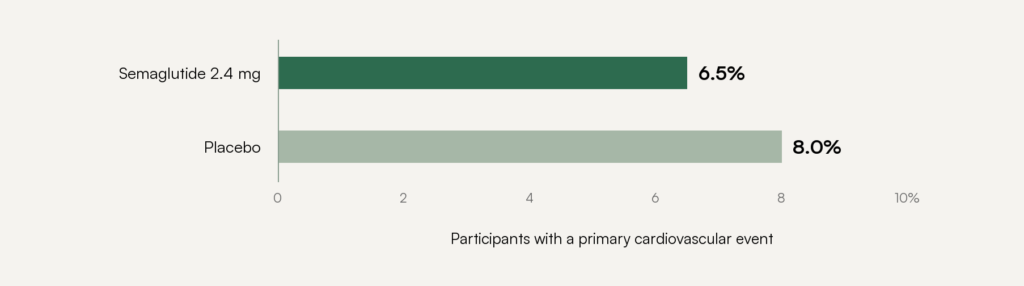
Figure 1. SELECT trial: 569/8,803 versus 701/8,801 participants had cardiovascular death, nonfatal myocardial infarction or nonfatal stroke; mean follow-up 39.8 months. Adults were at least 45, with established cardiovascular disease, BMI at least 27 and no diabetes. Unadjusted event proportions shown; no individual benefit is predicted. Source: Lincoff et al.[3]
Plan for affordability and access
A plan can be medically appropriate yet difficult to continue. Asking about affordability is a care-planning conversation, not a comparison of brands or providers. Can the person access the next prescription and follow-up? Are changes in coverage, household circumstances or availability likely to interrupt care? Who should they contact before they run out? These questions can be raised without assuming that everyone faces the same financial circumstances or prefers the same solution.
Continuity deserves explicit discussion. In SURMOUNT-4, adults without diabetes who completed an initial tirzepatide treatment period were randomized to continue it or switch to placebo. Those switched to placebo regained weight on average, while continued treatment supported maintenance and further reduction.4 The selected trial population and withdrawal design matter. The study does not establish a universal tapering, restarting or lifetime-treatment instruction. Individual results vary. Changes should be discussed with the prescribing clinician rather than improvised from an article.
A shared next step
A useful review ends with a plan the person can explain back: what happens next, who is responsible and when the plan will be reconsidered. The table below is an editorial discussion aid, not a validated assessment tool. Its purpose is to make room for questions that a weight chart alone cannot answer.
| Discussion Area | A question to bring |
|---|---|
| Progress | Which goals are we reviewing, and what would make us reconsider the plan? |
| Symptoms and nutrition | What changes in symptoms, food intake or daily function should I report? |
| Continuity | Who should I contact if access, cost or circumstances change? |
| Next review | When will we review this again, and how do I reach the team sooner? |
Table 1. Questions for a follow-up conversation. An editorial discussion aid, not a validated clinical assessment.
Meaningful GLP-1 follow-up is a continuing conversation with a clear owner. It gives clinical measurements their context, invites the patient’s priorities and makes the next step understandable. That is a practical standard for evaluating care without promising a particular result or reducing the person to a single measure.
Author Bio