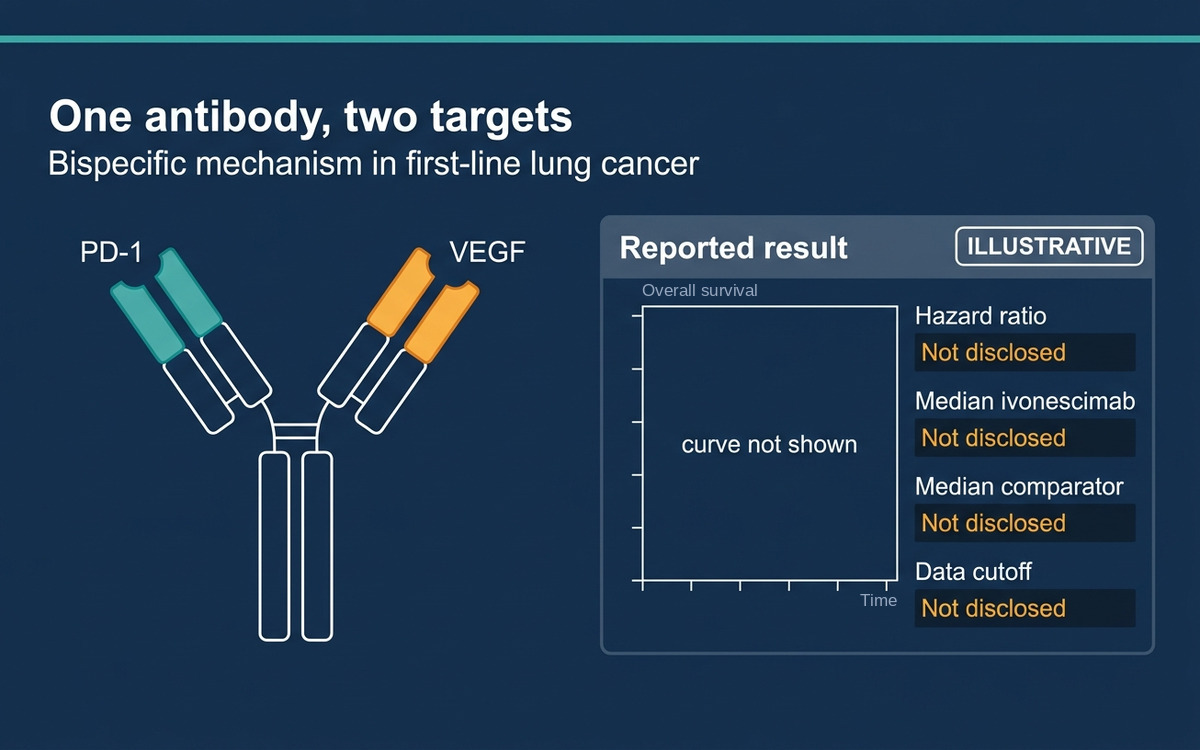
Akeso has reported that ivonescimab beat pembrolizumab on overall survival in a Chinese Phase III trial. HARMONi-2 is the fourth Phase III trial of ivonescimab to meet an overall survival endpoint. The ivonescimab overall survival result is the first against pembrolizumab given alone. It lands ten weeks before a United States regulatory decision on the same molecule. The companies disclosed no hazard ratio, no median figures and no data cutoff.
Akeso announced the result on 2 September 2026. Summit Therapeutics, which holds rights outside China, issued a parallel statement the same day. Both describe a pre-specified interim analysis of the Phase III HARMONi-2 study. Both say the full data will be presented at an upcoming medical conference. Trade reporting places that presentation at the World Conference on Lung Cancer in Seoul, from 12 to 15 September 2026.
What the ivonescimab overall survival announcement said
HARMONi-2, also listed as AK112-303 and NCT05499390, is a randomised, double-blind study conducted by Akeso in China. It enrolled 398 patients with locally advanced or metastatic non-small cell lung cancer. Every participant had a tumour expressing PD-L1. Patients received either ivonescimab or pembrolizumab as a single agent in the first-line setting.
The releases state that the ivonescimab overall survival improvement was statistically significant. Both describe that benefit as clinically meaningful. Neither release quantifies it. LSDN found no hazard ratio, confidence interval or p value in either statement. Neither carried a median survival figure or a death count as at 4 September 2026. Neither company gave a data cutoff date.
That gap matters for interpretation. A pre-specified statistical boundary was crossed, and that is a real event. The size of the benefit cannot be judged from what has been published so far.
Overall survival sat on a secondary endpoint
HARMONi-2 was not designed to test survival first. In April 2025, Summit described the study as designed to test progression-free survival as its sole primary endpoint. Akeso’s September release describes overall survival as a key secondary endpoint. That distinction shapes how much statistical weight the result can carry. The ivonescimab overall survival analysis was therefore not the trial’s primary test.
The primary endpoint was met at the first analysis. Median progression-free survival reached 11.14 months on ivonescimab against 5.82 months on pembrolizumab. The hazard ratio was 0.51, with a 95 per cent confidence interval of 0.38 to 0.69. The p value was below 0.0001. Objective response rates were 50.0 per cent and 38.5 per cent respectively. Those data were published in The Lancet in March 2025.
An earlier survival look did not clear the bar. Chinese health authorities requested an interim overall survival analysis in 2025. Summit reported a hazard ratio of 0.777 at 39 per cent data maturity. That analysis carried a nominal alpha level of 0.0001, and it did not reach significance.
How ivonescimab differs from a checkpoint inhibitor
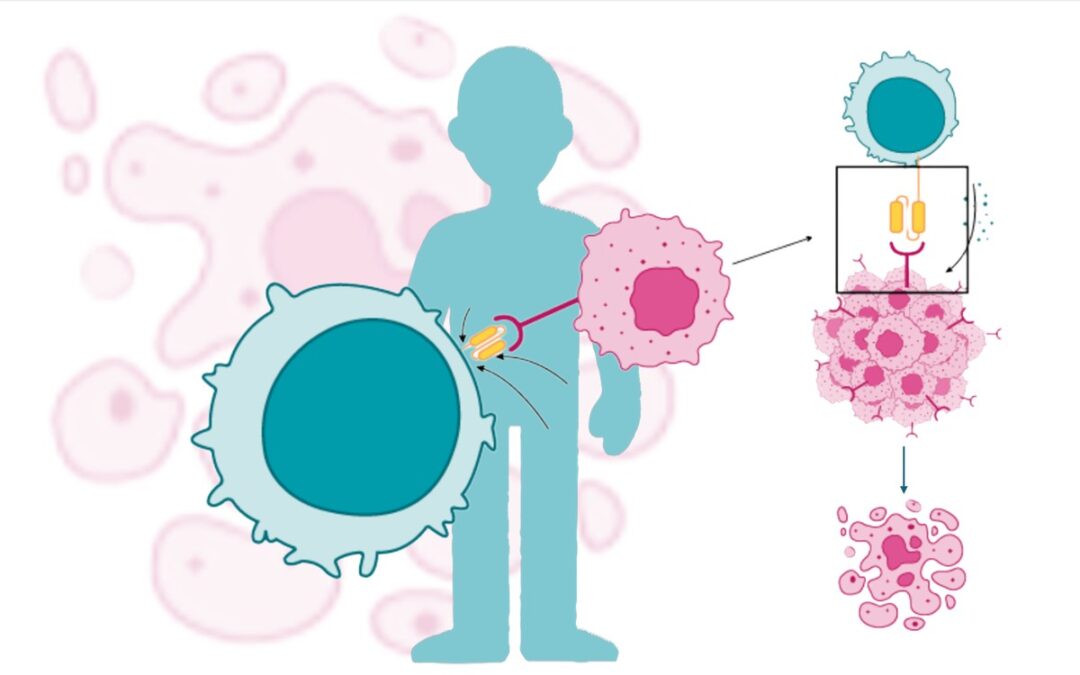
Ivonescimab is a single molecule with two targets. One arm blocks PD-1, the checkpoint that pembrolizumab also addresses. The other arm binds VEGF, a driver of tumour blood vessel formation. Combining both mechanisms in one antibody is the basis of the class.
The commercial logic is straightforward. Pembrolizumab is the established first-line standard in PD-L1 high non-small cell lung cancer. Any molecule that displaces it addresses one of the largest markets in oncology.
Safety data still come from the primary analysis
The ivonescimab overall survival announcement carried no new safety information. The safety picture therefore rests on the primary analysis presented in 2024. Treatment-related serious adverse events occurred in 20.8 per cent of ivonescimab patients. The comparable pembrolizumab figure was 16.1 per cent. Grade 3 or higher treatment-related events were 29.4 per cent against 15.6 per cent. Hypertension was reported in 15.7 per cent of ivonescimab patients against 2.5 per cent. Grade 3 or higher immune-related events were reported as broadly similar between the two arms.
Readers should treat that as an incomplete safety record. Agents that block VEGF also carry a recognised risk of bleeding. LSDN found no updated adverse event tabulation in either September statement. The conference presentation is the point at which those questions can be answered.
The FDA filing rests on a different trial
The application under review at the FDA does not come from HARMONi-2. Summit is seeking approval for ivonescimab plus chemotherapy in a narrower setting. That indication covers EGFR-mutated, locally advanced or metastatic non-squamous disease after progression on a TKI. The agency accepted the application in January 2026 under standard review. The goal date under the Prescription Drug User Fee Act is 14 November 2026.
The HARMONi dataset behind the November decision
The supporting study is HARMONi, registered as NCT06396065. Median progression-free survival was 6.8 months against 4.4 months on chemotherapy alone. Overall survival reached 16.8 months against 14.0 months, with a hazard ratio of 0.79. The p value was 0.0570, so that survival endpoint missed significance. The statistical analysis plan required a p value of 0.0448 at that analysis. Summit announced publication of the primary analysis in The Lancet Oncology in August 2026.
Summit reported an updated survival analysis on 22 July 2026, using a June 2026 data cutoff. The hazard ratio was 0.76 in the full study population and 0.76 in the Western subgroup. Confidence intervals and p values were withheld for a later presentation. Summit has separately published a hazard ratio of 0.78 on longer Western follow-up. Its p value of 0.0332 was nominal, and no HARMONi survival analysis has met the pre-specified threshold. Maky Zanganeh is President and Co-Chief Executive Officer of Summit. She said the results supported the translation of the ivonescimab profile across the globe.
Western read-across remains the open question
Ivonescimab has now beaten pembrolizumab on both endpoints in a Chinese study. It has not yet done so in a global one. That distinction sits at the centre of the commercial case.
Akeso has also reported a survival win in HARMONi-6. That study paired ivonescimab with chemotherapy against tislelizumab plus chemotherapy in squamous disease. LSDN covered the HARMONi-6 survival result in June 2026. On 12 August 2026, the NMPA approved that regimen for first-line squamous disease. It was the third China approval for an ivonescimab-containing regimen since May 2024.
That approval also carried a complication. BioSpace reported on 17 August 2026 that the NMPA label showed progression-free survival from HARMONi-6 degrading over time. Leerink Partners responded with increased pessimism about the asset. LSDN found no sponsor release quantifying that label change as at 4 September 2026.
On 30 April 2026, Summit said the squamous cohort of HARMONi-3 missed progression-free survival at an interim analysis. An independent data monitoring committee recommended that the study continue, and it remains double-blinded. Final progression-free survival data are still awaited. Akeso reported a further Phase III win in late August 2026. Ivonescimab plus chemotherapy beat durvalumab plus chemotherapy in first-line biliary tract cancer in China. Fierce Pharma described it as the molecule’s first Phase III win beyond lung cancer.
HARMONi-7 is the closest global comparison
HARMONi-7 is the trial that most closely mirrors HARMONi-2. It compares ivonescimab monotherapy with pembrolizumab monotherapy in first-line metastatic disease. Enrolment requires a PD-L1 tumour proportion score of at least 50 per cent. Patients with actionable genomic alterations are excluded. Summit lists the study as NCT06767514 and began enrolling in 2025.
The regulatory weight of the Chinese dataset is limited. BioPharma Dive reported on 3 September 2026 that HARMONi-2 will not serve as the main evidence for United States approval. It said the FDA will look instead to a global trial, with results expected in 2028.
What the readout means for the PD-1 and VEGF deal wave
The class has attracted heavy licensing spend since late 2024. Pfizer disclosed an upfront payment of 1.25 billion dollars to 3SBio in May 2025. That deal carries up to 4.8 billion dollars in milestones. Bristol Myers Squibb committed 1.5 billion dollars upfront to BioNTech in June 2025. That agreement was reported at up to 11.1 billion dollars in total. Merck and AbbVie have each licensed a rival bispecific as well.
Every one of those assets originated in China. They form part of a broader shift of Western pipeline sourcing towards China. The ivonescimab overall survival win therefore reads across to each of them. It does not, however, answer the geographic question that HARMONi-3 raised.
The UK and European position
Ivonescimab holds no marketing authorisation outside China. Akeso received its HARMONi-2 based approval from the National Medical Products Administration in April 2025. Inside China the molecule now carries three approved indications. LSDN found no announced filing with the MHRA or the European Medicines Agency as at 4 September 2026.
Pembrolizumab is the funded NHS option in part of the population that HARMONi-2 studied. NICE recommends it for untreated PD-L1 positive metastatic non-small cell lung cancer. That recommendation applies where the tumour proportion score is at least 50 per cent. HARMONi-2 enrolled patients across the wider PD-L1 positive range. Any UK challenge to pembrolizumab therefore depends on HARMONi-7, not on the Chinese dataset. Fierce Pharma noted a further limit on the result. Pembrolizumab plus chemotherapy, not pembrolizumab alone, is standard care for most first-line patients. The comparison therefore matters most in the PD-L1 high subgroup.
Market reaction and what to watch next
Investors read the news as positive. Benzinga reported Summit shares up 10.79 per cent at 15.55 dollars during the session on 3 September 2026. BioPharma Dive reported a rise of up to 14 per cent, with Akeso shares closing 3 per cent higher. Benzinga also noted Merck shares down 0.85 per cent that day, without linking the move to the trial.
Analysts split on how far the ivonescimab overall survival result travels. Tyler Van Buren of TD Cowen said the data derisk the global study. David Dai of UBS expects a reduction in death risk of about 24 per cent. That figure is his projection, not a number either sponsor has released.
Three events will settle how much the readout is worth. The first is the World Conference on Lung Cancer presentation carrying the hazard ratio and the medians. The second is the FDA decision due on 14 November 2026. The third is the final progression-free survival analysis from HARMONi-3.
Until then, the ivonescimab overall survival claim rests on a sponsor statement without figures. That is a meaningful signal for the mechanism. It is not yet a dataset that payers, regulators or prescribers can weigh.