
While cancer immunotherapies—particularly immune checkpoint blockades (ICBs)—have transformed clinical oncology, primary and acquired resistance remain major hurdles in solid tumors. Mounting evidence reveals that this non-responsiveness is deeply tied to the metabolic ecosystem of the tumor microenvironment (TME). As malignant cells rapidly proliferate, they establish hyper-competitive metabolic conditions characterized by severe nutrient depletion, hypoxia, low extracellular pH, and the buildup of immunosuppressive metabolites.
These severe environmental stressors impair infiltrating T lymphocytes, pushing them into a state of progressive metabolic exhaustion and dysfunction. Understanding how metabolic conditions within tumors affect immune cell behavior is now recognized as essential for developing next-generation therapeutic strategies.
Upcoming Industry Webinar: Preclinical Modeling of T Cell Dysfunction
To address the limitations of conventional preclinical models—which often fail to capture the complex crosstalk between tumor metabolism and immune regulation—Creative Biolabs will host an exclusive educational webinar focusing on advanced translational strategies.
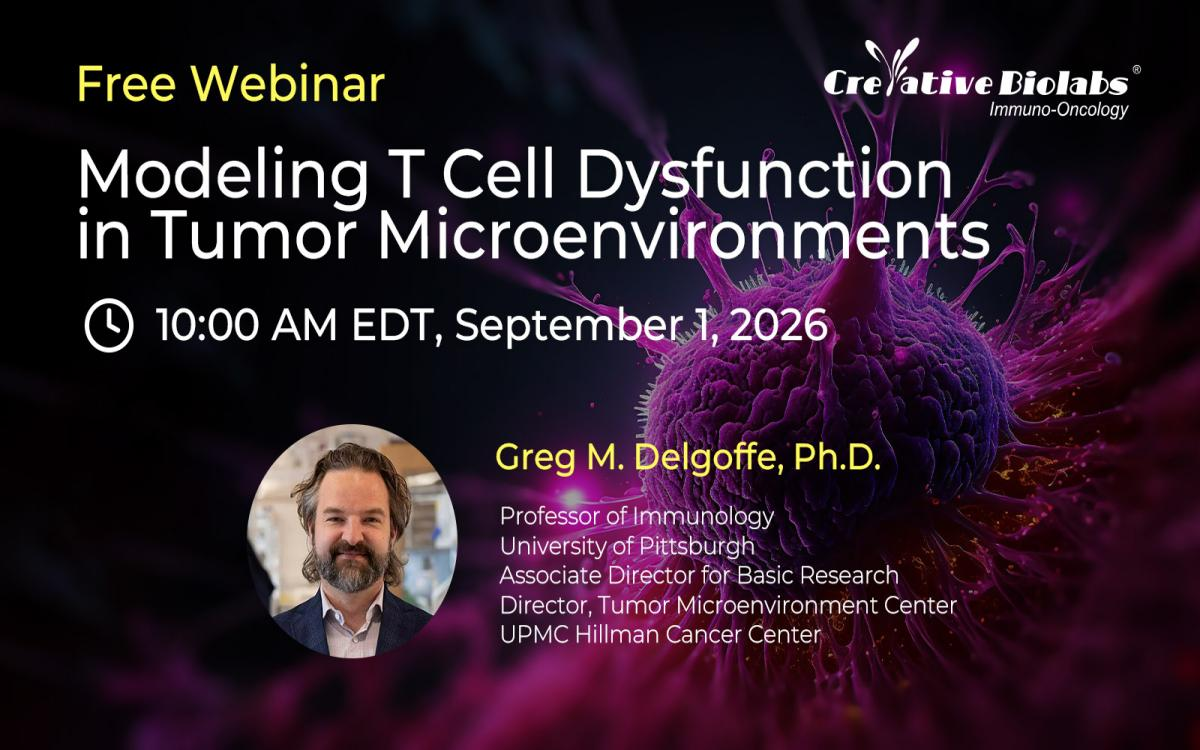
Webinar Topic: Modeling T Cell Dysfunction in Tumor Microenvironments
Date & Time: September 1, 2026 | 10:00 AM EDT
Keynote Speaker: Dr. Greg M. Delgoffe, Professor of Immunology at the University of Pittsburgh and Director of the Tumor Microenvironment Center at UPMC Hillman Cancer Center.
In this session, Dr. Delgoffe will discuss approaches for modeling tumor microenvironments in preclinical research systems. The lecture will detail how researchers can transition from standard cell cultures toward metabolically distinct tumor models and defined immunologic stress conditions.
Key topics covered in the event include:
- Mechanisms by which nutrient depletion and toxic byproducts drive T cell exhaustion.
- Strategies for establishing physiologically relevant metabolic stress in preclinical systems.
- How metabolically rewired tumors reveal novel mechanisms of immune evasion.
- Applying immunometabolic insights to design synergistic combination immunotherapies.
High-Resolution Characterization of the Metabolic TME
Building upon the modeling principles discussed in immunometabolism research, translating these mechanistic insights into viable therapies requires quantitative analytical workflows. Solid tumors exhibit profound spatial heterogeneity; areas surrounding underdeveloped vascular beds experience severe hypoxia and lactic acidosis, whereas peripheral regions face distinct nutrient pressures.
To uncouple these regional metabolic drivers, scientists are leveraging multi-omics platforms capable of resolution down to single cells:
Physiological Status Assessment: Rapid quantitative profiling of intratumoral hypoxia and acidic pH dynamics serves as a foundation for identifying prognostic biomarkers.
Single-Cell & Spatial Metabolomics: Coupling mass spectrometry imaging with single-cell analysis maps metabolic intermediates (such as ATP, amino acids, and lipids) directly to specific immune cell subsets within their native tissue architecture.
Metabolic Cytometry & CyTOF: Mass cytometry by time-of-flight enables simultaneous, high-dimensional tracking of nutrient transporters, key metabolic enzymes, and functional activation markers across heterogeneous cellular populations.
Integrating advanced tumor metabolic microenvironment analysis allows translational researchers to evaluate how therapeutic interventions affect T cell metabolic fitness.
Reprogramming the Microenvironment: Turning “Cold” Tumors “Hot”
Understanding metabolic dysfunction provides the framework for therapeutic intervention—specifically transforming immunologically “cold” tumors (characterized by low T cell infiltration and dense immunosuppressive stroma) into “hot,” inflamed tumors responsive to immune attack.
Recent translational strategies focus on four major avenues for TME reprogramming:
1. Inducing Immunogenic Cell Death (ICD)
Activating innate immune pathways through STING agonists, oncolytic viruses, photothermal/photodynamic therapies, or targeted chemotherapies induces ICD. This process releases tumor-associated antigens and damage-associated molecular patterns (DAMPs), stimulating dendritic cell maturation and boosting T cell priming.
2. Targeted TME Pathway Remodeling
Molecular targets within the tumor stroma can be selectively inhibited to alter signaling cascades. For example, inhibition of the deubiquitinating enzyme USP8 has been shown to remodel the TME architecture, shifting the molecular state of cold tumors and sensitizing them to checkpoint inhibition.
3. Nanomedicine Engineering
Nanoparticle delivery systems are engineered to overcome physical TME barriers, such as dense extracellular matrix produced by cancer-associated fibroblasts (CAFs). By targeting stromal components, nucleic acids, or cellular stress pathways, nanomedicines facilitate deeper immune infiltration.
4. Immuno-Stimulatory Conjugates (ISACs)
Combining targeted antibody engineering with strategic payload selection allows localized delivery of potent immune activators. By developing custom strategies to heat up immunologically cold tumors—such as site-specific conjugates carrying TLR or STING agonists via stable, cleavable linkers—investigators can trigger localized immune activation without provoking systemic toxicity.
Conclusion
Overcoming T cell dysfunction requires a dual approach: building preclinical models that accurately replicate metabolic stress and utilizing high-resolution analytical tools to evaluate therapeutic responses. As research continues to uncover how metabolic pressures drive immune evasion, integrating advanced preclinical modeling with targeted microenvironment-modifying therapies will be pivotal in expanding the reach of immuno-oncology.
Author Bio
Dr. Emily R. Coleman is a senior scientist at Creative Biolabs with a background in immunology, oncology research, and translational biotherapeutic development. Her work focuses on translating complex biological mechanisms into practical experimental strategies for next generation therapeutic discovery, with particular expertise in tumor immunology and antibody engineering.
At Creative Biolabs, she provides scientific insight across multiple R&D domains, including antibody discovery and development, gene and cell therapy research, and translational assay design. She is particularly focused on improving the connection between mechanistic biology and predictive preclinical models to support more effective therapeutic development across immune related disease areas.