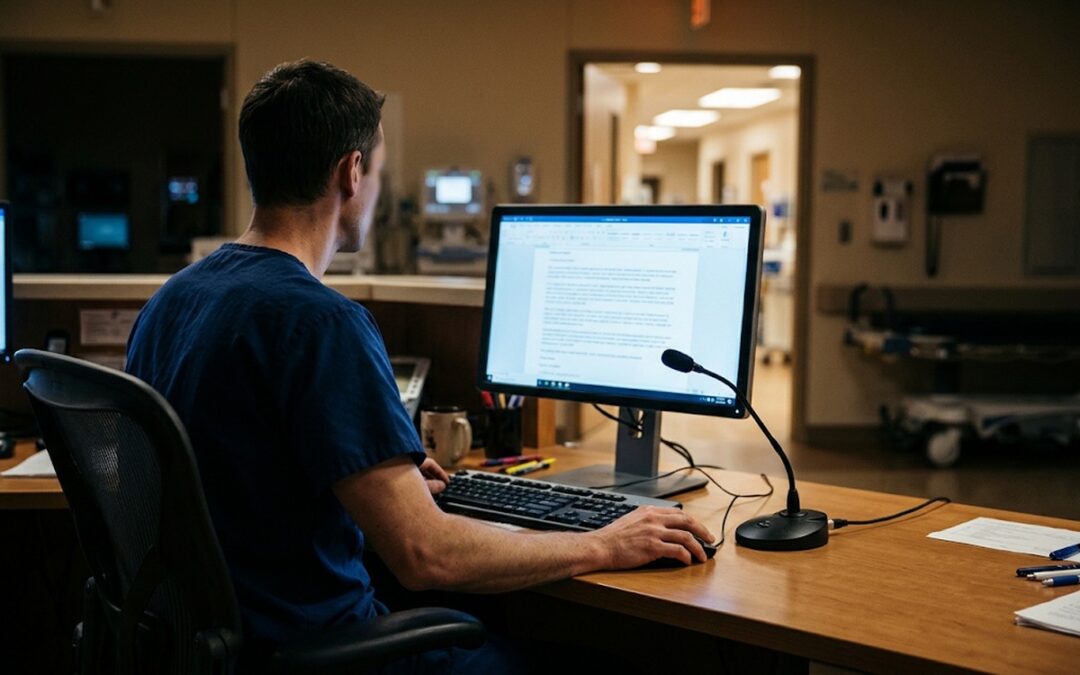
A radiologic study today rarely arrives alone. It comes wrapped in automated detection flags, quantitative lesion scores, an AI-drafted report, historical imaging, EHR clinical notes, and subspecialty consult requests. What it does not come wrapped in is medical AI coordination.
Each input promises speed, yet the radiologist still sits at the center, manually checking what applies, reconciling contradictions, and deciding what belongs in the signed record.
The bottleneck in medical AI has shifted. We have crossed a critical threshold where generating another prediction no longer saves time, it creates friction.
The real advantage in health tech is no longer task automation, but medical AI coordination: the architecture that organizes inputs from clinicians, algorithms, and medical records into a single, accountable diagnostic decision.
Every New AI Output Creates Another Reconciliation Decision
Radiology gives us an early view of this problem because it has attracted more medical AI development than any other specialty. A review of the US Food and Drug Administration’s AI device list found that 723 of 950 authorizations as of August 2024 were in radiology.
That expansion creates portfolio chaos. One algorithm detects an intracranial hemorrhage, another measures a nodule, and a third drafts report text. Each returns data on its own timeline, in its own format, and often inside its own proprietary viewer.
A point solution does not land in a vacuum. Without unified workflow routing, every model adds an invisible cognitive tax.
A 2024 Radiology review warned that multiple AI tools, inconsistent standards, and different result formats can produce a disorganized clinical environment where the radiologist inherits the manual reconciliation burden, checking pending status, verifying clinical applicability, and resolving conflicting outputs before signing off.
Faster Component Tasks Can Leave the Diagnostic Pathway Unchanged
Automation already produces measurable gains when a task fits cleanly into an existing workflow.
In a 2025 prospective cohort at Northwestern Medicine, an AI model generated draft radiograph reports inside the existing reporting system. Across 11,980 assisted interpretations, radiologists completed documentation 15.5% faster, with no detected change in peer-reviewed clinical accuracy or report quality.
The tool succeeded because it mirrored a proven clinical dynamic: one contributor prepares a draft, and the accountable radiologist edits and signs it. It did not force a context switch or open a parallel queue.
When algorithms operate in isolation, local time savings evaporate.
Many studies still stop at intermediate measures such as task duration or time to the next step, according to a 2026 review of AI across the imaging workflow. Shaving thirty seconds off image segmentation means little if the reader loses those seconds switching screens, hunting down clinical history, and verifying raw predictions.
AI Should Reduce Diagnostic Variability by Reconciling Clinical Judgments
Placing an AI prediction alongside a clinician does not guarantee a smarter diagnostic system. A Nature Medicine study tested AI assistance across 140 radiologists and 15 chest X-ray tasks. The effects varied substantially between readers, and inaccurate AI predictions harmed aggregate performance and performance on half of the pathologies studied.
This variation points to a factor beyond predictive performance: how the model’s output reaches the clinician (an interface). In another experiment, 113 radiologists assessed 5,650 chest X-rays using AI with the same underlying predictive performance. Readers who saw explanatory heatmaps achieved 83.8% balanced accuracy, compared with 79.1% for readers who received black-box outputs.
The value of AI output depends on how it is presented to clinicians. Clear uncertainty signals, visible conflicts, and a straightforward way to reject a prediction all shape the performance of the broader diagnostic system.
Medical AI Coordination Is Becoming Core Infrastructure
Taken together, fragmented outputs, efficiency gains that disappear downstream, and variable human-AI performance point to a common need: medical AI coordination across the diagnostic pathway as a whole.
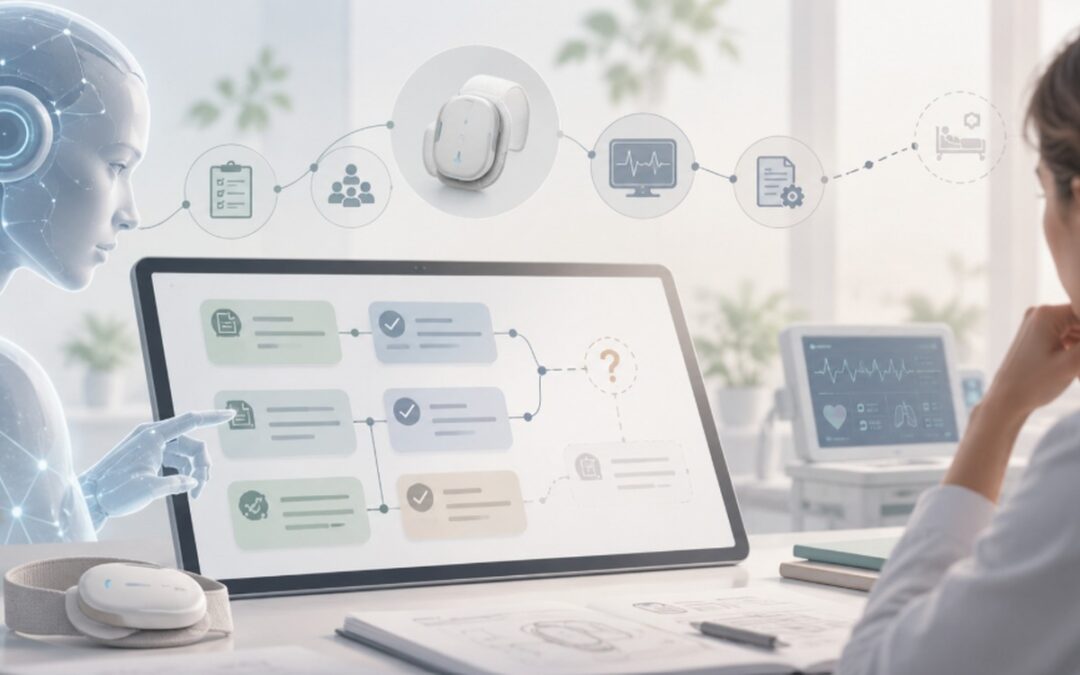
A true medical AI coordination layer needs to route the right study to the right model or specialist. It should assemble relevant priors and clinical context, show whether an output is pending or failed, surface disagreement, preserve who contributed what, and keep one clinician visibly responsible for the final decision.
This separation of functions is already reflected in industry standards. The current IHE Radiology framework treats AI workflow, AI results, and the assessment of those results as separate integration problems. Producing an inference, rendering a result, and assessing its clinical validity are fundamentally different tasks.
Standards define how these functions connect; active governance keeps those connections working in practice. Mayo Clinic recently described the post-deployment management of 17 radiology algorithms. The program monitors utilization, technical failures, data drift, and user feedback, catching cases where images stopped reaching the appropriate model through the orchestration engine. Either the platform coordinates these inputs in the background, or clinical and IT staff carry it manually.
The Future Moat: From Model Count to Workflow Orchestration
The era of evaluating healthcare AI by model count or benchmark accuracy alone is over. As high-performing models become widely available, product defensibility moves to the coordination layer.
For clinical teams, AI will prove most useful when it reduces the work of reconciling scattered inputs. It should bring algorithmic findings, prior studies, clinical notes, and specialist opinions into one transparent process while keeping responsibility for the final decision clear.
Author Bio