
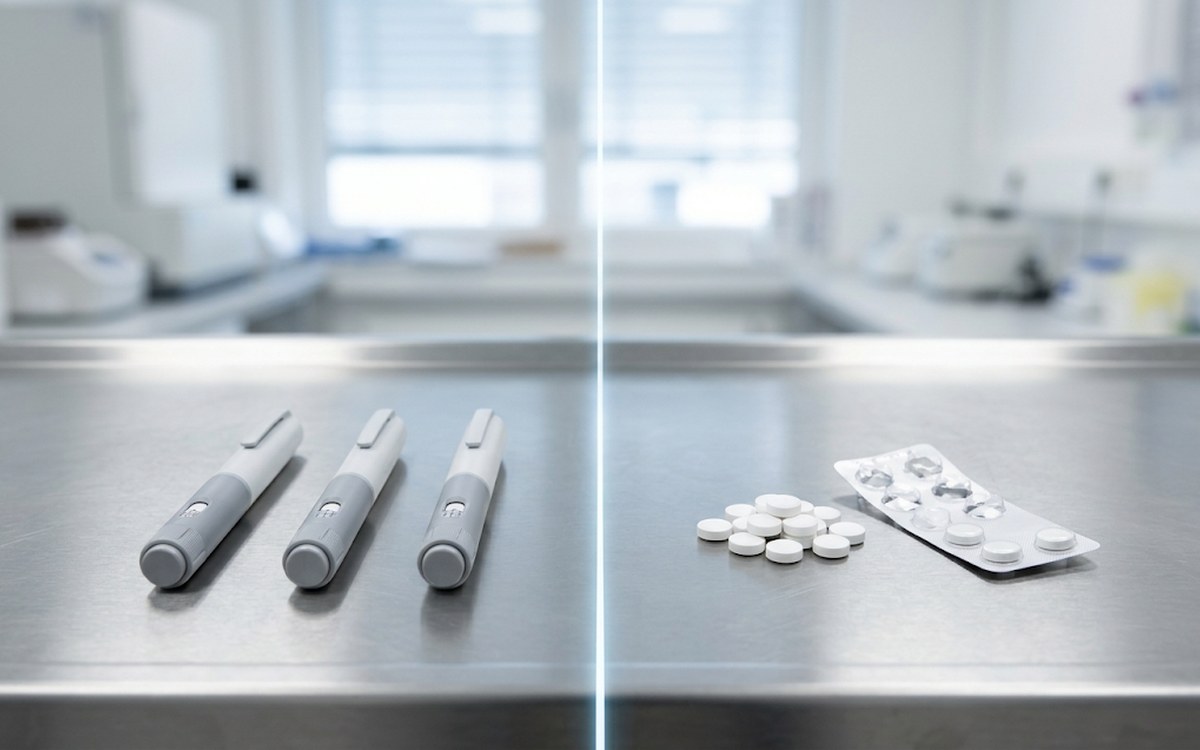
Lilly vs Novo is the rivalry that defines obesity medicine, and 2026 has redrawn the balance between the two companies. Third-quarter results published on 29 October and 4 November show Eli Lilly growing at a scale few drugmakers have reached. Novo Nordisk, meanwhile, has returned to growth after a difficult start to the year.
The picture is not one-sided, however. Novo leads the new oral segment by sales, and both companies are absorbing falling US prices. The wider sector picture is covered in our review of pharma Q3 2026 earnings.
Lilly vs Novo: the size of the gap in 2026
Lilly reported third-quarter revenue of $24.4 billion, an increase of 39 per cent. Mounjaro generated $10.7 billion, up 65 per cent, while Zepbound added $5.35 billion, up 49 per cent. The oral drug Foundayo contributed $184 million. Together, the three incretin medicines accounted for roughly two thirds of group revenue.
Novo’s quarter looked very different in scale. Group sales reached DKK 79.2 billion, about $11.9 billion at current exchange rates. That was growth of 4 per cent at constant exchange rates. Total obesity sales rose 22 per cent to DKK 26.1 billion. Ozempic, by contrast, fell 5 per cent to DKK 29.7 billion. On these figures, Lilly’s three incretin products alone outsold Novo’s entire business in the quarter.
| Third quarter 2026 | Eli Lilly | Novo Nordisk |
|---|---|---|
| Group revenue | $24.4bn (up 39%) | DKK 79.2bn (up 4% at CER) |
| Leading obesity injectable | Zepbound $5.35bn (up 49%) | Wegovy injectable DKK 20.4bn (down 2% at CER) |
| Oral obesity pill | Foundayo $184m | Wegovy pill DKK 5.39bn |
| Full-year 2026 outlook | Revenue $91bn to $92bn | Adjusted sales growth of minus 2% to plus 2% at CER |
The full-year guidance tells the same story. Lilly began 2026 forecasting revenue of $80 billion to $83 billion. It now expects $91 billion to $92 billion, up from a previous range of $85 billion to $87 billion. Chair and chief executive Dave Ricks said Lilly “had another strong quarter, exceeding our prior expectations”.
Novo’s recovery from a weak start
Novo opened the year on the defensive. On 4 February it forecast that adjusted sales and operating profit would each fall by 5 to 13 per cent. Its shares fell 18 per cent that morning. The company cited competition, patent expiries in some markets and US pricing pressure.
Since then, the outlook has improved three times. In May, Novo narrowed the expected decline to 4 to 12 per cent. In August, it guided to growth of minus 6 to zero per cent. On 4 November it raised both measures to a range of minus 2 to plus 2 per cent. That turnaround matters for the Lilly vs Novo comparison, because it ends a run of profit warnings.
Adjusted operating profit rose 27 per cent at constant exchange rates in the third quarter. Part of that reflects a weak comparison, as Novo booked DKK 9 billion of transformation costs a year earlier. Reported operating profit fell 9 per cent after DKK 8.7 billion of non-cash impairments. These related to ziltivekimab and the right-sizing of Novo’s manufacturing network.
“We delivered a stronger-than-expected third quarter,” said chief executive Mike Doustdar in the company announcement. He added that growth “was led by our obesity portfolio”.
Volume up, prices down for both companies
In the Lilly vs Novo comparison, pricing is the common thread. Lilly’s worldwide volume rose 53 per cent, but realised prices fell 15 per cent. In the US, volume grew 41 per cent while prices fell 7 per cent, driven mainly by Zepbound. Outside the US, prices fell 29 per cent, largely after Mounjaro joined China’s national reimbursement list.
Novo describes a similar trend. Its quarterly filing links lower realised US prices partly to its most-favoured-nation agreement with the US administration. From 1 January 2027, the list price of Wegovy will fall by about 50 per cent. Ozempic will fall by about 35 per cent, and both will move to $675. About 35 per cent of Wegovy injectable prescriptions in the quarter were self-pay.
Access is widening at the same time. According to Novo, Medicare Part D coverage for obesity medicines began on 1 July 2026 through a bridge programme. Lilly also credited expanded US coverage for obesity care in its quarterly statement. Self-pay routes are widening too. On 6 November, Lilly agreed to offer Zepbound and Foundayo through the Hims & Hers telehealth platform. Self-pay prices start at $299 a month for Zepbound and $149 for Foundayo.
The oral race: where Novo still leads
The oral segment is where the Lilly vs Novo balance looks most even, and Novo holds the edge. Wegovy pill launched in the US in January and generated DKK 5.39 billion in the third quarter. That was up 53 per cent on the second quarter, Reuters reported. US sales accounted for DKK 4.18 billion. Novo said US prescriptions reached about 3.6 million in the quarter and more than 8 million since launch.
Injectable Wegovy remains under pressure, however. Its US sales fell 13 per cent at constant exchange rates, although combined US Wegovy sales rose 21 per cent.
Lilly’s Foundayo arrived later. Lilly announced its FDA approval on 1 April 2026, with self-pay pricing from $149 a month for the lowest dose. In the ATTAIN-1 trial, participants on the highest dose who stayed on treatment lost 12.4 per cent of body weight. Foundayo revenue reached $184 million in the third quarter, up from $98 million in the second.
In sales terms, Wegovy pill outsold Foundayo by more than four to one. Prescription share is harder to judge. Novo says the Wegovy franchise holds over half of new patient starts in the US branded obesity market. Lilly’s chief financial officer, Lucas Montarce, gave a different measure on the earnings call. He said about four in ten US patients starting an oral obesity medicine choose Foundayo. The companies define their markets differently, so the two claims cannot be reconciled directly.
The UK: two pills on the private market
The UK offers an early read on Lilly vs Novo in Europe. Both pills are now available, but only privately. The MHRA approved Wegovy pill for weight loss on 11 June 2026. Trade reports confirmed it was on sale in pharmacies by early July. Foundayo followed on 10 August, when the MHRA authorised orforglipron for weight management and type 2 diabetes.
The UK was the first country in Europe to approve Foundayo. Julian Beach, the MHRA’s executive director of healthcare quality and access, welcomed the decision. He said the agency was “pleased to be the first regulator in Europe to authorise this tablet”. Foundayo reached UK pharmacies on 24 August through private prescription.
Clinicians see a role for both tablets. Naveed Sattar, professor of cardiometabolic medicine at the University of Glasgow, commented on the approval to the Science Media Centre. He welcomed another oral option and highlighted its convenience, since it can be taken at any time of day. He added that oral semaglutide appears to deliver somewhat greater weight loss and has proven cardiovascular benefits.
Neither pill is yet available on the NHS. NICE is appraising orforglipron for overweight and obesity under ID6516, with an expected publication date of 18 November 2026. That decision will help determine whether the oral contest extends into NHS weight management services.
What will decide Lilly vs Novo in 2027?
Novo: CagriSema and new oral candidates
Novo’s milestone table lists a US regulatory decision for CagriSema in the fourth quarter of 2026. Doustdar said the company is preparing for a US launch in early 2027, subject to approval. In the REDEFINE 9 trial, CagriSema 1.0/1.0 mg produced weight loss of 21 per cent at week 68.
Earlier data were less clear-cut. In February, CagriSema missed its primary endpoint in REDEFINE 4, a head-to-head trial against tirzepatide. Novo also began the AMAZE 9 phase 3 trial of oral zenagamtide in September.
Lilly: retatrutide and EloraTZP
Lilly’s next wave centres on retatrutide, a triple hormone receptor agonist. In the quarter, it reported positive topline phase 3 results against Ozempic 2 mg in type 2 diabetes. Lilly also reported phase 2 results for EloraTZP, which combines eloralintide with tirzepatide. Phase 3 trials of EloraTZP are due to start in the fourth quarter of 2026. On 9 November, Lilly also reported positive late-stage results for Foundayo in obstructive sleep apnoea. It plans to seek US approval for that use by the end of 2026.
The state of play in late 2026
The Lilly vs Novo contest in 2026 is no longer about supply or first-mover status. Lilly leads clearly on injectable revenue, international growth and overall scale. Novo has stabilised its outlook and holds the early lead in oral obesity treatment. Both companies are trading lower prices for higher volume, and that trade-off deepens in 2027.
Several dated events will test the current balance. NICE expects to publish its orforglipron decision on 18 November. A US decision on CagriSema is due before the year ends. Novo’s list price cuts then take effect on 1 January. Approvals and data across the class are logged in the Obesity Drug News tracker.