
Single-use medical electronics are one of the fastest-growing sources of electronic waste, yet almost none of their metals or batteries are recovered. The barrier is not technology. It is contamination, and the cost that comes with it.
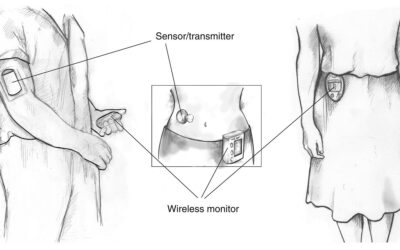
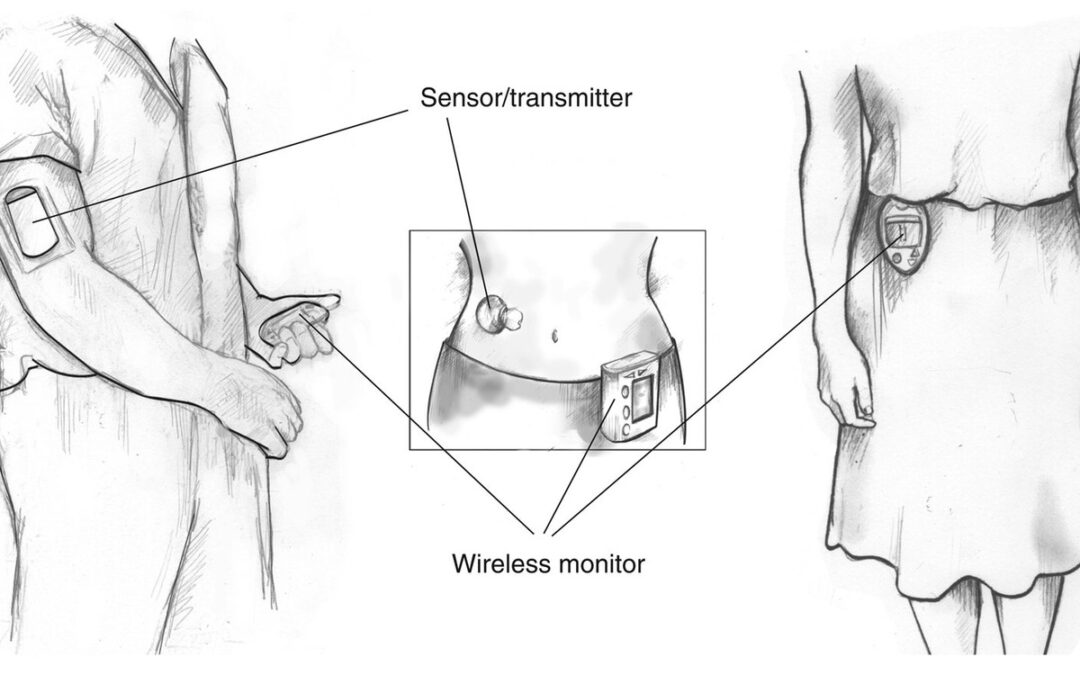
Every week or two, millions of people with diabetes peel a continuous glucose monitor (CGM) off their skin and throw it away. Each sensor contains a small battery, a printed circuit board and traces of precious metals. Dexcom and FreeStyle Libre alone account for more than 153 million discarded CGM devices every year, and their batteries rely on silver and lithium chemistries that carry environmental costs of their own [1].
That is a small slice of a much larger problem. The world generated 62 million tonnes of e-waste in 2022, and only 22.3% of it was documented as properly collected and recycled [2]. Medical electronics are a modest share of that total, but they are the hardest share to recover, for reasons that have little to do with chemistry or engineering.
A small device, a fast-growing stream
Wearable medical electronics are set for explosive growth. A 2026 life-cycle study in Nature projects that annual demand for wearable healthcare electronics could rise 42-fold by 2050, approaching two billion units a year [3]. Without mitigation, these devices could generate more than one million tonnes of cumulative e-waste by 2050 [4].
The category now spans glucose sensors, insulin patch pumps, smart inhalers, wearable ECG monitors and disposable patches. Most share three features that matter for recycling:
- A printed circuit board. In the Nature study, the circuit board accounts for about 70% of a device’s carbon footprint, and its integrated circuits rely on precious metals such as gold [4].
- A sealed battery. FreeStyle Libre sensors use zinc-silver oxide cells, while Dexcom sensors use lithium-manganese dioxide cells [1].
- Mixed, bonded materials. Abbott itself has noted that its sensor kits are made from multiple materials and are not designed for easy disassembly [5].
Individually, each device holds only tiny amounts of valuable material. At hundreds of millions of units a year, those amounts add up to a real material stream. The question is why so little of it is ever recovered.
The contamination barrier
A laptop and a used glucose sensor contain similar materials. The difference is what happens the moment the sensor touches blood or bodily fluids: it becomes potentially infectious waste, and the rules change completely.
It travels as dangerous goods. In Europe, infectious clinical waste is carried under the ADR rules for road transport as UN 3291, a Class 6.2 infectious substance. That means UN-approved, leak-proof packaging under packing instruction P621 (puncture-resistant for sharps), a consignment note, emergency instructions and trained drivers [6]. In the United States, the equivalent category is regulated medical waste, shipped under federal hazardous materials rules [7].
It must be decontaminated before anything else happens. No recycler can open, shred or sort an item that may carry pathogens. The waste must first be treated, typically by autoclaving, steam or microwave treatment, which the World Health Organization recommends as alternatives to incineration [8].
The battery adds a second hazard. Lithium-manganese dioxide cells can react violently with air and water and pose a fire risk if not handled properly [1]. A used medical wearable is therefore often both an infectious waste and a battery hazard.
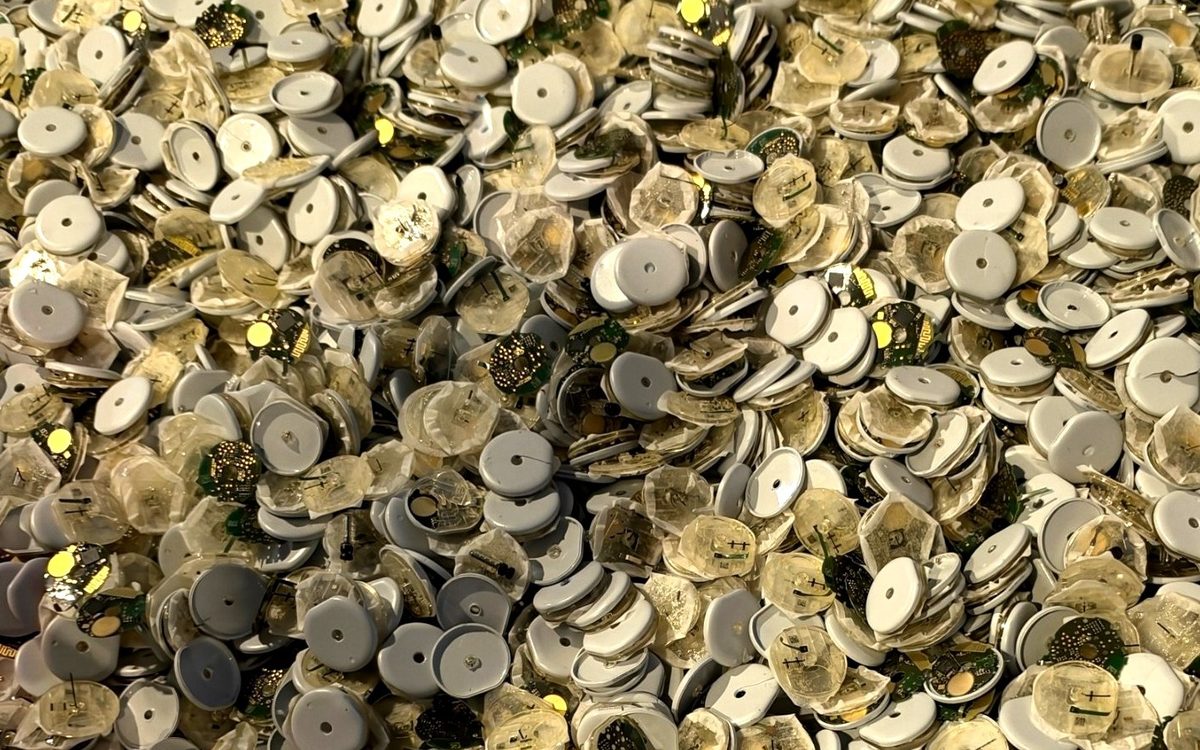
I have seen this first-hand. My company has processed several tonnes of used continuous glucose monitors, the wearable sensors that stay attached to the body around the clock. Each one contains a surprisingly valuable circuit board, yet the battery and the traces of blood and bodily fluids make the stream exceptionally difficult to handle. The only workable route has been a two-step process: a specialised partner decontaminates the devices first, and only then can we separate and recover the metals, the batteries and the non-metallic fractions.
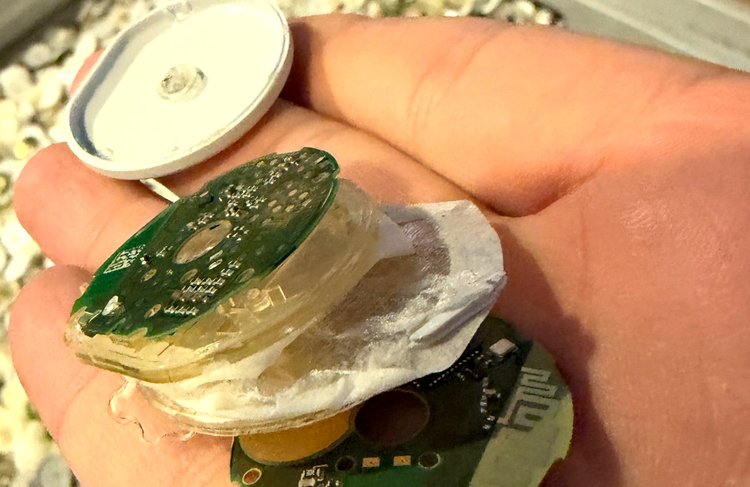
An opened continuous glucose monitor sensor, showing its circuit board and battery. Photo: Arnold Platz
Each of these steps costs money before a single gram of metal is recovered. In my experience in metal recovery, contaminated medical electronics cost roughly three times as much to handle as standard e-waste. Published data on clinical waste point the same way: a Royal College of Nursing survey of NHS trusts in England found median 2015/16 costs of £337 per tonne for infectious waste suitable for alternative treatment and £475 per tonne for infectious waste that must be incinerated, against £142 per tonne for municipal residual waste. That is roughly 2.4 to 3.3 times the cost [9].
The outcome is predictable. When the cost of making a device safe to recycle is higher than the value of the metal inside it, the device is burned. Even well-intentioned manufacturer programmes reflect this: Abbott’s US take-back pilot sent returned sensor kits to waste-to-energy facilities, not to material recovery, although the company said it was working on a recycling solution [5]. Others show that a different route is possible. Insulet now offers free recycling of used Omnipod pods to all its US customers: returned pods are decontaminated first and then sent to a recycler specialising in electronics and medical products [10].
What is lost when devices are burned
Incineration solves the infection problem but creates others. The WHO warns that burning waste containing heavy metals such as lead, mercury and cadmium can spread toxic metals into the environment, and that only modern incinerators operating at 850 to 1,100 °C with gas cleaning meet international dioxin and furan standards [8]. Landfilled silver-oxide batteries carry their own risk of groundwater contamination [1].
The second loss is the material itself. The e-waste generated worldwide in 2022 contained an estimated US$91 billion of metals, including about US$15 billion of gold and US$19 billion of copper [2]. The materials in a medical sensor include several that Europe and the United States now treat as critical or strategic: lithium and manganese in the batteries of some sensors, copper in the circuitry and, on the US list, silver in the batteries of others [11, 12]. Once a device has been incinerated, those metals are either lost in the ash or recoverable only at much higher cost.
The third loss is a missed opportunity for the sector’s own climate goals. Healthcare organisations are under growing pressure to cut emissions across their supply chains. A device category that is used for up to two weeks and then incinerated sits uncomfortably with those commitments.
What could change the economics
The problem is economic, so the solutions have to change the numbers. Four levers stand out.
- Design the electronics out of the contamination zone. If the part that touches the body can be separated from the electronic core, the core can avoid infectious-waste handling altogether. The authors of the Nature study already recommend modular designs in which the outer covering is replaced while the integrated circuit stays intact [4]. The same principle would make end-of-life recovery far cheaper.
- Make batteries removable. From 18 February 2027, the EU Batteries Regulation requires portable batteries to be readily removable and replaceable by the end user, with only narrow derogations, which the Commission’s guidance explains [13]. Legal analysis of that guidance indicates that many medical devices fall within scope, while some categories, such as implantable devices, may qualify for exemptions [14]. The guidance does not deal specifically with continuous glucose monitors, so how the rule will apply to them is not yet clear. A battery that comes out cleanly is a battery that can be recycled separately and safely.
- Build take-back for recovery, not just disposal. Manufacturer collection can work when it is convenient: in France, around two thirds of FreeStyle Libre users return their sensors through a dedicated channel [15]. The next step is to route those returns to decontamination and material recovery, rather than to energy recovery.
- Decontaminate at scale. In my view, decontamination is expensive per tonne largely because the market is fragmented and poorly organised. Volumes are small, few companies specialise in medical electronics, and in my experience much of this waste arrives at treatment sites poorly categorised, which forces extra handling and the most cautious, costly treatment. The NHS in England has reached a similar conclusion for clinical waste in general: its clinical waste strategy calls better segregation crucial and estimates that full segregation could cut the need for high-temperature incineration by up to 35% [16]. Pooling volumes into dedicated streams, with clear sorting and labelling at the point of collection, could make large-batch decontamination viable and bring the cost down. Denmark is setting out to build this model. In the HoliMed partnership (2025 to 2027), device makers including Ambu and Johnson & Johnson are working with hospitals and a specialised recycler on a system to collect mixed contaminated single-use devices, sort and decontaminate them centrally, and recover plastics and metals for reuse [17].
Designing for the end, not just the start
Medical electronics are built to strict standards for safety, sterility and reliability during use. Almost no attention goes to what happens after use. With demand set to grow many times over in the coming decades, that gap will only widen.
The hardest e-waste to recycle is not hard because the materials are exotic. It is hard because contamination makes every step slower, more regulated and more expensive. That is a design and policy problem, and it can be solved. Insulet’s programme shows that decontamination before recycling can be offered nationwide, and Denmark’s HoliMed partnership is setting out to build it across device types. What is missing is scale. The sooner device makers, healthcare providers, recyclers and regulators treat end-of-life as part of the product, the sooner these devices will stop going up in smoke.
Author Bio