
Artificial intelligence (AI) is rapidly transforming healthcare, moving beyond research laboratories into hospitals, clinics, and public health systems worldwide. Today, AI supports clinicians in areas such as medical imaging, clinical documentation, decision support, genomics, and drug discovery, demonstrating its potential to improve efficiency, enhance precision, and accelerate scientific innovation. Recent advances in multimodal and generative AI have further expanded these possibilities, enabling healthcare systems to process complex clinical information more effectively while reducing administrative burden.
Yet healthcare is unlike any other industry. Every technological advancement has the potential to affect patient lives, making trust as important as innovation. An AI system may demonstrate impressive technical performance, but its value depends on whether clinicians can rely on it, patients can trust it, and healthcare organizations can integrate it safely into clinical practice.
The future of healthcare AI will therefore be defined not only by increasingly sophisticated algorithms but also by responsible implementation. Strong clinical evidence, transparent governance, rigorous evaluation, and meaningful human oversight will determine whether AI strengthens healthcare while preserving the confidence that remains fundamental to the clinician–patient relationship.
Why Responsible AI Matters
Artificial intelligence has the potential to become one of the most influential technological advances in modern healthcare, but innovation alone is not enough. Unlike many other industries, healthcare operates in an environment where every clinical decision can directly affect patient safety, quality of care, and public trust. As AI systems become increasingly integrated into clinical practice, they must be held to the same high standards of scientific evidence, ethical responsibility, and regulatory oversight that govern medicines, medical devices, and clinical interventions.
Responsible AI extends beyond developing accurate algorithms. It requires a lifecycle approach in which AI systems are designed, validated, deployed, and continuously monitored to ensure they remain safe, effective, and equitable across diverse healthcare settings. Performance demonstrated in controlled research environments does not automatically translate into reliable outcomes in routine clinical practice. AI systems should therefore undergo rigorous external validation across different institutions, patient populations, and clinical workflows before widespread adoption.
International regulators are increasingly aligning around these principles. In January 2026, the U.S. Food and Drug Administration (FDA) and the European Medicines Agency (EMA) jointly introduced the Guiding Principles of Good AI Practice in Drug Development, emphasizing human-centred design, data quality, transparency, risk-based performance assessment, lifecycle management, and multidisciplinary collaboration. Similarly, the World Health Organization (WHO) continues to advocate that AI should augment—not replace—the expertise, ethical judgement, and accountability of healthcare professionals.
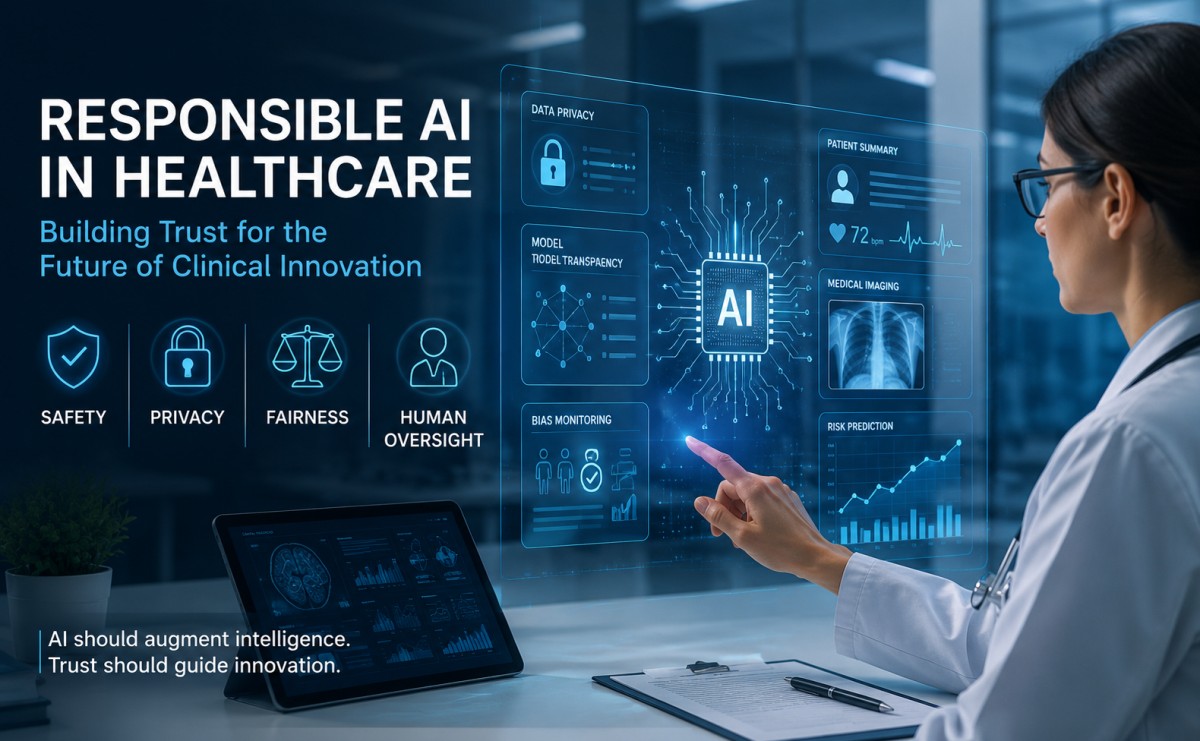
Ultimately, responsible AI is not a barrier to innovation; it is the foundation that allows innovation to be trusted. By prioritizing patient safety, transparency, fairness, and human oversight from the outset, healthcare systems can adopt AI with greater confidence while ensuring that technological progress remains firmly aligned with the interests of patients and society.
AI in Healthcare Today
Artificial intelligence is steadily evolving from experimental research into practical clinical applications. While widespread adoption remains at different stages across healthcare systems, AI is increasingly supporting clinicians in diagnosis, treatment planning, administrative workflows, biomedical research, and population health. The defining characteristic of today’s healthcare AI is not autonomy, but augmentation—helping healthcare professionals interpret complex information, reduce routine workload, and make more informed decisions.
Medical imaging remains one of the most mature and extensively studied applications of AI. Deep learning models have demonstrated the ability to identify subtle imaging patterns across radiology, pathology, dermatology, and ophthalmology that may warrant further clinical evaluation. Recent studies have shown that AI-assisted breast cancer screening has the potential to improve cancer detection while maintaining clinically acceptable screening performance. These findings illustrate how carefully validated AI systems can enhance diagnostic workflows without replacing specialist expertise. Similar advances are being investigated across lung cancer screening, stroke imaging, retinal disease detection, and digital pathology, where AI serves as a clinical support tool rather than an independent decision-maker.
Generative AI is also reshaping healthcare by addressing one of medicine’s most persistent challenges: administrative burden. AI-powered ambient documentation systems can automatically generate clinical notes from conversations between clinicians and patients, allowing healthcare professionals to devote more time to direct patient care. A large NHS-supported evaluation reported that ambient AI documentation enabled clinicians to spend more time interacting with patients while reducing documentation workload. Building on these findings, NHS England has continued expanding guidance and adoption of AI-enabled ambient documentation and related AI technologies across health and care settings.
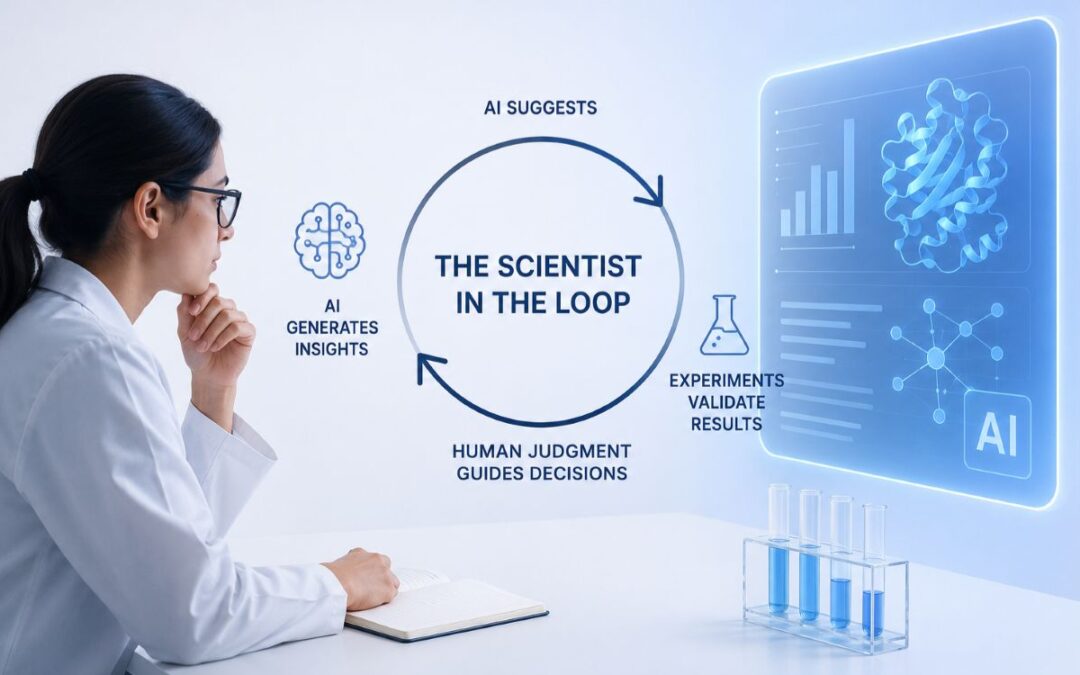
Beyond clinical practice, AI is accelerating scientific discovery. In biomedical research, machine learning models analyse enormous volumes of genomic, molecular, and biomedical data to identify potential therapeutic targets, predict protein structures, optimise molecular design, and support early stages of drug discovery. Breakthroughs such as AI-driven protein structure prediction have transformed biological research by enabling scientists to investigate disease mechanisms at an unprecedented scale. Although every potential therapy must still undergo laboratory investigation, clinical trials, and regulatory review, AI is helping researchers prioritise promising candidates more efficiently and accelerate parts of the discovery process.
The next generation of healthcare AI is increasingly multimodal, integrating medical images, laboratory results, electronic health records, genomic information, and clinical notes to provide more comprehensive clinical insights. Rather than analysing a single source of information, these systems aim to support clinicians by bringing together multiple forms of patient data that traditionally exist in separate systems. While this approach remains under active evaluation, it represents an important step toward more personalised, data-informed healthcare.
Collectively, these developments demonstrate that AI is becoming an integral component of modern healthcare—not as a replacement for clinicians, but as a carefully validated technology designed to strengthen clinical decision-making, advance biomedical research, and improve healthcare delivery while keeping patient safety at the centre of innovation.
Building Trust Through Governance
The rapid evolution of healthcare AI has shifted the global conversation from what AI can do to how it should be implemented responsibly. As AI systems move from research settings into routine clinical practice, robust governance frameworks are becoming essential to ensure that innovation remains safe, ethical, transparent, and centred on patient welfare.
Recent international developments reflect this transition. In July 2026, the World Health Organization (WHO) convened representatives from 37 countries in Lisbon to develop a shared agenda for AI governance in health. The meeting emphasized that while AI adoption is accelerating worldwide, governance, regulatory oversight, workforce preparedness, and accountability must advance at a similar pace. WHO’s regional assessment also found that although nearly two-thirds of countries in the WHO European Region are already using AI in diagnostics, only a small proportion have established dedicated health-specific AI strategies or clear liability frameworks. These findings highlight that technological progress alone is insufficient without appropriate governance structures.
Trustworthy AI requires continuous oversight throughout the entire lifecycle of an AI system. Before deployment, systems should undergo rigorous clinical validation across multiple healthcare settings and diverse patient populations. After implementation, continuous performance monitoring is equally important to detect model drift, identify emerging biases, evaluate safety, and ensure that performance remains consistent as clinical practice and patient populations evolve.
Transparency is another critical component of responsible AI. Healthcare professionals should understand the intended purpose, limitations, and appropriate clinical use of AI-supported recommendations, enabling them to exercise informed clinical judgement rather than relying unquestioningly on algorithmic outputs. At the same time, patients should have confidence that their personal health information is protected through strong data governance, cybersecurity measures, and compliance with applicable privacy regulations.
Ultimately, governance should not be viewed as slowing innovation. Instead, it provides the scientific, ethical, and regulatory foundation that enables healthcare organizations to adopt AI responsibly, maintain public confidence, and ensure that technological advances translate into meaningful improvements in patient care.
My Perspective: Looking Beyond Today’s Applications
As a healthcare AI author, I believe artificial intelligence has the potential to become one of the most significant scientific developments in modern healthcare. While much of today’s conversation focuses on improving operational efficiency and reducing administrative burden, I believe AI’s greatest long-term contribution will extend far beyond these immediate applications.
One of the areas I find most promising is biomedical research. Advances in machine learning are enabling researchers to analyse complex genomic, molecular, and clinical datasets at an unprecedented scale. AI is increasingly supporting target identification, biomarker discovery, protein structure prediction, and the early stages of drug discovery, helping scientists identify promising therapeutic candidates more efficiently. Regulatory agencies, including the U.S. Food and Drug Administration (FDA) and the European Medicines Agency (EMA), have also introduced shared principles for the responsible use of AI throughout the drug development lifecycle, recognising both its transformative potential and the importance of rigorous scientific oversight. Although every new medicine must still undergo laboratory research, clinical trials, and regulatory review, AI has the potential to accelerate scientific discovery while preserving the evidence-based standards that protect patient safety.
I am equally encouraged by the growing role of AI-assisted technologies in clinical care. Across radiology, pathology, surgery, and primary care, AI is increasingly being evaluated as a clinical decision-support technology that complements rather than replaces healthcare professionals. The emergence of multimodal AI—capable of integrating medical images, laboratory findings, electronic health records, genomic information, and clinical documentation—marks an important step toward more personalised and data-informed healthcare. However, these technologies should remain tools that enhance human expertise rather than autonomous systems that make clinical decisions independently. Clinical judgement, ethical reasoning, empathy, and communication remain fundamentally human responsibilities that technology cannot replace.
Recent international developments reinforce this balanced perspective. Initiatives led by the World Health Organization (WHO), together with evolving regulatory frameworks from the FDA and EMA and the growing adoption of AI across national healthcare systems, demonstrate that the future of healthcare AI will be shaped as much by trust, governance, transparency, and accountability as by technological innovation itself. The conversation is no longer centred solely on what AI can achieve; it is increasingly focused on how these technologies can be implemented responsibly while maintaining public confidence.
Looking ahead, I believe the true measure of AI’s success will not be the sophistication of its algorithms or the speed of technological progress. Its lasting impact will be reflected in its ability to improve patient outcomes, accelerate scientific discovery, support healthcare professionals in delivering safer and more personalised care, and strengthen healthcare systems worldwide. Achieving this vision will require sustained collaboration among clinicians, researchers, engineers, policymakers, regulators, industry, and patients, ensuring that every technological advancement remains guided by scientific evidence, ethical responsibility, and an unwavering commitment to improving human health.
Author Bio