
Most of the argument about AI in mental health care is about chatbots that talk like therapists. The bigger change is happening somewhere less visible: in the notes, forms and insurance paperwork that sit between a clinician and the next person they are trying to help.
Anyone who has run a clinical service knows the scene. The last session ends at six. The notes are still waiting at nine. In a widely cited time and motion study of US physicians, every hour of direct time with patients came with nearly two more hours of electronic record and desk work during the clinic day, plus one to two hours most evenings [1]. Many mental health clinicians will recognize the pattern.
That is where AI in mental health care is being adopted fastest, and the law is starting to catch up. Here is where the line now sits in the United States, and three lessons for anyone building or buying these tools.
What the law now says
US states regulate the practice of medicine and therapy, so the rules arrive state by state.
In 2025 Illinois passed the Wellness and Oversight for Psychological Resources Act, which bars anyone from offering therapy or psychotherapy delivered by AI, while allowing licensed professionals to use AI for administrative and supplementary support. It requires written, revocable consent from the client before AI records or transcribes a session [2].
California, the largest US state by population, drew a broader line in September 2026. A new law, AB 1979, takes effect on 1 January 2027 [3]. It requires hospitals, clinics and physician practices to take reasonable steps so that a licensed professional keeps the ability to exercise independent professional judgment whenever care is informed by the output of a clinical decision support system. It bars them from using AI to independently perform any clinical function the law reserves for a licensed person. And it carves out AI used for documentation and communication that does not involve the application of professional judgment [3].
That last phrase matters, and it is easy to misread. The carve-out covers routine communication, such as an automated message that a record has been updated. A clinical note is different. Read plainly, what goes into it, what is left out and what it concludes are professional judgments. So a note drafted by AI is not outside the law simply because it is “documentation”. The draft is fine. The judgment that turns it into a record belongs to the licensed person who signs it.
The same month, California’s governor vetoed a separate bill aimed specifically at AI in psychotherapy, saying its definitions were broad enough to catch legitimate clinical tools [4]. The direction is clear even where the details are still moving: AI can help, and a licensed person stays responsible.
Lesson 1: Put AI on the drafting. Keep a licensed person on every decision and every signature.
The strongest trial evidence so far supports this split. In a randomized trial of ambient AI scribes with 238 physicians at UCLA, published in NEJM AI in late 2025, one tool cut time spent in notes by 9.5% compared with usual care, and the other made no significant difference [5]. Both drafted notes that clinicians rated as having clinically significant inaccuracies “occasionally”, most often omissions. The authors concluded that these inaccuracies “require ongoing vigilance” [5].
Read that carefully and the design follows. The draft saves effort. The review is the safety system. A note should never reach the record without a clinician reading it, correcting it and signing it, and the software should make that step easy rather than invisible. If a tool encourages a one-click approval, it has moved the clinical judgment from the clinician to the model, which is what the new laws are written to prevent.
Lesson 2: Design for the person who has to defend the answer.
Not every problem needs AI. A useful test is to ask who will have to explain the result later.
When an auditor, a payer or a licensing board may ask why something happened, a written rule is often the better tool. A rule can be read, tested and pointed to. Routing a claim, flagging a missing signature or reminding a team that a review is due are jobs for plain logic that behaves the same way every time.
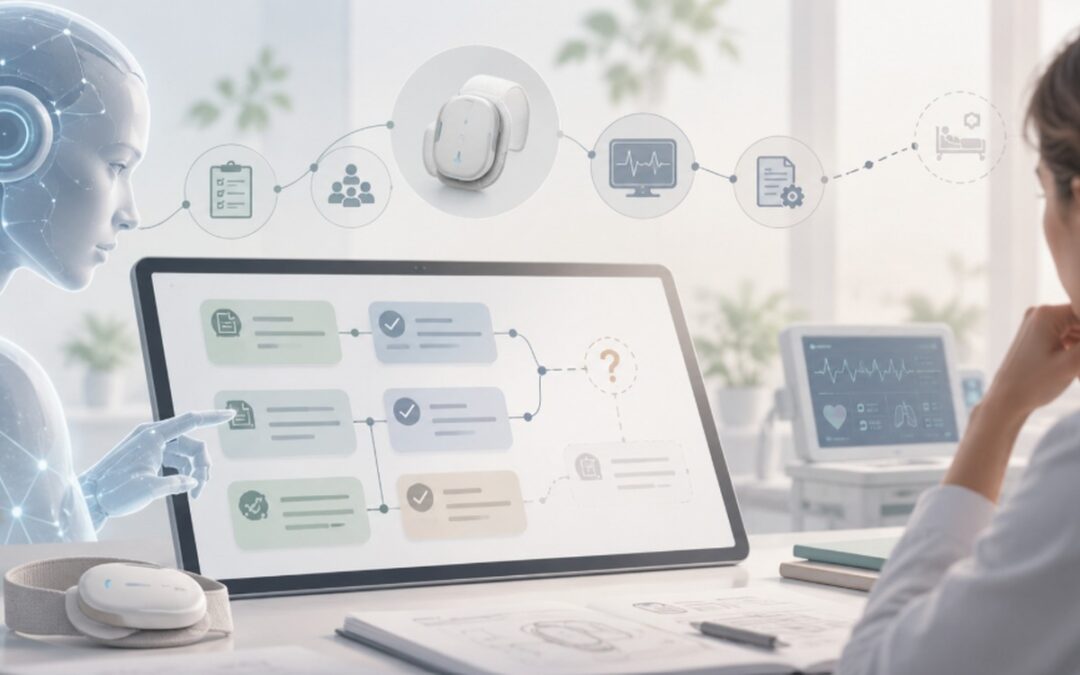
AI earns its place where the input is messy and a person checks the output: summarizing a long, inconsistent insurance benefits document, drafting a first version of a note, sorting incoming faxes. In each case the AI produces a draft and a human confirms it. Organizations that keep that pattern, AI on reading and drafting and people on deciding, will find the new rules easy to live with. Those that let a model act on its own will find them expensive.
Lesson 3: Measure what clinicians sign, not what the software produces.
Vendors tend to report how many notes their tool generated. That number says little about care. Better measures are the ones a clinical leader would want to defend: how often clinicians substantially edit a draft, what kinds of errors they catch, whether anything important is being left out, and whether consent was recorded where the law requires it.
Be careful with time savings, too. The UCLA trial noted that its main measure, time in the note, does not capture the minutes clinicians spend editing AI drafts, so reported savings may be an overestimate [5]. A service that adopts AI documentation should not promise faster notes until it has measured the editing time as well.
What this is not
This is not an argument against AI in mental health care. Documentation burden is real, and tools that give clinicians time back deserve a place. Nor is it a claim that drafting is risk free. Errors of omission are still errors, which is why the signature carries weight.
It is an argument about where to put the line for AI in mental health care. Software can read, sort and draft. A licensed professional decides and signs. Several US states have now written that into law, and I expect more to follow. Builders and buyers outside the US can design for the same line now; the tools that already work this way will need the fewest changes.
Author Bio