

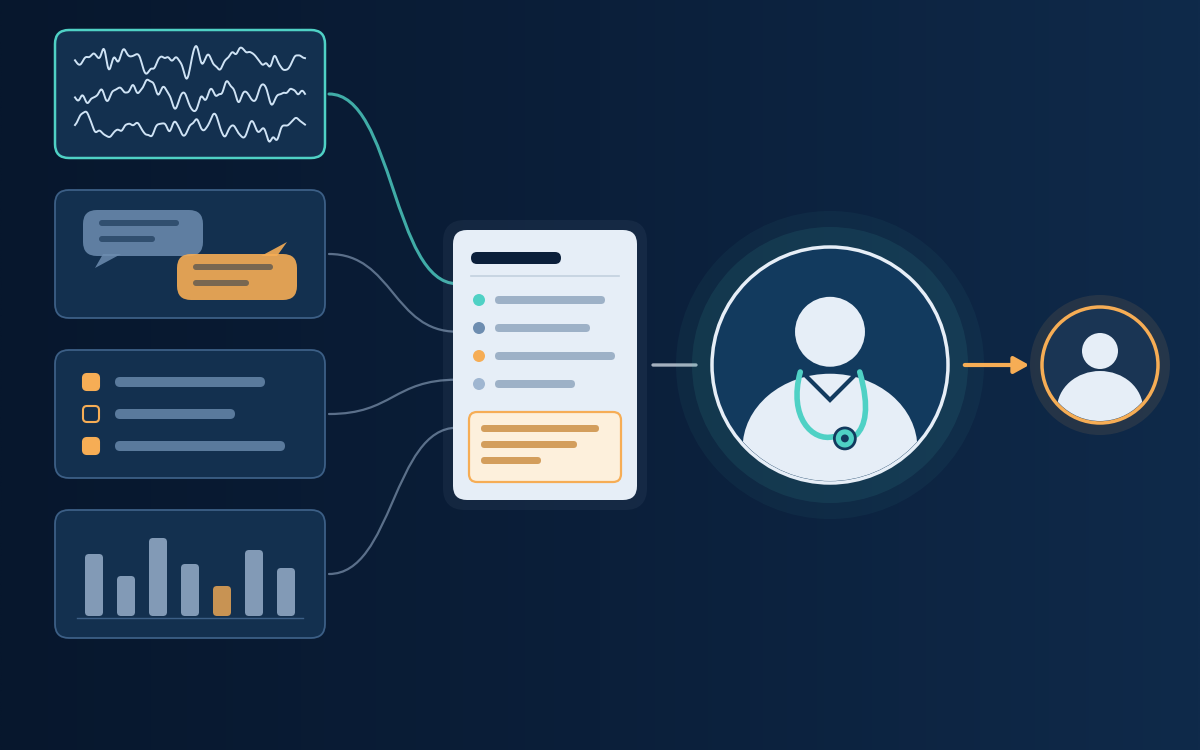
The search for a single brainwave test for ADHD has largely failed. But that was always the wrong goal. The more useful question is whether EEG, used alongside clinical assessment, could add information that helps make ADHD assessment more accurate and treatment more personal. The evidence so far is promising but mixed, and it deserves an honest look.
ADHD is diagnosed on behaviour. A skilled clinician takes a detailed developmental history, gathers rating scales from the person and those who know them, and judges whether difficulties are lifelong, pervasive and impairing [1, 2]. There is no blood test, scan or brainwave reading that confirms it.
Most of the debate about EEG in ADHD has asked whether it could replace that process, or make it faster. I think that is the wrong question. The more useful question is whether information about how someone’s brain is actually functioning can help clinicians get the answer right, and choose the right support afterwards.
The accuracy problem
The independent review chaired by Professor Peter Fonagy, published in October 2026, said that “we cannot conclude that overdiagnosis is occurring at scale”, while noting that the balance of risks is changing. It was also clear that “overdiagnosis, misdiagnosis and underdiagnosis are all system failures” [1]. With open ADHD referrals exceeding 560,000 by the end of 2025 [1], getting each ADHD assessment right matters as much as getting it done.
Accuracy is hard because ADHD rarely arrives alone, and many other conditions can look like it. Anxiety, low mood, trauma, sleep problems, autism, learning difficulties and the effects of stress can all disrupt attention, organisation and self-regulation [3]. Two people can describe the same difficulties for very different reasons. A clinician relying only on what people report, however skilled, is working from the outside in.
The wrong question: one magic marker
For two decades, EEG research in ADHD was dominated by one measure: the theta/beta ratio (TBR), the balance between slower and faster brain rhythms at rest. Early studies suggested it was raised in ADHD, and hopes grew that it could become a diagnostic test.
It hasn’t held up as one. A 2013 meta-analysis of more than 1,700 children and adolescents found that the difference between groups had shrunk over the years, and concluded that excessive TBR “cannot be considered a reliable diagnostic measure of ADHD” [4]. In 2016 the American Academy of Neurology advised against using TBR to confirm a diagnosis, because of the risk of false positives [5]. A 2026 analysis that tested hundreds of reasonable ways of calculating TBR in a large paediatric sample found that group differences depended heavily on those choices [6].
The lesson is not that EEG is useless. It is that ADHD is not one thing. Children and adults with the same diagnosis can show quite different EEG profiles, and some show no differences at all [4, 7]. A single number was never likely to capture a condition that varies this much. Expecting one marker to diagnose ADHD on its own asked EEG to do a job that no single measure, behavioural or biological, can do.
What EEG adds alongside clinical judgement
The more promising idea is augmentation: EEG as one more source of information in the assessment, read by a clinician alongside the history, rating scales and observation.
The most direct test of this so far is a 13-site study of 275 children and adolescents referred with attention or behaviour concerns [8]. Site clinicians made their diagnoses blind to the EEG result, and the two were then combined using a predefined algorithm after the blind was broken. Both were compared with the consensus diagnosis of a multidisciplinary team. The authors estimated that integrating EEG could improve diagnostic accuracy from 61% to 88%, mainly by flagging cases where the site clinician’s ADHD diagnosis was not supported by the team. Those figures need careful reading. The authors describe the clinician-alone results as “assumption-based estimates”, the study was industry-funded, and it has not been independently replicated. It underpinned US clearance of a TBR-based system in 2013, as an aid to clinical assessment rather than a stand-alone test [9].
The American Academy of Neurology’s 2016 advisory takes a more cautious view. It concluded that it is unknown whether combining clinical examination with the theta/beta ratio increases diagnostic certainty over examination alone, and recommended that the ratio should not be used to confirm a diagnosis, or to support further testing after a clinical evaluation, except in research [5]. Taken together, these findings suggest that augmentation is a question worth testing properly, not one that has been answered. What the 13-site study does show is the kind of design that is needed: one that asks what EEG adds to a clinician’s ADHD assessment, not whether it can replace it.
Newer analysis methods may also help. Researchers now separate the brain’s rhythmic (periodic) activity from its background (aperiodic) activity [10], which older ratios blurred together. In young children, medication-naive ADHD has been linked to differences in aperiodic activity [11], and these may explain many earlier TBR findings [6]. Aperiodic measures are thought to reflect aspects of how excitable brain networks are, although what they mean is still debated [6, 10]. If that work holds up, it could bring EEG a little closer to mechanisms rather than labels.
This is where neurophysiology might help. In research, EEG profiles in ADHD have been described as typical, slowed, over-aroused or unusual in other ways [7]. A profile like this cannot tell a clinician whether someone has ADHD. But, if validated, it could raise questions worth asking, such as whether sleep, arousal or another condition is driving the picture, and help strengthen or challenge a working formulation.
From diagnosis to treatment
The bigger prize may be after diagnosis. People with ADHD respond differently to the same treatment, and choosing between options is still largely trial and error.
EEG differences within ADHD may help here. In early work, response to stimulant medication was seen mainly in particular EEG subgroups [7]. In the international iSPOT-A study of 336 children and adolescents with ADHD, TBR did not separate responders from non-responders to methylphenidate, but a slower frontal alpha peak frequency predicted non-response in male adolescents [12]. That finding needs replication, but it is the kind of question EEG may be well placed to answer.
A 2022 review of treatment biomarkers for ADHD concluded that candidate predictors, “particularly those based on low-cost and non-invasive EEG assessments, show promise for the future stratification of patients to specific treatments”. It was equally clear that current research “does not support any immediate clinical applications” [13].
This is what precision psychiatry means in practice. It is not a single test that hands out a diagnosis. It is the gradual addition of biological information, such as neurophysiology, to clinical assessment, so that people with the same label can be understood, and treated, as the different individuals they are [14].
What it will take
Moving from promising studies to routine practice will need four things.
- Validation where it matters. Studies need to test EEG in the people clinics actually see, with overlapping difficulties, rather than against healthy volunteers. They also need large, diverse, independent samples: small studies can produce impressive but unstable accuracy figures [13, 15]. As a 2022 review pointed out, EEG findings in ADHD still lack independent replication and mostly fall short of the accuracy needed for a clinical test [14].
- Evidence across the lifespan. Brain activity changes a great deal with development, and most research is in children [4, 11]. Far less is known about adults, including those diagnosed later in life.
- Proportionate regulation. Software that informs diagnosis or treatment is generally regulated as a medical device, and UK rules for software and AI are still evolving [16]. Consumer devices sold for focus or wellbeing are a different category and should not be used to diagnose.
- Clinicians who can interpret it. EEG adds value only when it is read in context, by people who understand both its strengths and its limits. A number on a report should prompt clinical thinking, not replace it.
A step towards precision psychiatry
The history of the theta/beta ratio is sometimes told as a story of EEG failing ADHD. I read it differently. It showed that looking for one marker to diagnose a varied, developmental condition was the wrong ambition.
The better ambition is more modest and more useful. Clinical ADHD assessment remains the foundation. Neurophysiology could add an objective layer that helps challenge or support a formulation, flags when something else may be going on and, in time, helps match people to the treatments most likely to work for them. Whether it can do that reliably is still an open question, and answering it properly should be the next step.
The Fonagy review’s reminder that “diagnosis is not need” [1] points the same way. The aim is not simply to label people faster. It is to understand each person’s brain well enough to help them. EEG, used well and alongside skilled clinicians, could be part of how we get there.
Author Bio