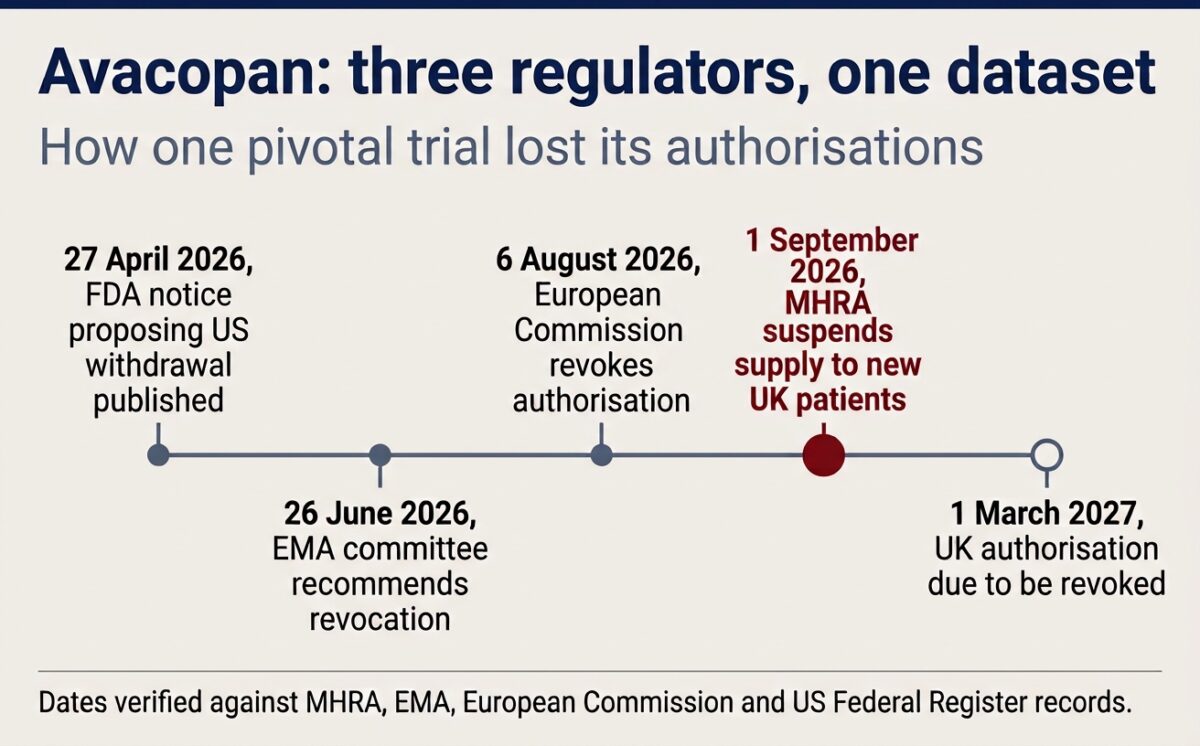
The avacopan UK suspension took effect on 1 September 2026. The Medicines and Healthcare products Regulatory Agency stopped supply of the medicine to new patients that day. It also signalled its intention to revoke the UK marketing authorisation on 1 March 2027. The regulator acted after concluding that the pivotal trial can no longer demonstrate efficacy. The MHRA names the product Avacopan Vifor. The same medicine is known internationally as Tavneos.
What the MHRA decided
The MHRA said the available evidence no longer supports a positive benefit-risk balance. Its notice cited concerns about the integrity and reliability of data from the pivotal clinical study. The agency concluded that the study can no longer be relied upon to demonstrate efficacy. It acted under Regulations 69 and 71 of the Human Medicines Regulations 2012.
Julian Beach, MHRA Executive Director Healthcare Quality and Access, set out the reasoning. “Patient safety is our highest priority,” he said. He added that the efficacy data was “no longer sufficiently reliable to support a positive benefit-risk balance”.
A six-month managed withdrawal now follows. Existing patients may continue to receive supply during that window. Clinicians must not start new patients on the medicine. They must also review current patients at the earliest opportunity. Patients are told not to stop treatment without speaking to their specialist. Existing monitoring for liver function, white blood cell count and serious infection still applies.
How the ADVOCATE data unravelled
ADVOCATE was the Phase III study behind the authorisation. The FDA notice of opportunity for a hearing identifies it as study CL010_168, registered as NCT02994927. It randomised 331 adults with ANCA-associated vasculitis one to one. One arm received avacopan 30 mg twice daily. The other received a protocol-specified prednisone taper. All participants received background immunosuppressive therapy.
The primary endpoints were remission at week 26 and sustained remission at week 52. Both were assessed using the Birmingham Vasculitis Activity Score. The FDA had told ChemoCentryx in 2016 that approval required superiority on week 52 sustained remission. The FDA notice sets out what happened after the data were unblinded. The database locked on 5 November 2019. The prespecified superiority analysis for sustained remission returned a two-sided p value of 0.1025. Unblinded ChemoCentryx personnel then selected nine subjects for readjudication.
Five avacopan patients moved from not in sustained remission to sustained remission. A second database lock followed on 20 November 2019. The reanalysis returned a two-sided superiority p value of 0.0132. The FDA says the adjudication charter forbade readjudication after unblinding.
The New England Journal of Medicine retracted the 2021 publication on 29 June 2026. The notice records that two academic authors, David Jayne and Peter Merkel, requested it. Neither knew of the readjudication at the time, according to the journal.
The avacopan UK suspension and the NICE access question
NICE recommended avacopan in technology appraisal TA825. The wording of that recommendation matters now. NICE recommends the medicine “within its marketing authorisation” for severe active granulomatosis with polyangiitis or microscopic polyangiitis in adults. It applies to use alongside a cyclophosphamide or rituximab regimen. It also applies only where the company supplies the medicine under the agreed commercial arrangement.
That phrasing ties NHS access to an authorisation that no longer covers new starts. The avacopan UK suspension therefore closes the NICE route for new patients from 1 September 2026. LSDN found no revised NICE position published as at 2 September 2026. The cyclophosphamide and rituximab regimens named in TA825 are unaffected by the decision.
Where the FDA process still stands
The United States process remains open. The FDA asked Amgen to withdraw the product voluntarily on 16 January 2026. The company refused. CDER proposed withdrawing approval of NDA 214487 on 27 April 2026. The agency cited two statutory grounds. The first is lack of substantial evidence of effectiveness under section 505(e)(3). The second is untrue statements of material fact under section 505(e)(5).
Safety sits alongside the efficacy question. The FDA issued a drug safety communication on 31 March 2026. It identified 76 cases of drug-induced liver injury in postmarketing reports through 9 October 2024. Seventy-four of those cases reported a serious outcome. Those included 54 hospitalisations and eight deaths. Seven cases reported biopsy-confirmed vanishing bile duct syndrome, and three of those were fatal. The median time to onset was 46 days. The FDA counted 66 cases from Japan and five from the United States. The agency set liver testing every two weeks at first, then monthly.
Amgen’s counter-evidence
Amgen requested a hearing rather than withdraw the product. It submitted data to the FDA on 23 July 2026. The submission includes a blinded readjudication by the Duke Clinical Research Institute. Amgen says that review confirmed non-inferiority against the prednisone taper. It reports remission at week 26 of 68.1 per cent against 67.1 per cent. It reports sustained remission at week 52 of 61.4 per cent against 52.4 per cent.
Superiority was not demonstrated at week 52, unlike the original analysis. The confidence interval for that difference ran from minus 0.3 to 19.9. Amgen also says the medicine substantially reduced glucocorticoid exposure. On safety, it says no US deaths have been linked to serious liver injury. It puts the US treated population at more than 8,000 patients. Those figures come from the company rather than from a regulator. The readjudication was also posted as a preprint in August 2026. No hearing date had been published as at 2 September 2026.
Amgen rejected the UK decision in a statement to trade press. “We disagree with the MHRA’s decision to withdraw Tavneos from the U.K. market,” the company said. It added that it was “deeply concerned about the impact this decision may have on rare disease patients”. The company also said the regulator gave insufficient weight to the totality of the evidence. Amgen elsewhere cites more than 70 published real-world studies.
The European sequence before the avacopan UK suspension
The EMA moved first. Its human medicines committee recommended revoking the marketing authorisation on 26 June 2026. The committee found that ADVOCATE breached good clinical practice principles. It also said the data supplied at assessment were incorrect and misleading. Supportive post-marketing data and post-hoc analyses did not close the gap.
The European Commission adopted the revocation decision on 6 August 2026. CSL said it respected the outcome and would implement it in full. CSL Vifor commercialises the product outside the United States under agreement with ChemoCentryx. Amgen acquired ChemoCentryx in 2022 and holds the US rights.
What UK clinicians were working with
UK specialists spent months without a domestic regulator position. UKIVAS issued a statement on avacopan on 1 May 2026. It recorded that no MHRA statement was known to the group at that point. It relayed the FDA advice that professionals discuss avacopan and other options with patients. It also restated that hepatotoxicity is a serious adverse reaction seen in earlier work.
“Close blood monitoring is now recommended for all patients,” the statement said. Six named clinicians signed it, including the British Society for Rheumatology guidelines lead. That statement predates the avacopan UK suspension by four months. The gap illustrates how long UK prescribers waited for a domestic ruling.
Commercial exposure and the wider lesson
The avacopan UK suspension affects a small share of Amgen’s revenue base. Tavneos generated 459 million dollars globally in 2025. That was a 62 per cent rise on 283 million dollars in 2024. Amgen reported total revenues of 36.8 billion dollars for the year. The company does not break out UK sales separately.
The regulatory lesson runs wider than one revenue line. Three regulators have now acted on the same trial conduct findings. Two have removed the authorisation and one has proposed removal. The sequence turns adjudication governance into a live market access risk. Charters that forbid readjudication after unblinding are now enforcement material.
What happens next
The UK window now runs to 1 March 2027. Revocation of the UK marketing authorisation is scheduled for that date. Existing patients keep access until then, subject to specialist review. The avacopan UK suspension leaves the FDA as the last regulator still deciding. Amgen’s hearing request remains with the agency, and its Duke analysis remains contested in public.
LSDN has covered the wider regulatory pressure on autoimmune therapies recently. That includes the review of autoimmune CAR-T safety after Novartis halted eight trials. Steroid-sparing remains the prize in these diseases. LSDN covered that case in the brepocitinib approval in dermatomyositis and its UK access questions