

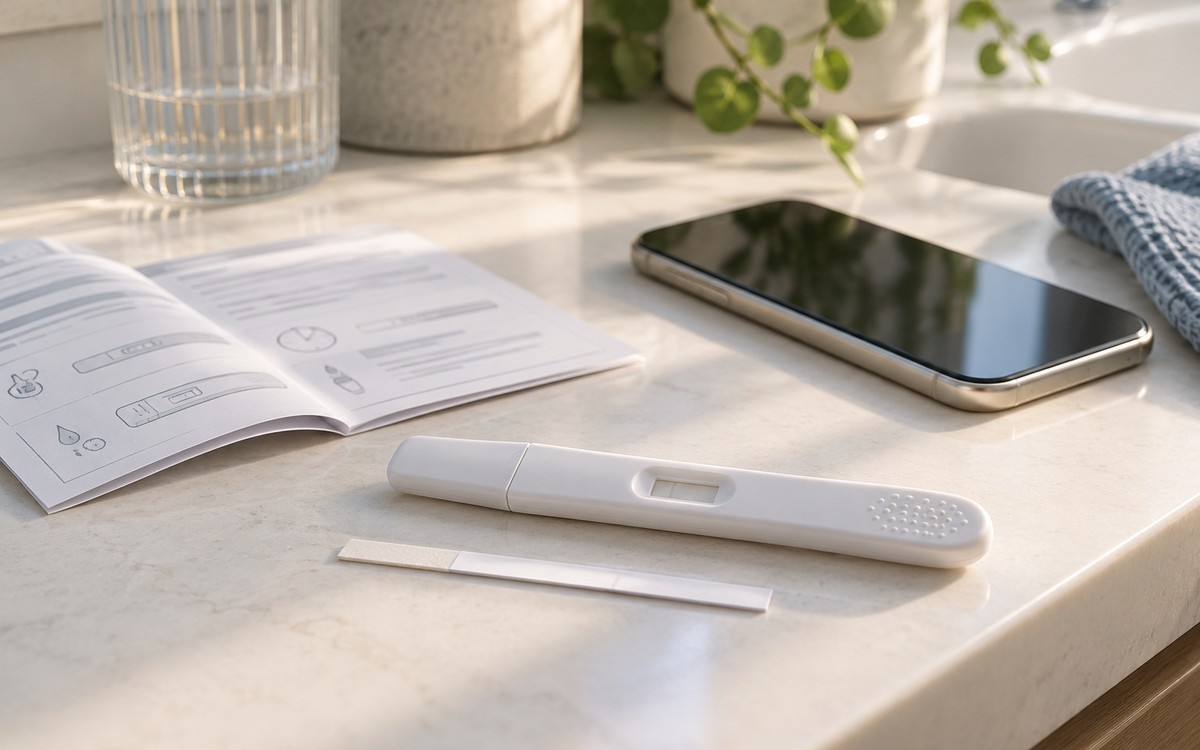
Imagine someone using a home pregnancy test exactly as instructed. They take the sample, check the result within the stated time and see a negative result. But they tested before pregnancy hormone levels were high enough to detect. The test may have worked as intended. What has not worked is the conclusion that pregnancy has been ruled out [1].
This is an easy gap to overlook when a product team is focused on analytical performance. A result can be valid, visible and correctly read, yet its meaning can still be misunderstood. And when a diagnostic test moves from a clinic to someone’s bathroom, there may be no health professional present to explain the difference.
Home pregnancy and ovulation tests offer a useful case study for diagnostic-device teams worldwide. Australia’s regulatory requirements provide one example of why the design brief must extend beyond whether a device produces the expected line or symbol. It also needs to ask what people think that result proves, where uncertainty remains and what they are likely to do next.
A correct reading is not the same as a correct conclusion
A pregnancy test detects human chorionic gonadotrophin (hCG) in urine. A negative result early in pregnancy may simply mean that hCG has not yet reached the test’s detection threshold. The person did not necessarily make a mistake and the device did not necessarily fail. The limitation is biological timing. Clear instructions therefore need to help someone understand when a negative result may need repeating and when medical advice is appropriate [1].
Ovulation predictor kits create a different opportunity for confusion. They detect a rise in urinary luteinising hormone (LH), which is useful for predicting the approach of ovulation. An LH surge is not direct observation of an egg being released. A person can correctly identify a positive result yet believe the test has confirmed that ovulation has already happened [2].
That difference matters to product design. Consider a hypothetical usability session: a participant recognises the positive LH result, then says, “So that means I definitely ovulated.” The first part of their response would score as accurate result-reading. The second suggests that the explanation has not conveyed the limits of the test.
It would be premature to assume the leaflet caused the misunderstanding. The person may have brought that expectation with them, or the wording, illustration or surrounding digital information may have reinforced it. A good evaluation asks what they understood and investigates where the belief came from before deciding what to change.
Australia already requires design for real-world self-testing
This is not a new regulatory obligation waiting to be invented. Australia’s Therapeutic Goods Administration (TGA) sets out requirements for in vitro diagnostic (IVD) devices intended for self-testing. Essential Principle 15 addresses the skills and means available to users, reasonably foreseeable variation in technique and environment, understandable instructions and the reduction of errors in sample handling, use and result interpretation [3].
The TGA’s clinical-evidence guidance offers a particularly useful example. If the control line on a pregnancy test does not appear, the result is invalid. The user should not be left to interpret it as negative. The information supplied with the device should make the invalid result and the need to test again with a different device clear [4].
That is a deceptively small design problem. Can someone distinguish “no valid result” from “negative” at a glance? Is the explanation beside the result illustration, or separated from it? Can they find the next action without searching through several paragraphs? An unreadable instruction is not rescued by being technically correct.
The TGA’s risk-control principles also give priority to safer design before relying on warnings about remaining risks. For self-tests, evaluation with representative intended users can show whether the sample steps, control indicator, reading window and result explanations work together without coaching. The evidence should reflect the people and settings the device is actually intended for [3, 5].
Digital instructions are part of that experience, not an automatic solution. A QR code or phone screen can explain a result in more detail, but the essential information must not become inaccessible because a person has no connection, a small screen or difficulty navigating. Teams should examine the journey across the pack, printed instructions and any digital support, not assess each in isolation.
Test the meaning people take away
A person who says the instructions are easy to read has provided useful feedback. They have not yet demonstrated that they understood the result. That distinction deserves its own measurement in home diagnostic usability work.
An Australian online randomised experiment involving 226 adults investigated communication of the accuracy of COVID-19 rapid antigen self-tests. Participants given health-literacy-sensitive information were better able to interpret specificity, the proportion of people without the target condition who receive a negative result. Differences in their stated intentions to self-isolate were not statistically significant [6].
The researchers changed both the accuracy information and its presentation, so the study cannot isolate the effect of layout alone. It also examined hypothetical COVID-19 situations, not pregnancy or ovulation testing. It would be wrong to claim that the findings prove a new fertility-test leaflet improves clinical outcomes. What the study offers is a useful evaluation lesson: understanding, confidence and intended action are different things to measure [6].
For home pregnancy and ovulation tests, a team could separately assess four tasks: performing the test, identifying the displayed result, explaining what the result does and does not establish, and choosing an appropriate next step from a realistic scenario. Neutral prompts such as “What does this result tell you?” are more informative than questions that reveal the answer.
If a design revision fixes one misunderstanding, the team should check that it has not created another. A clearer explanation of early negatives should not make urgent symptoms sound safe to ignore. The evidence should show what changed for intended users, not simply that a new version looks more polished.
A clear next step matters as much as a clear result
Some decisions cannot safely be made from a home test alone. A positive urine pregnancy test does not establish where a pregnancy is located. Australian guidance on ectopic pregnancy draws on symptoms, clinical assessment, ultrasound and hCG measurements when further assessment is needed [7].
This makes the information following a result part of the safety discussion. A routine question about whether to repeat a test is different from abdominal pain, shoulder-tip pain, heavy bleeding or faintness in someone who may be pregnant. Healthdirect advises going straight to an emergency department for symptoms such as these during pregnancy [8].
Manufacturers should not have to turn a test leaflet into a clinical textbook. They do need to make the boundaries of the result and the route to help recognisable. In user evaluations, it is worth asking whether people can identify ordinary follow-up advice, recognise when symptoms change the urgency, and find a suitable Australian care pathway. Understanding a message is not the same as accessing care, so any claim about improved follow-up needs evidence of the latter.
The language also matters. A positive result may be welcome, unwanted or complicated. Calm, neutral explanations can make room for those different experiences while remaining precise about what the test shows and what support is available.
Three questions worth bringing to the next design review
When a home diagnostic device is assessed, three questions can keep the human consequences in view.
Can intended users obtain and identify a valid result without coaching? This covers the physical test, instructions, result display and foreseeable difficulties in the home setting.
Can they explain the result’s limits in their own words? Correctly recognising a line should not be mistaken for understanding what has been detected, what remains uncertain or whether another step is needed.
Can they find an appropriate next action when it matters? The route to routine advice and the warning signs requiring urgent assessment should be understandable without assuming a clinician is standing nearby.
Back at the bathroom sink, the person holding the test does not need to understand laboratory assays. They need to know what the result can tell them, what remains uncertain and where to turn. That clarity should be built into the product, not left for the person to work out alone.
Author Bio